All species › Pigeons and doves › Doves and pigeons › Purple Quail-Dove
Purple Quail-Dove | Geotrygon purpurata
Blauwkruinkwartelduif | Paloma perdiz púrpura | Juriti-púrpura
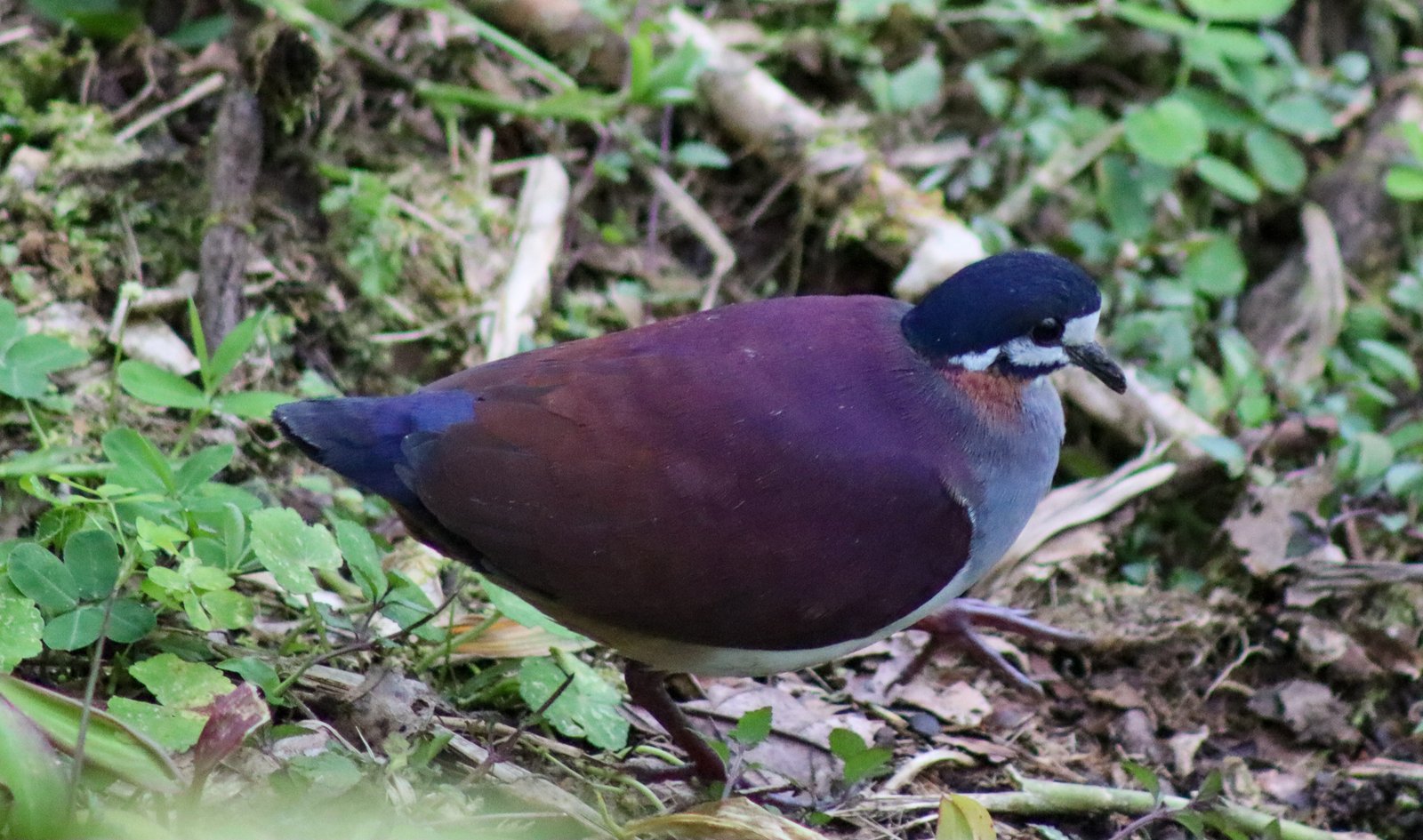
The Purple Quail-Dove is a compact, short-tailed ground dove of the Chocó rainforest, with a white face, a greyish-blue crown and a purple-glossed back. It lives hidden on the forest floor of the lowlands and foothills on the Pacific side of Colombia and northwestern Ecuador. Until recently it was treated as one species with Sapphire Quail-Dove.
Voice
A low, hollow, muffled cooing, hoo-ooo, repeated at long intervals from the forest floor or a low branch.
Recording: Olaf Jahn — CC BY-NC-SA 4.0 · xeno-canto
Identification
22–24 cm, compact, with a short tail and fairly long legs. The forehead and face are white, with a narrow black line below the eye and a black malar stripe. The crown is greyish blue, the hindneck glossed green to bronze. The back and wing coverts are purplish brown with a purple gloss; the rump is dark purplish blue. The throat and belly are white, the breast grey. The legs are pinkish red. The sexes are similar; juveniles are duller and browner.
Confusion species
Sapphire Quail-Dove Geotrygon saphirina closely resembles this species but lives east of the Andes. Ruddy Quail-Dove Geotrygon montana lacks the white face; the male is rufous, the female olive-brown. Olive-backed Quail-Dove Leptotrygon veraguensis in the Chocó is dark olive-brown with a white stripe below the eye and a grey crown.
Habitat
Humid, undisturbed rainforest of the lowlands and foothills on the Pacific side, from sea level to about 1000 m. It walks over the forest floor, searching for seeds, fallen fruit and invertebrates. The nest is a platform of twigs low in the vegetation.
Where the bird is most at home, classified by the vegetation units of the Andes and the west coast.


Range and movements
In Colombia on the Pacific side of the Western Andes, from Chocó to Nariño. In Ecuador in the northwest, mainly in Esmeraldas and adjacent provinces. Absent from Peru, Bolivia and the Galápagos. Not known outside the guide area.
- Resident
- dark = core range, pale = thinly spread
How and when to look
Along forest trails in the Chocó rainforest in the early morning, when the bird walks across the trail; otherwise it sits still on the forest floor and flies off low when disturbed.
Conservation status
Endangered. Its small range in the Chocó lowlands is losing forest to logging, agriculture, oil palm plantations and mining; it is also hunted.
Scientific name
Geotrygon purpurata | (Salvin, 1878)
Salvin described the species in 1878 as Osculatia purpurata; because it was later moved to another genus, the author and year stand in brackets. The genus Geotrygon was introduced in 1847 by Gosse. The genus name combines Greek geō-, 'ground-', with trugōn, 'turtle dove'. The species name comes from Latin purpuratus, 'clad in purple'. The specimen the first description was based on came from Ecuador.