All species › Pigeons and doves › Doves and pigeons › Sapphire Quail-Dove
Sapphire Quail-Dove | Geotrygon saphirina
Saffierkwartelduif | Paloma perdiz zafiro | Juriti-safira
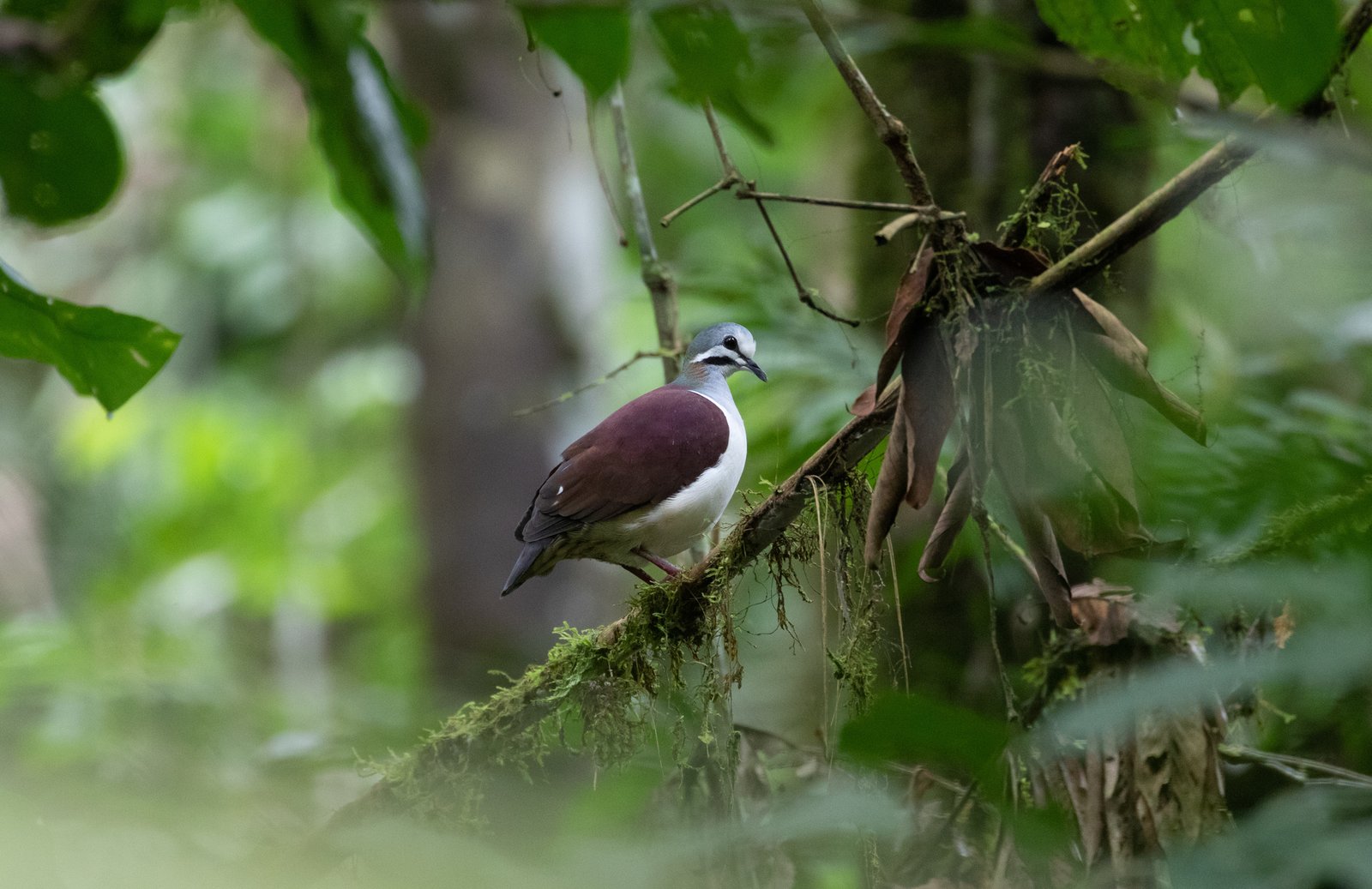
The Sapphire Quail-Dove is a compact ground dove of the humid forest at the foot of the eastern Andes, with a white face and a deep bluish-violet rump. It lives hidden on the forest floor and is usually noticed only when it walks across a forest trail or flies off low.
Voice
A low, hollow, muffled cooing, hoo-ooo, the second note drawn out, repeated at long intervals.
Recording: Mitch Lysinger — CC BY-NC-SA 4.0 · xeno-canto
Identification
22–25 cm, compact, with a short tail and fairly long legs. The forehead and face are white, with a black line below the eye and a black malar stripe. The crown is grey to greyish blue, the hindneck glossed green to bronze. The back is brown with a purple to bronze gloss; the rump is deep bluish violet. The throat and belly are white, the breast grey, the flanks and undertail coverts buff. The legs are pinkish red. The sexes are similar; juveniles are duller.
Confusion species
Purple Quail-Dove Geotrygon purpurata closely resembles this species but lives west of the Andes in the Chocó. Ruddy Quail-Dove Geotrygon montana lacks the white face; the male is rufous, the female olive-brown. Violaceous Quail-Dove Geotrygon violacea has a white forehead but no black facial stripes, and a purple mantle.
Habitat
Humid, little-disturbed forest of the foothills and adjacent lowlands east of the Andes, mainly between about 300 and 1000 m, locally lower in terra firme forest. It walks over the forest floor, searching for seeds, fallen fruit and invertebrates.
Where the bird is most at home, classified by the vegetation units of the Andes and the west coast.


Range and movements
In Colombia in the southeast, at the foot of the Andes. In Ecuador on the east slope of the Andes and in the adjacent lowlands. In Peru on the east slope and in the adjacent lowlands, mainly in the north and centre. In Bolivia not or barely recorded. Absent west of the Andes and from the Galápagos. Outside the guide area in western Brazil.
- Resident
- dark = core range, pale = thinly spread
How and when to look
Along forest trails in the foothill forest of eastern Ecuador and northern Peru in the early morning; otherwise it sits still on the forest floor and flies off low when disturbed.
Conservation status
Least Concern. Forest loss from clearing and road building in the foothills is a local threat.
Scientific name
Geotrygon saphirina | Bonaparte, 1855
Bonaparte described the species in 1855 and placed it straight away in the genus where it still stands. The genus Geotrygon was introduced in 1847 by Gosse. The genus name combines Greek geō-, 'ground-', with trugōn, 'turtle dove'. The species name comes from Latin sapphirinus, 'sapphire-blue'. The specimen the first description was based on came from Río Napo, Ecuador.