All species › Pigeons and doves › Doves and pigeons › Ruddy Quail-Dove
Ruddy Quail-Dove | Geotrygon montana
Rosse kwartelduif | Paloma perdiz rojiza | Pariri
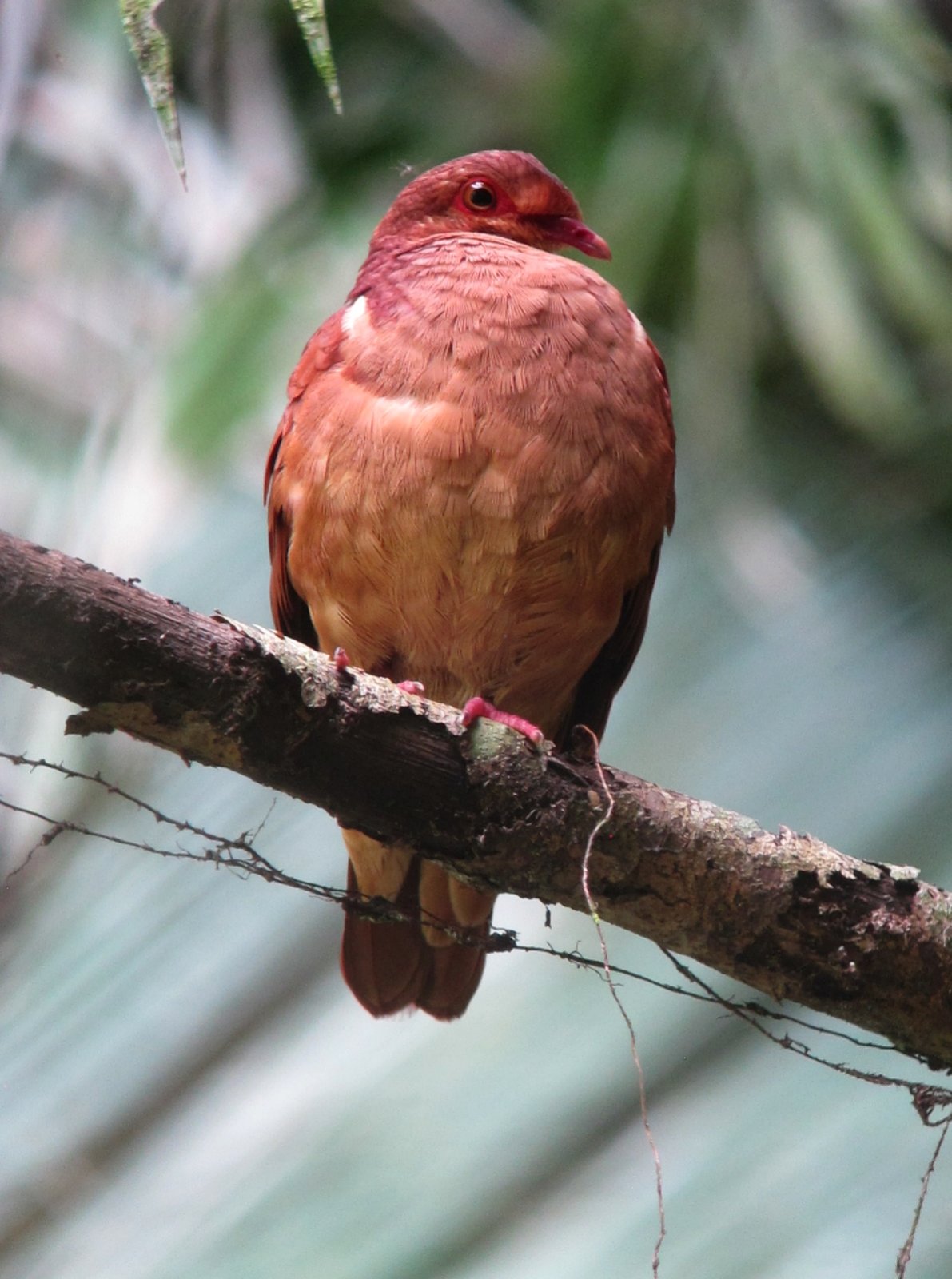
The Ruddy Quail-Dove is the most widespread quail-dove of tropical America: a compact ground dove of the forest floor, the male rufous with a red bill and a striped face. In the guide area it lives in humid lowland forest and lower montane forest on both sides of the Andes.
Voice
A low, hollow, fading hoooo, repeated every few seconds; ventriloquial, so that the direction of the sound is often unclear.
Recording: Aran Rodrigues Cardoso — CC BY-NC-SA 4.0 · xeno-canto
Identification
21–25 cm, compact, with a short tail. The male is rufous on the upperparts with a purple gloss on the mantle. The face is cinnamon with a rufous stripe from below the eye to the ear coverts; the throat is pale buff. The breast is pinkish brown, the belly buff. The bill, eye-ring and legs are red to pinkish red. The female is olive-brown on the upperparts and dull buff below, with a similar but fainter facial pattern. Juveniles have rufous feather fringes.
Confusion species
Violaceous Quail-Dove Geotrygon violacea has a white forehead and white belly and no facial stripe. Purple Quail-Dove Geotrygon purpurata and Sapphire Quail-Dove Geotrygon saphirina have a white face with black stripes and a grey crown. White-throated Quail-Dove Zentrygon frenata lives higher in montane forest and has a grey head, a white throat and a black malar stripe.
Habitat
Humid lowland forest, foothill forest and lower montane forest, also older secondary forest, from sea level to about 1500 m, locally higher. It walks over the forest floor, searching for seeds, fallen fruit and invertebrates. The nest is a loose platform of twigs low in a shrub or on a palm frond.
Where the bird is most at home, classified by the vegetation units of the Andes and the west coast.


Range and movements
In Colombia widespread in the lowlands and foothills on both sides of the Andes. In Ecuador in the western and eastern lowlands and on both slopes of the Andes. In Peru mainly in the Amazonian lowlands and on the east slope. In Bolivia in the northern lowlands and at the foot of the Andes. Absent from the Galápagos. Outside the guide area from Mexico and the Caribbean through Central America to northeastern Argentina.
- Resident
- dark = core range, pale = thinly spread
How and when to look
Along forest trails in the early morning, when the bird walks across the trail or flies off low with rapid wingbeats when disturbed; usually heard more often than seen.
Conservation status
Least Concern. Widespread, but dependent on forest and locally hunted.
Scientific name
Geotrygon montana | (Linnaeus, 1758)
Linnaeus described the species in 1758 as Columba montana; because it was later moved to another genus, the author and year stand in brackets. The genus Geotrygon was introduced in 1847 by Gosse. The genus name combines Greek geō-, 'ground-', with trugōn, 'turtle dove'. The species name comes from Latin montanus, 'of the mountains'; the species, however, lives mainly in lowland forest. The specimen the first description was based on came from Jamaica.