All species › Pigeons and doves › Doves and pigeons › Violaceous Quail-Dove
Violaceous Quail-Dove | Geotrygon violacea
Bisschopskwartelduif | Paloma perdiz violácea | Juriti-vermelha
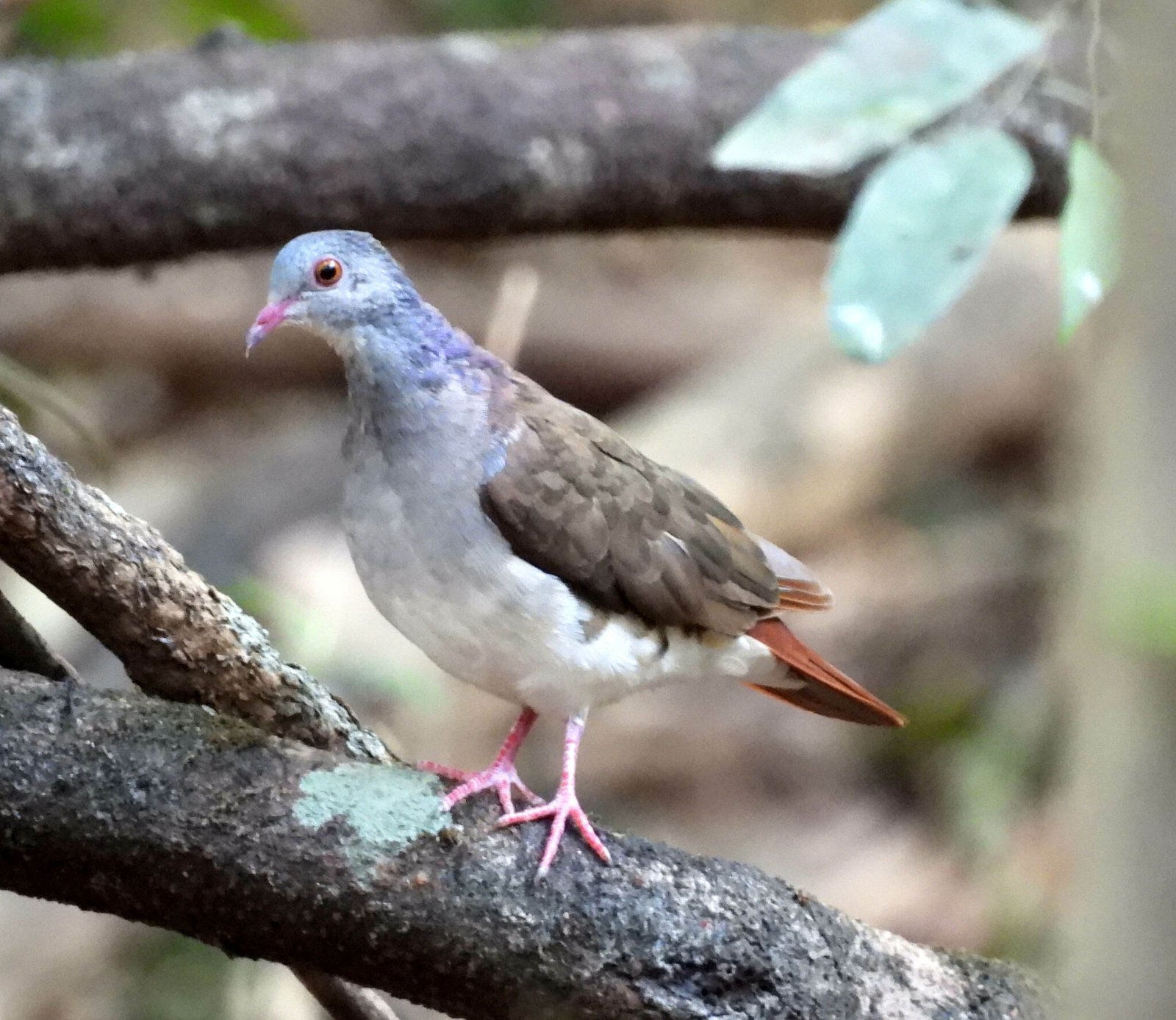
The Violaceous Quail-Dove is a small, compact ground dove of the interior of humid lowland forest, with a purple-glossed back and a pale, unstriped head. In the guide area it is scarce and local, with a scattered distribution in Colombia and Bolivia. It lives hidden on the forest floor and is mostly noticed when it flushes at your feet.
Voice
A soft, low, rather muffled ooh or woo-oo, repeated at regular intervals from a branch close to the ground; often for long periods.
Recording: Fernando Igor de Godoy — CC BY-NC-SA 4.0 · xeno-canto
Identification
22–24 cm, compact, with a short tail and fairly long legs. The forehead and face are pale grey to whitish, without the facial stripe of other quail-doves; the crown is greyer. The nape and mantle are rufous brown with a strong purple to violet gloss; wings and tail are chestnut. The throat is white, the breast pale grey with a lilac to vinaceous wash, the belly white. Bill and eye-ring are red, the iris orange to red, the legs reddish pink. The female is duller, with a more olive-brown back and less gloss; young birds are browner, with rufous feather fringes.
Confusion species
Ruddy Quail-Dove Geotrygon montana is much commoner in the guide area and has a distinct dark facial stripe on a pale cheek, more rufous upperparts and, in the female, olive-brown tones. Sapphire Quail-Dove Geotrygon saphirina of western Amazonia has a white facial stripe, a blue-grey crown and white underparts. Doves of the genus Leptotila are larger, longer-tailed and greyish brown, with white tail corners.
Habitat
The interior of humid and semi-humid lowland and hill forest, also gallery forest and old secondary forest, mainly below 1000 m. It walks alone or in pairs on the forest floor, searching for seeds, fallen fruit and small invertebrates. The nest is a loose platform of twigs in a shrub or low tree.
Where the bird is most at home, classified by the vegetation units of the Andes and the west coast.


Range and movements
Local and scarce. In Colombia scattered in the north and in the middle Magdalena Valley, locally also in the east. In Bolivia in the lowlands of the north and east. For Peru there are only a few reports; it has not been recorded in Ecuador. Absent from the Galápagos. Outside the guide area from Nicaragua to Panama, in Venezuela and Suriname, and in Brazil, Paraguay and north-eastern Argentina.
- Resident
- dark = core range, pale = thinly spread
How and when to look
The best chance is in humid lowland forest in eastern Bolivia, where you can listen for its low call in the early morning. It often flushes only at the last moment and then disappears low between the trunks.
Conservation status
Least Concern. In the guide area scarce and rarely reported; sensitive to deforestation and fragmentation of lowland forest.
Scientific name
Geotrygon violacea | (Temminck, 1809)
Temminck described the species in 1809 as Columba Violacea; because it was later moved to another genus, the author and year stand in brackets. The genus Geotrygon was introduced in 1847 by Gosse. The genus name combines Greek geō-, 'ground-', with trugōn, 'turtle dove'. The species name comes from Latin violaceus, 'violet-coloured'. The specimen the first description was based on came from the Americas (according to the description).