All species › Pigeons and doves › Doves and pigeons › Olive-backed Quail-Dove
Olive-backed Quail-Dove | Leptotrygon veraguensis
Veraguakwartelduif | Paloma perdiz de Veragua | Pariri-de-dorso-oliva
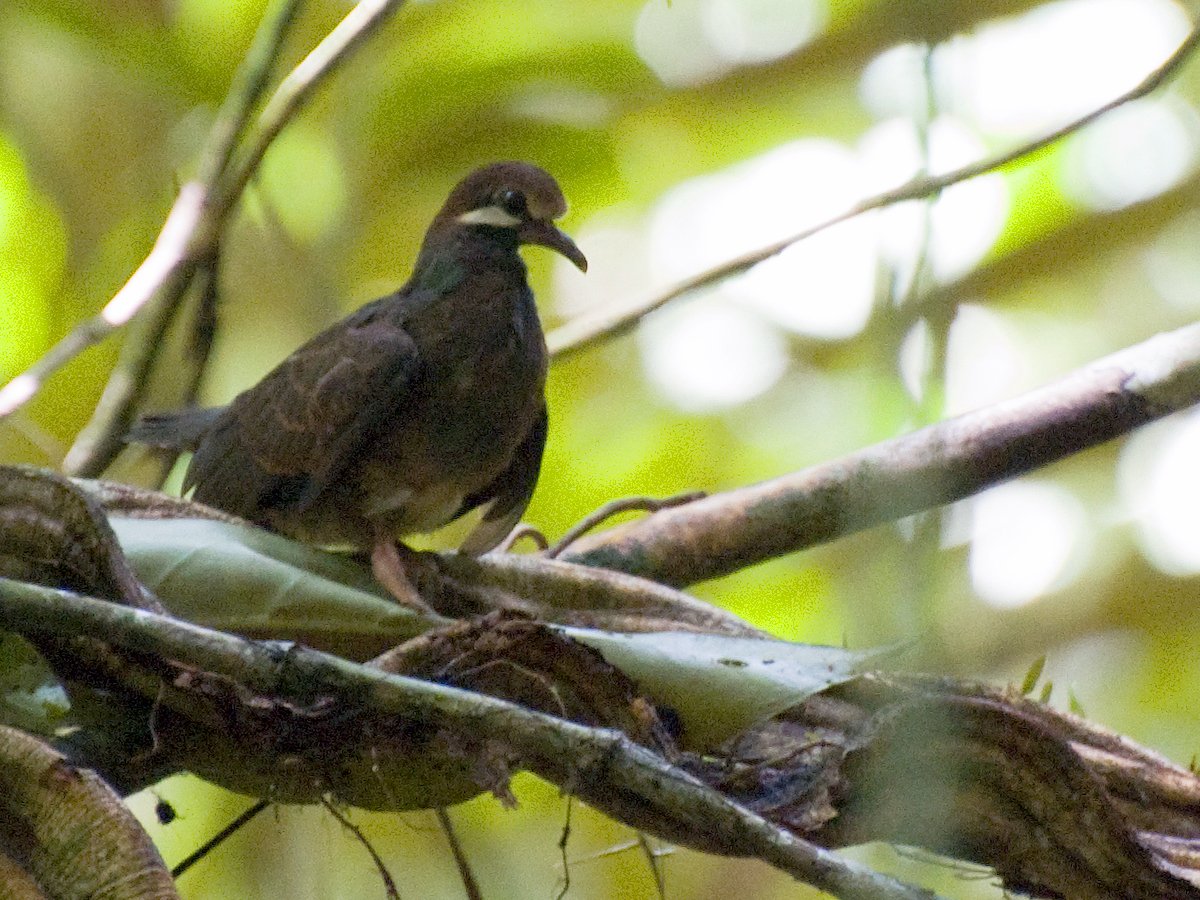
The Olive-backed Quail-Dove is a dark, compact ground dove of the Chocó rainforest, with a conspicuous white stripe below the eye. It is the only species in its genus and in the guide area occurs only in western Colombia and north-western Ecuador. It lives hidden on the floor of wet lowland forest.
Voice
A low, hollow, somewhat croaking koo-oop or woop, repeated at intervals of a few seconds from the ground or a low branch.
Recording: Olaf Jahn — CC BY-NC-SA 4.0 · xeno-canto
Identification
23–25 cm, compact and short-tailed. The upperparts are dark olive brown, with a purple to bronze-green gloss on the hindneck and mantle. The forehead is pale grey to whitish, the crown greyer. A broad white stripe runs below the eye, bordered below by a narrow black malar stripe; the throat is white. Breast and flanks are dark greyish brown, the belly warm ochre brown. The legs are pink to red. The sexes are similar; young birds are duller, with rufous feather fringes.
Confusion species
Ruddy Quail-Dove Geotrygon montana is rufous brown above, with a pale cheek and a dark facial stripe, and has a red bill. Sapphire Quail-Dove Geotrygon saphirina also has a white facial stripe, but a blue-grey crown, a purple back and white underparts. Russet-crowned Quail-Dove Zentrygon goldmani, found in hill forest in the far north-west of Colombia, has a russet crown and pale underparts.
Habitat
The interior of very wet lowland and hill rainforest, also old secondary forest, from sea level to about 900 m. It walks on the forest floor, often in ravines and along streams, and eats seeds, fallen fruit and small invertebrates. The nest is a platform of twigs low in a shrub or young palm.
Where the bird is most at home, classified by the vegetation units of the Andes and the west coast.


Range and movements
In Colombia in the lowlands and foothills on the Pacific side, from the northern Chocó southwards, locally also inland in the north to the lower Cauca and Magdalena valleys. In Ecuador in the north-west, mainly in Esmeraldas and adjacent provinces. Absent from Peru, Bolivia and the Galápagos. Outside the guide area in eastern Costa Rica and in Panama.
- Resident
- dark = core range, pale = thinly spread
How and when to look
Search in the Chocó rainforest of north-western Ecuador and western Colombia, early in the morning along forest trails in ravines, where it sometimes walks across the path. The low call gives it away sooner than its plumage.
Conservation status
Least Concern. In the guide area local and rarely reported; sensitive to the continuing deforestation of the Chocó lowlands.
Scientific name
Leptotrygon veraguensis | (Lawrence, 1866)
Lawrence described the species in 1866 as Geotrygon Veraguensis; because it was later moved to another genus, the author and year stand in brackets. The genus Leptotrygon was introduced in 2013 by Banks, Weckstein, Remsen & Johnson. The genus name combines Greek leptos, 'delicate, slender', with trugōn, 'turtle dove'. The species name veraguensis refers to Veraguas in Panama, not necessarily the type locality. The specimen the first description was based on came from Veraguas, Panama.