All species › Pigeons and doves › Doves and pigeons › White-tipped Dove
White-tipped Dove | Leptotila verreauxi
Verreaux' duif | Paloma montaraz común | Juriti-pupu
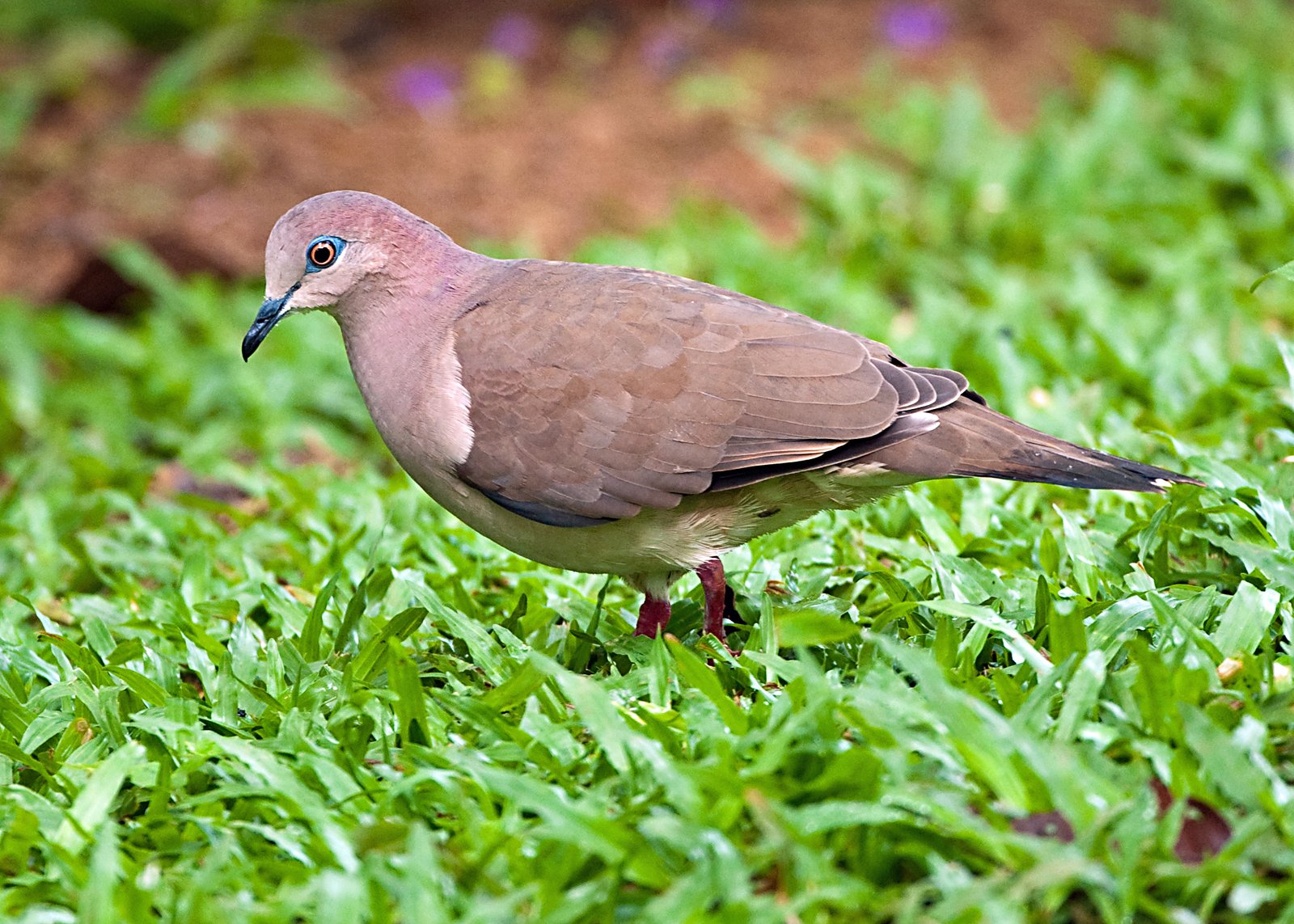
The White-tipped Dove is a medium-sized, greyish-brown dove with white tail corners that lives mainly on the ground in forest edges and scrub. It is the most widespread Leptotila in the Americas, from the southern United States to Argentina. In the guide area it occurs in dry and semi-humid regions on both sides of the Andes; its hollow call is a familiar sound in dry forest.
Voice
A low, hollow oo-wooooo, like blowing across the mouth of a bottle; the first note short and soft, the second long and sustained. Repeated at intervals, often throughout the day.
Recording: Étienne Leroy — CC BY-NC-SA 4.0 · xeno-canto
Identification
25–29 cm, with a medium-length, rounded tail. The upperparts are plain olive brown to greyish brown. The forehead is pale grey to pinkish white, the crown and hindneck greyer, with a faint purple to green gloss on the nape. Breast pinkish grey to pale brown, belly and undertail coverts white. The bare skin around the eye is blue to bluish grey, reddish in some subspecies; the iris is yellow to orange, the legs red. The underwing is rufous, visible in flight. The outer tail feathers have broad white tips. The sexes are alike; young birds have rufous feather fringes.
Confusion species
Grey-fronted Dove Leptotila rufaxilla of the Amazonian lowlands has a whiter forehead, a blue-grey crown, red bare eye-ring and more rufous sides to the head. Pallid Dove Leptotila pallida of the Chocó lowlands is paler, with a cinnamon-brown back and a white belly. Ochre-bellied Dove Leptotila ochraceiventris of south-western Ecuador and north-western Peru has an ochre-yellow belly. Yungas Dove Leptotila megalura of the Bolivian Yungas is larger and has a pale cheek and a longer tail.
Habitat
Dry and semi-humid forest, forest edges, scrub, riparian woodland, shade coffee, gardens and parks, from sea level to about 2500 m in the dry Andean valleys. It walks much on the ground, alone or in pairs, and eats seeds, fallen fruit and small invertebrates. When disturbed it flushes with loud wing-clapping and lands low in the vegetation. The nest is a loose platform of twigs in a shrub or tree.
Where the bird is most at home, classified by the vegetation units of the Andes and the west coast.


Range and movements
Common. In Colombia widespread in the northern lowlands, in the Andean valleys and on the Llanos. In Ecuador in the west and in the dry inter-Andean valleys. In Peru on the coast and the western slope, in the Marañón Valley and locally in dry valleys on the eastern side. In Bolivia in the dry Andean valleys and in the lowlands of the east and south. Absent from most of the Amazonian lowlands and from the Galápagos. Outside the guide area from Texas and Mexico to Venezuela, the Guianas, Brazil, Paraguay and Argentina.
- Resident
- dark = core range, pale = thinly spread
How and when to look
In the dry forest of south-western Ecuador and north-western Peru, in the dry Andean valleys and in parks you can hear and see it daily; it often walks along trails and across open patches under shrubs.
Conservation status
Least Concern. Common; it adapts well to secondary forest, scrub and farmland.
Scientific name
Leptotila verreauxi | Bonaparte, 1855
Bonaparte described the species in 1855 and placed it straight away in the genus where it still stands. The genus Leptotila was introduced in 1837 by Swainson. The genus name (originally Leptoptila) combines Greek leptos, 'delicate, slender', with ptilon, 'feather'. The species name honours Jules Pierre Verreaux (1807–1873), French natural-history dealer and collector. The specimen the first description was based on came from Colombia.