All species › Pigeons and doves › Doves and pigeons › Caribbean Dove
Caribbean Dove | Leptotila jamaicensis
Witbuikduif | Paloma caribeña | Juriti-caribenha
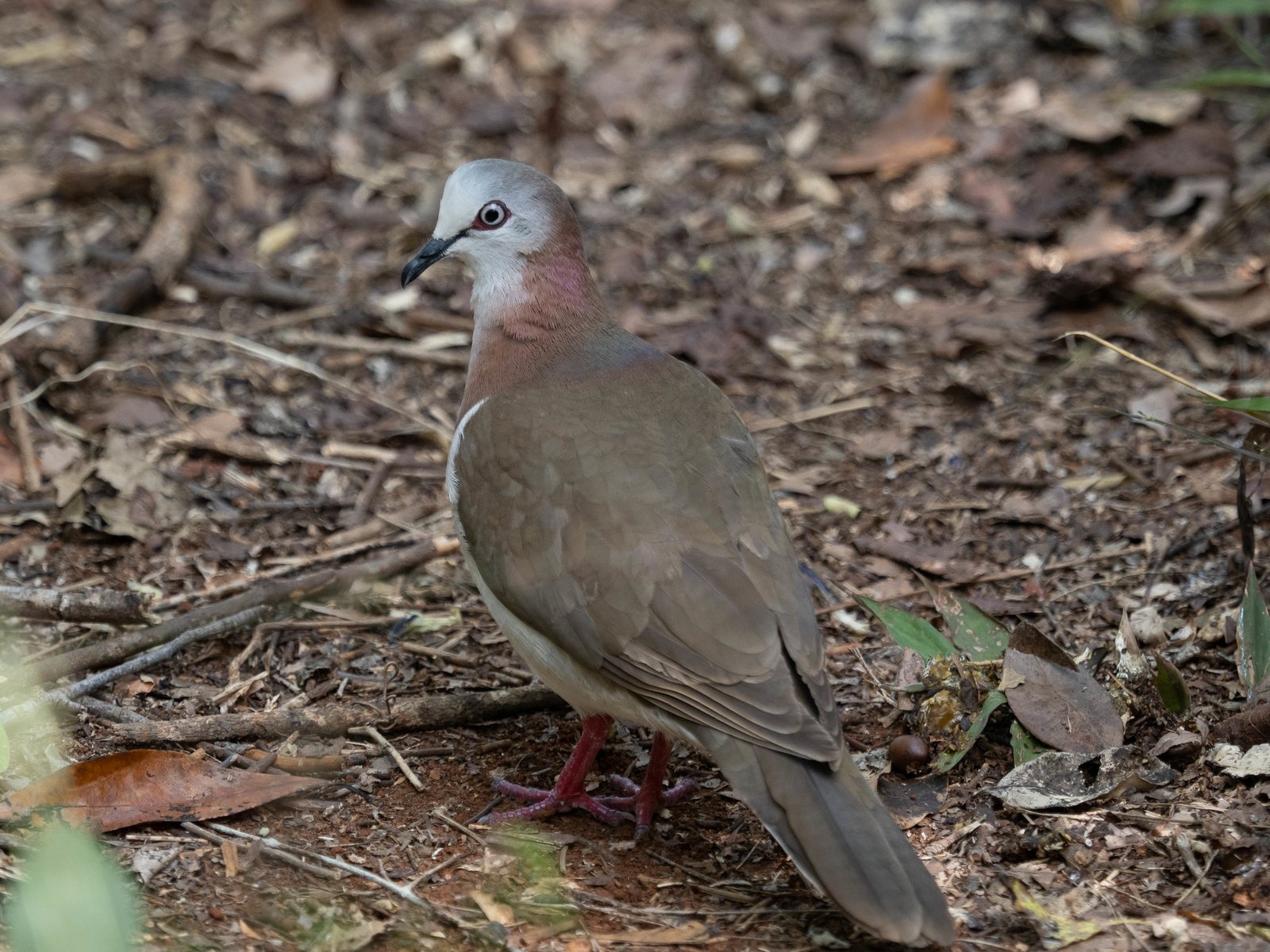
The Caribbean Dove is a large, pale Leptotila of the western Caribbean, with a white front and a glossy neck. In the guide area it occurs only on the Colombian island of San Andrés, in the Caribbean Sea off the coast of Nicaragua. There it is a familiar resident of scrub and gardens.
Voice
A series of three or four hollow, low notes, oo-oo-oo-ooooo, the last one held longest; repeated at intervals.
Recording: Eric Antonio Martinez — CC BY-NC-SA 4.0 · xeno-canto
Identification
28–32 cm, bulky, with a medium-length, rounded tail. Forehead and face are white to creamy white, the crown grey. The hindneck and sides of the neck have a strong pinkish-purple to greenish gloss. The upperparts are plain olive brown. Throat, breast and belly are white, the breast with a faint pinkish-grey wash. The bare eye-ring is red, the iris reddish to orange, the legs red. The outer tail feathers have white tips; the underwing is rufous. The sexes are alike; young birds are duller, with rufous feather fringes.
Confusion species
In the guide area no other Leptotila occurs on San Andrés. White-crowned Pigeon Patagioenas leucocephala, which also lives on the island, is dark slate grey with a white crown and keeps mainly to trees. White-tipped Dove Leptotila verreauxi of the mainland is greyer in front, with a less white belly and less gloss on the neck.
Habitat
Dry to semi-humid scrub, thickets and woodland edges, mangrove, coconut plantations, pastures with trees, gardens and yards, at sea level. It walks much on the ground, alone or in pairs, and eats seeds, fallen fruit and small invertebrates. The nest is a platform of twigs in a shrub or low tree.
Where the bird is most at home, classified by the vegetation units of the Andes and the west coast.


Range and movements
In the guide area only on San Andrés, in the Colombian part of the western Caribbean Sea, where an endemic subspecies lives. Absent from mainland Colombia, Ecuador, Peru, Bolivia and the Galápagos. Outside the guide area on Jamaica and the Cayman Islands, on the Yucatán Peninsula and on islands off the coast of Honduras.
- Resident
- dark = core range, pale = thinly spread
How and when to look
On San Andrés in scrub, gardens and along country lanes in the interior of the island, especially in the early morning, when it forages on the ground and calls.
Conservation status
Least Concern. On San Andrés it depends on the remaining scrub and woodland on the densely built-up island.
Scientific name
Leptotila jamaicensis | (Linnaeus, 1766)
Linnaeus described the species in 1766 as Columba jamaicensis; because it was later moved to another genus, the author and year stand in brackets. The genus Leptotila was introduced in 1837 by Swainson. The genus name (originally Leptoptila) combines Greek leptos, 'delicate, slender', with ptilon, 'feather'. The species name jamaicensis refers to Jamaica, not necessarily the type locality. The specimen the first description was based on came from Jamaica.