All species › Pigeons and doves › Doves and pigeons › Grey-chested Dove
Grey-chested Dove | Leptotila cassinii
Cassins duif | Paloma pecho gris | Juriti-de-peito-cinza
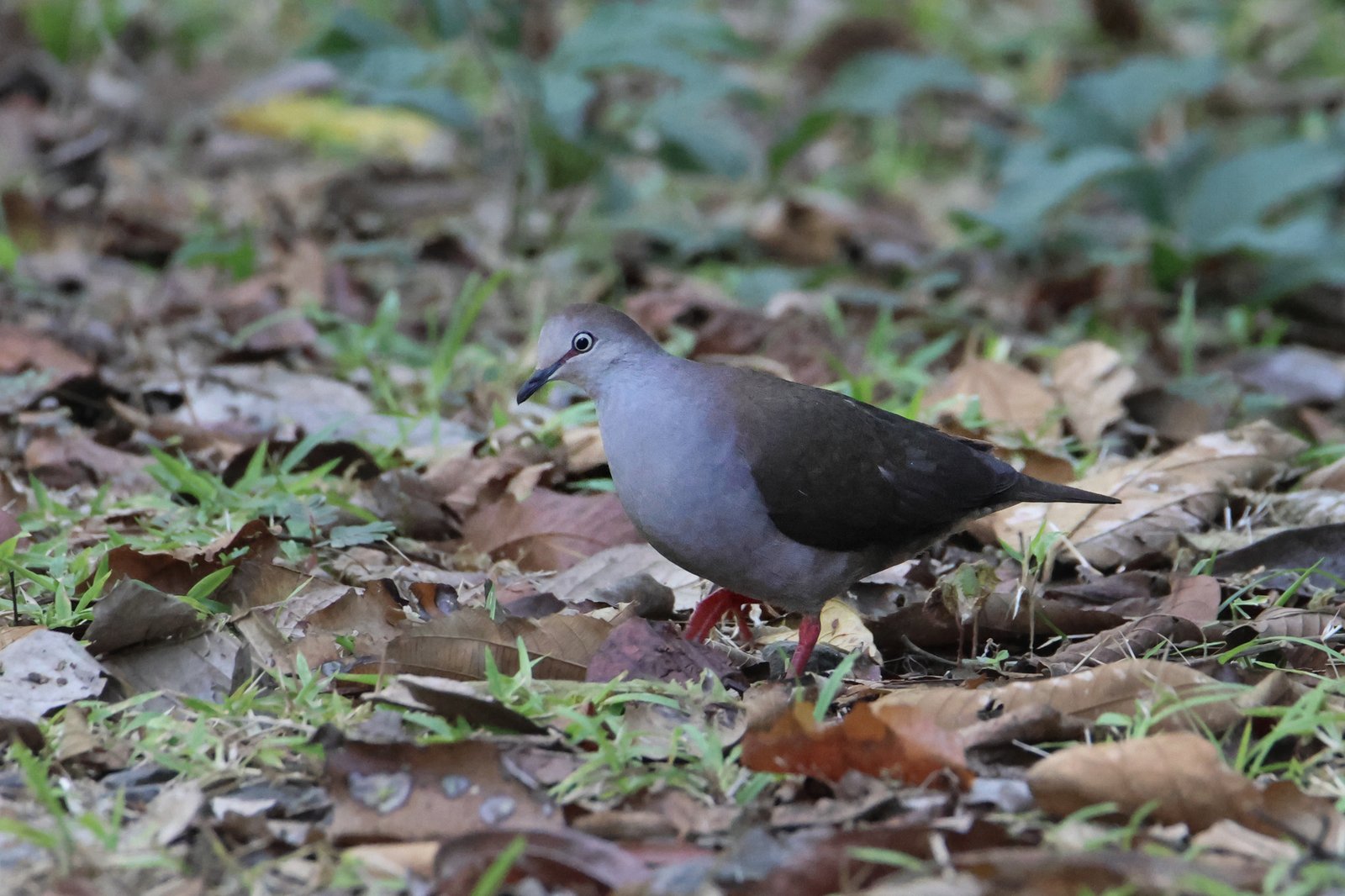
The Grey-chested Dove is a dark Leptotila of humid lowland forest, with a grey breast and head and an olive-brown back. In the guide area it reaches only northern and western Colombia, the southern edge of a range that extends to Mexico. It lives on the floor of closed forest and is usually heard before it is seen.
Voice
A long, soft, falling and somewhat plaintive note, woooooo, repeated at intervals of many seconds from the ground or a low branch.
Recording: Johan Chaves — CC BY-NC-SA 4.0 · xeno-canto
Identification
24–26 cm, with a fairly short, rounded tail. The crown is grey, sometimes with a brownish wash, the forehead slightly paler; the hindneck has a faint purple gloss. The upperparts, wings and tail are dark olive brown. Cheeks, sides of the neck and breast are plain grey, the throat whitish and the belly white. The bare skin around the eye is red, the iris yellow to orange, the legs red. The outer tail feathers have narrow white tips; the underwing is rufous. The sexes are alike; young birds are browner, with rufous feather fringes.
Confusion species
Pallid Dove Leptotila pallida of western Colombia is paler, with a cinnamon-brown back, a pinkish-grey breast and a whiter face. White-tipped Dove Leptotila verreauxi lives in drier, more open country, is paler greyish brown, has a pink-tinged breast, a blue eye-ring and broader white tail tips. Grey-headed Dove Leptotila plumbeiceps has a blue-grey crown contrasting sharply with the brown back and a pinkish-brown breast.
Habitat
The interior and edges of humid lowland and hill forest, also old secondary forest, riparian woodland and shady plantations, mainly below 1000 m. It walks alone or in pairs on the forest floor and eats seeds, fallen fruit and small invertebrates. The nest is a platform of twigs in a shrub or low tree.
Where the bird is most at home, classified by the vegetation units of the Andes and the west coast.


Range and movements
In Colombia in the lowlands of the north-west and north: the Chocó on the Pacific side, the Urabá region and the lowlands on the Caribbean side east to the middle Magdalena Valley. Absent from Ecuador, Peru, Bolivia and the Galápagos. Outside the guide area from south-eastern Mexico through Central America to Panama.
- Resident
- dark = core range, pale = thinly spread
How and when to look
In humid lowland forest of north-western Colombia, early in the morning along quiet forest trails, where it walks on the ground and, when disturbed, flies off low between the trunks. Listen for the long, falling call.
Conservation status
Least Concern. In the guide area local; it has declined where lowland forest has been cleared.
Scientific name
Leptotila cassinii | Lawrence, 1867
Lawrence described the species in 1867 and placed it straight away in the genus where it still stands. The genus Leptotila was introduced in 1837 by Swainson. The genus name (originally Leptoptila) combines Greek leptos, 'delicate, slender', with ptilon, 'feather'. The species name honours John Cassin (1813–1869), American ornithologist at the Academy of Natural Sciences in Philadelphia. The specimen the first description was based on came from along the Panama Railroad, Panama.