All species › Pigeons and doves › Doves and pigeons › Tolima Dove
Tolima Dove | Leptotila conoveri
Tolimaduif | Paloma montaraz de Tolima | Juriti-de-tolima
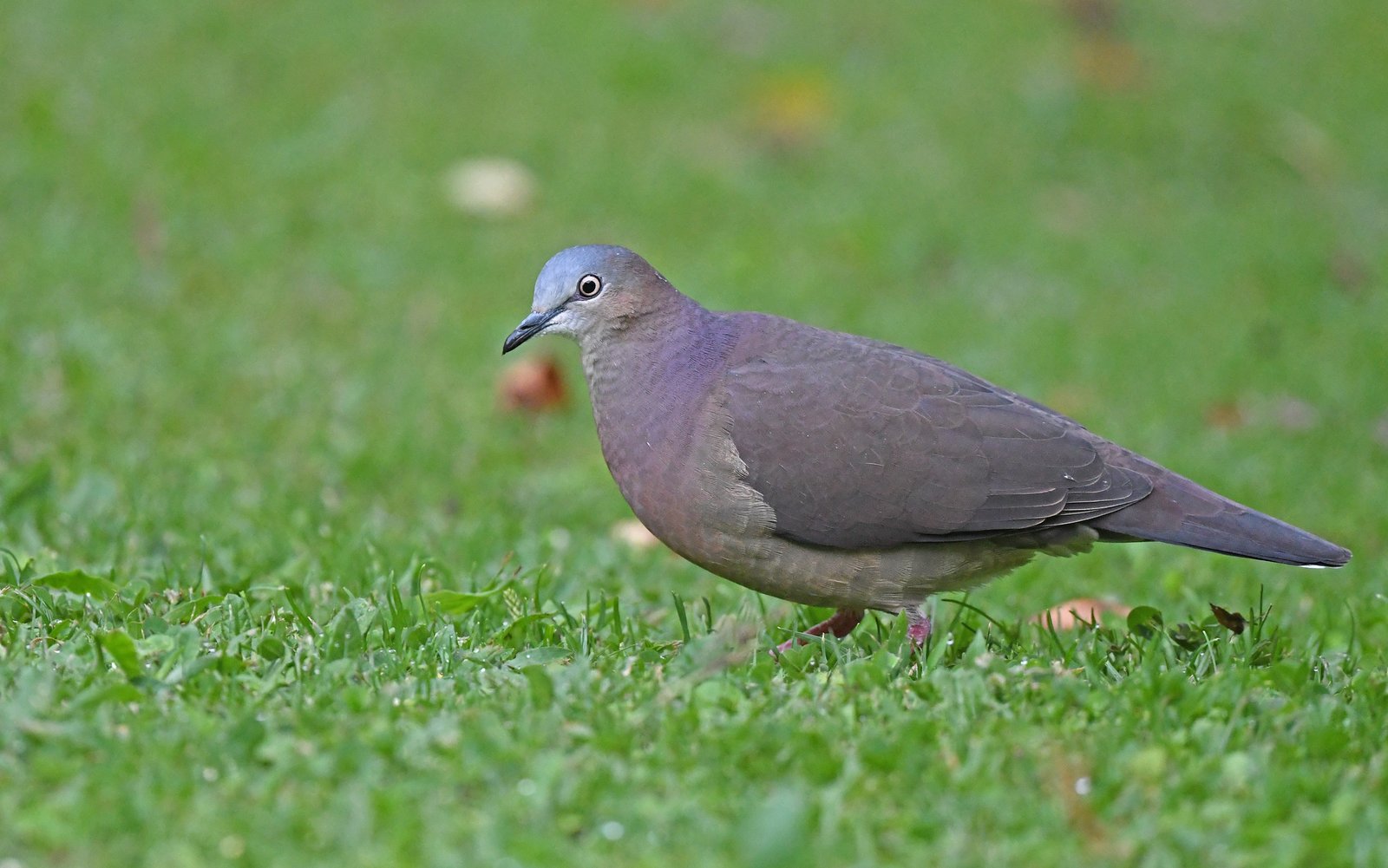
The Tolima Dove is a Leptotila found only in Colombia, on the slopes above the upper Magdalena Valley. It lives in montane forest, forest edges and scrub at middle elevations and is named after the department of Tolima. For a long time little was known about it; it has since been found at a number of sites in Tolima and Huila.
Voice
A low, hollow cooing, oo-wooo, the second note longer, repeated at intervals from the undergrowth; similar to that of related Leptotila species.
Recording: Yair Guillermo Molina Martínez. — CC BY-NC-SA 4.0 · xeno-canto
Identification
25–26 cm, with a medium-length, rounded tail. The forehead is pale grey, the crown blue-grey, the hindneck with a purple gloss. The upperparts, wings and tail are dark olive brown. The throat is whitish, the breast washed pink to vinaceous, the belly and undertail coverts warm ochre to cinnamon brown. The bare skin around the eye is reddish, the legs red. The outer tail feathers have narrow white tips; the underwing is rufous. The sexes are alike; young birds are duller, with rufous feather fringes.
Confusion species
White-tipped Dove Leptotila verreauxi, which lives in drier and lower parts of the same valley, has a white belly, a paler, greyish-brown back and a blue eye-ring. Ruddy Quail-Dove Geotrygon montana and White-throated Quail-Dove Zentrygon frenata are more compact and shorter-tailed, with a striped head and without white tail corners.
Habitat
Humid montane forest, forest edges, old secondary forest, scrub and shade coffee on the slopes, roughly between 1300 and 2500 m. It walks on the ground, alone or in pairs, and eats seeds, fallen fruit and small invertebrates. Little is known about the nest.
Where the bird is most at home, classified by the vegetation units of the Andes and the west coast.


Range and movements
Endemic to Colombia: the eastern slope of the Central Andes in Tolima and Huila and locally the western slope of the Eastern Andes in Huila, above the upper Magdalena Valley. Absent from Ecuador, Peru, Bolivia and the Galápagos, and found nowhere outside the guide area.
- Resident
- dark = core range, pale = thinly spread
How and when to look
Search forest remnants and shade coffee on the slopes of Tolima and Huila, early in the morning, when it forages on the ground along trails and forest edges and calls.
Conservation status
Near Threatened. Small range in a region where much montane forest has been converted to farmland; it tolerates some disturbance and also lives in secondary forest and coffee plantations, but remains dependent on forest remnants.
Scientific name
Leptotila conoveri | Bond & Meyer de Schauensee, 1943
Bond & Meyer de Schauensee described the species in 1943 and placed it straight away in the genus where it still stands. The genus Leptotila was introduced in 1837 by Swainson. The genus name (originally Leptoptila) combines Greek leptos, 'delicate, slender', with ptilon, 'feather'. The species name honours Henry Boardman Conover (1892–1950), American ornithologist and collector associated with the Field Museum in Chicago. The specimen the first description was based on came from Colombia.