All species › Pigeons and doves › Doves and pigeons › Ochre-bellied Dove
Ochre-bellied Dove | Leptotila ochraceiventris
Geelbuikduif | Paloma montaraz ventriocre | Juriti-de-barriga-ocre
The Ochre-bellied Dove is a Leptotila of the Tumbesian region, with an ochre-yellow belly, a vinaceous breast and a purple-glossed neck. It occurs only in western and south-western Ecuador and the far north-west of Peru, where it lives in dry and semi-humid forest. The loss of this forest has made the species vulnerable.
Voice
A low, hollow, somewhat plaintive woo-ooo or a single long note, repeated at intervals from dense vegetation.
Recording: Karl S. Berg — CC BY-NC-SA 4.0 · xeno-canto
Identification
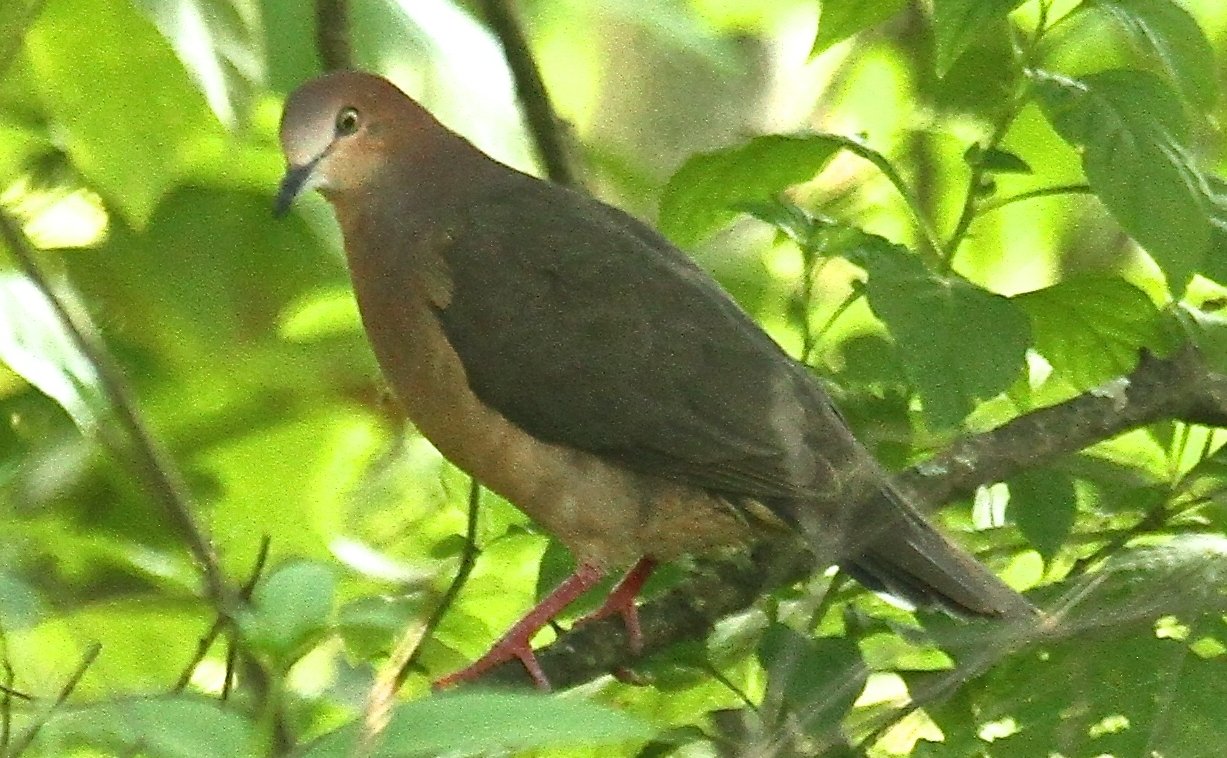
25–27 cm, with a medium-length, rounded tail. The forehead is pinkish grey to whitish; crown and hindneck are grey with a strong purple to maroon gloss. The upperparts, wings and tail are olive brown. The throat is white, the breast vinaceous to pinkish brown, the belly and undertail coverts warm ochre yellow to ochre brown. The bare skin around the eye is purplish red, the iris pale, the legs red. The outer tail feathers have narrow white tips; the underwing is rufous. The sexes are alike; young birds are duller, with rufous feather fringes.
Confusion species
White-tipped Dove Leptotila verreauxi, much commoner in the same area, has a white belly, a greyer breast and a blue eye-ring, and lacks the strong purple gloss on the neck. Pallid Dove Leptotila pallida lives in more humid lowland forest further north and is paler, with a cinnamon-brown back and a white belly.
Habitat
Semi-humid and deciduous forest, forest edges and old secondary forest, also more humid forest on hills and lower mountain slopes, from sea level to about 1500 m, locally higher. It walks on the ground in the undergrowth, alone or in pairs, and eats seeds, fallen fruit and small invertebrates. The nest is a platform of twigs in a shrub or low tree.
Where the bird is most at home, classified by the vegetation units of the Andes and the west coast.


Range and movements
In Ecuador in the west and south-west, from Manabí and Guayas to El Oro and Loja. In Peru only in the far north-west, mainly in Tumbes and Piura. Absent from Colombia, Bolivia and the Galápagos. It does not occur outside the guide area.
- Resident
- dark = core range, pale = thinly spread
How and when to look
In forest reserves in south-western Ecuador and in Tumbes in Peru, in the undergrowth of semi-humid forest on hills. Early in the morning you can see it walking on trails and hear its low call.
Conservation status
Vulnerable. The dry and semi-humid forest of the Tumbesian region has largely been cleared or degraded by grazing; the remaining population is fragmented and small.
Scientific name
Leptotila ochraceiventris | Chapman, 1914
Chapman described the species in 1914 and placed it straight away in the genus where it still stands. The genus Leptotila was introduced in 1837 by Swainson. The genus name (originally Leptoptila) combines Greek leptos, 'delicate, slender', with ptilon, 'feather'. The species name combines Latin ochraceus, 'ochre-coloured', with venter, 'belly'. The specimen the first description was based on came from Zaruma, El Oro, Ecuador.