All species › Passerines › Ovenbirds and woodcreepers › Dark-breasted Spinetail
Dark-breasted Spinetail | Synallaxis albigularis
Witkeelstekelstaart | Pijuí pechioscuro | João-de-peito-escuro
Dark-breasted Spinetail is a small spinetail of rank grass, cane and scrub in the western Amazon basin. It lives mainly on river islands and in young growth along rivers, but also in pastures and clearings. Its fast, long-repeated song is often heard in this habitat.
Voice
The song is a hurried cheep, du-du-du, often repeated at length. Also a short chatter and an accelerating whinny.
Recording: Juan Freile — CC BY-NC-SA 4.0 · xeno-canto
Identification
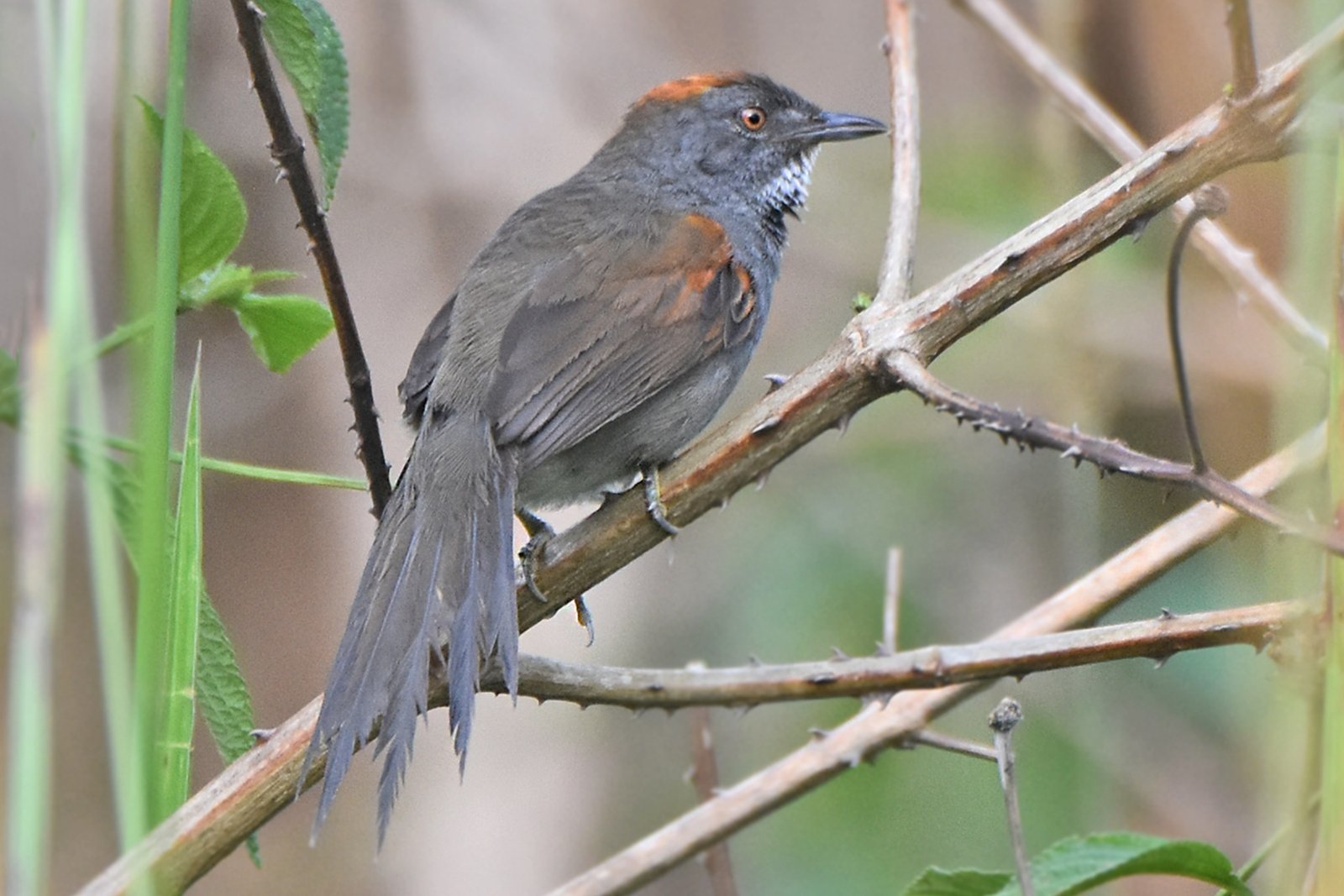
15–16 cm, with a fairly short, graduated tail. The face is brownish grey, the hindcrown and nape dark rufous, the back olive-brown and the wing coverts rufous. The throat is greyish white with sooty flecks; the breast and flanks are brownish grey, the belly paler. The sexes are alike.
Confusion species
Pale-breasted Spinetail Synallaxis albescens has a paler, buffy grey breast and a two-note song, and lives mainly in grassland and savanna outside the Amazon basin. Plain-crowned Spinetail Synallaxis gujanensis has a brown crown without rufous and paler buff underparts, and lives more at forest edges. Cabanis's Spinetail Synallaxis cabanisi is larger and darker, with a longer tail. Rio Orinoco Spinetail Synallaxis beverlyae, only along the Orinoco, has a whitish eyebrow and a much paler breast.
Habitat
Tall grass, scrub and stands of cane (Gynerium) on river islands, rank growth along rivers, shrubby clearings, pastures and plantations; mostly from sea level to 1500 m, locally to 2100 m. It forages low in the vegetation for insects. The nest is a ball of twigs with an entrance tube, low in dense vegetation.
Where the bird is most at home, classified by the vegetation units of the Andes and the west coast.


Range and movements
In Colombia in the south-east, in the Amazonian lowlands and at the foot of the eastern slope. In Ecuador in the eastern lowlands and foothills. In Peru in the east, in the lowlands and lower valleys. In Bolivia in the west. Absent from the Galápagos. Outside the guide area in western Brazil.
- Resident
- dark = core range, pale = thinly spread
How and when to look
Search river islands and banks with young growth, for example near Iquitos or along the Napo; the song gives the bird away, which usually stays low in the grass.
Conservation status
Least Concern. The species benefits locally from clearings and young growth.
Scientific name
Synallaxis albigularis | Sclater, 1858
Sclater described the species in 1858 and placed it straight away in the genus where it still stands. The genus Synallaxis was introduced in 1818 by Vieillot. The genus name comes from Ancient Greek sunallaxis, 'exchange'. The species name comes from Latin albus, 'white', and gula, 'throat', for the white throat. The specimen the first description was based on came from Río Napo, Ecuador.