All species › Passerines › Ovenbirds and woodcreepers › Rio Orinoco Spinetail
Rio Orinoco Spinetail | Synallaxis beverlyae
Orinocostekelstaart | Pijuí del Orinoco | João-do-orinoco
Rio Orinoco Spinetail was described only in 2009 and is known solely from scrub on islands and banks of the Orinoco. Its closest relative is Dark-breasted Spinetail. Its occurrence in the guide area has not been confirmed.
Voice
A series of six to nine rapid but well-separated notes, the first accented; also a longer, faster series and a single loud note. Few recordings exist.
No recording with a suitable Creative Commons licence is available for this species yet.
Identification
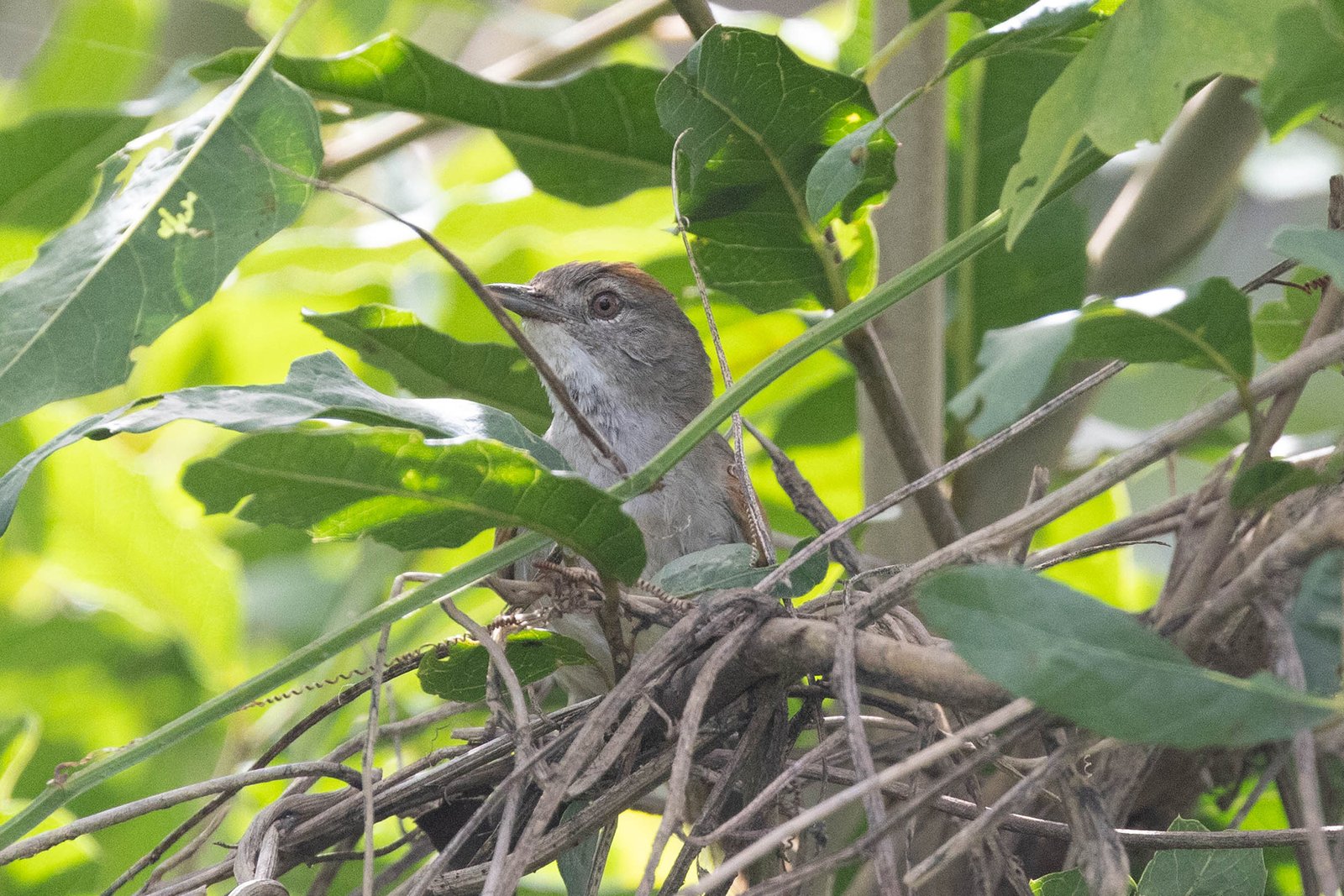
13–16 cm. The forehead and face are grey, with a whitish eyebrow and a whitish throat. The crown is orange-rufous, the nape smoky grey and the back greyish brown. The wing coverts are cinnamon-rufous, the graduated tail is brown with a rufous tinge and pointed feathers. The upper breast is pale grey, the rest of the underparts dull whitish tinged clay. The iris is pale grey to pale yellowish brown. The sexes are alike.
Confusion species
Dark-breasted Spinetail Synallaxis albigularis has a dark, brownish-grey breast and no obvious eyebrow, and lives further south, in the Amazon basin. Pale-breasted Spinetail Synallaxis albescens has an olive-brown back, a black-flecked throat and a two-note song, and lives in grassland and savanna. Yellow-chinned Spinetail Certhiaxis cinnamomeus is bright rufous above and white below.
Habitat
Scrubby vegetation on river islands and adjacent banks of the Orinoco, in ground that floods periodically, especially young growth that springs up after the water falls. It forages in dense vegetation, from the ground up to about 3 m, for insects.
Where the bird is most at home, classified by the vegetation units of the Andes and the west coast.


Range and movements
In Colombia only possibly in the far east, along the Orinoco at the border with Venezuela (Vichada); the reports there are undocumented and its occurrence is considered uncertain. Absent from Ecuador, Peru, Bolivia and the Galápagos. Outside the guide area along the main channel of the Orinoco in Venezuela, from the middle reaches to the delta.
- Resident
- dark = core range, pale = thinly spread
How and when to look
Search along the Orinoco near Puerto Carreño in young growth on islands and banks. As the species is unconfirmed in Colombia, a photo or sound recording of any sighting is valuable.
Conservation status
Near Threatened. The range is very small and the population size unknown, but probably stable. Cultivation on river islands in the dry season and increasing tourism on sandy islands may degrade the habitat.
Scientific name
Synallaxis beverlyae | Hilty & Ascanio, 2009
Hilty & Ascanio described the species in 2009 and placed it straight away in the genus where it still stands. The genus Synallaxis was introduced in 1818 by Vieillot. The genus name comes from Ancient Greek sunallaxis, 'exchange'. The species name honours Beverly J. Hilty, wife of Steven Hilty, the senior author of the description. The specimen the first description was based on came from Río Orinoco near Puerto Ayacucho, Venezuela.