All species › Passerines › Ovenbirds and woodcreepers › Pale-breasted Spinetail
Pale-breasted Spinetail | Synallaxis albescens
Temmincks stekelstaart | Pijuí pechiblanco | Uí-pi
Pale-breasted Spinetail is a small, pale spinetail of open grassland, savanna and pastures, with a very large range from Costa Rica to Argentina. It lives hidden in tall grass and scrub and repeats its two-note song endlessly. In the guide area it occurs mainly in Colombia and in the lowlands of Bolivia.
Voice
The song is a loud, scratchy two-note phrase, often rendered wee-bit, repeated endlessly from a low perch. The call is a sharp bip, often followed by a rattling churrr.
Recording: Franco Vushurovich — CC BY-NC-SA 4.0 · xeno-canto
Identification
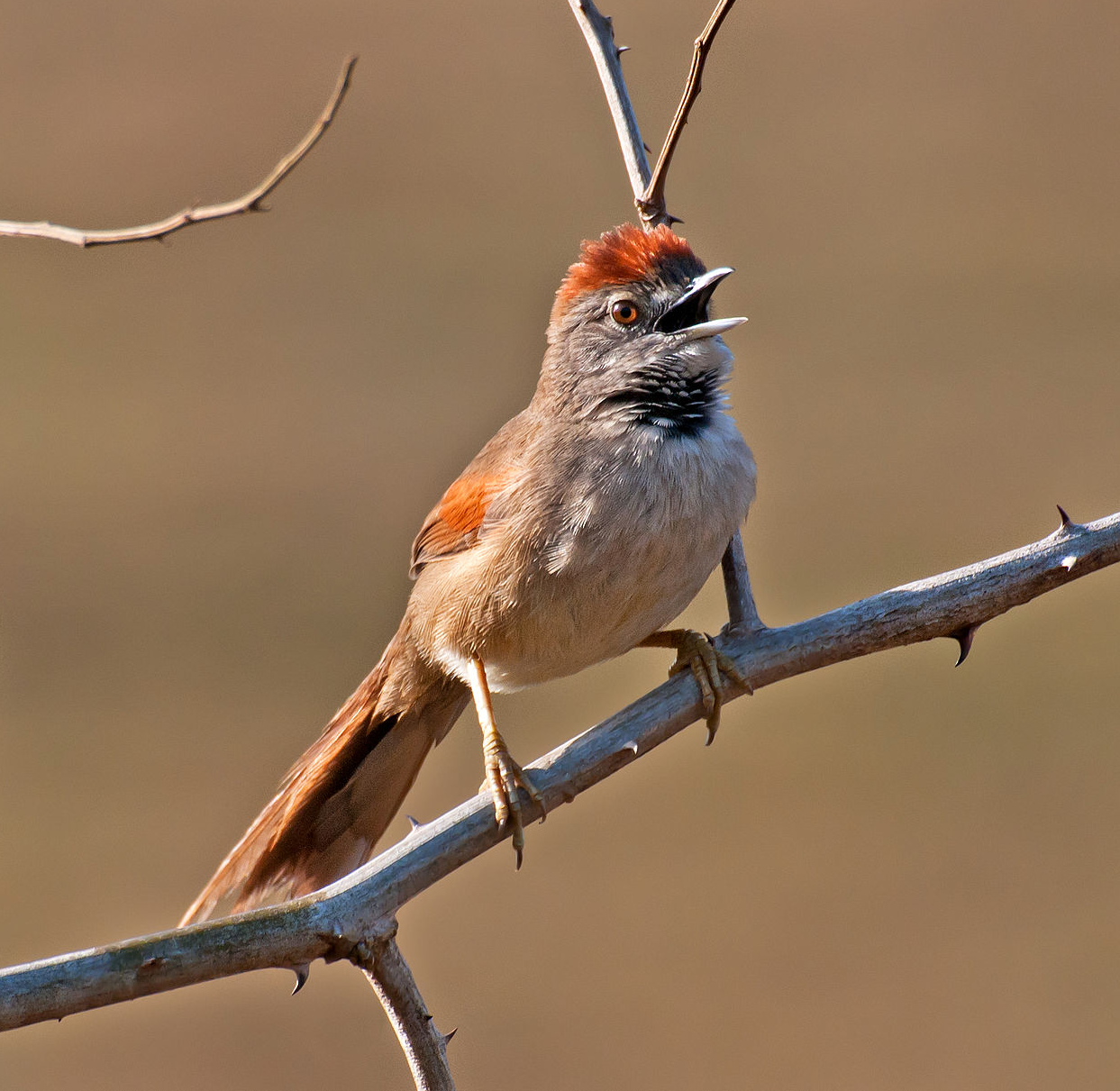
15–16 cm, with a long, graduated tail. The face is pale brownish grey with a paler eyestripe, the crown rufous, the back olive-brown and the wing coverts rufous. The throat is whitish with black flecks, the breast pale buffy grey and the belly whitish. The sexes are alike. Juveniles are paler and more rufous, with an almost white throat.
Confusion species
Cinereous-breasted Spinetail Synallaxis hypospodia (Bolivia, south-eastern Peru) has a dark brown back and a greyish-brown breast. Dark-breasted Spinetail Synallaxis albigularis has a darker, brownish-grey breast and a different song, and lives in the Amazon basin. Sooty-fronted Spinetail Synallaxis frontalis (Bolivia) has a rufous tail and a dark forehead. Azara's Spinetail Synallaxis azarae lives higher in the mountains and has a darker breast and a chestnut tail.
Habitat
Open grassland, savanna, pastures with shrubs, rank roadsides, marsh edges and shrubby forest edges, mostly below 1500 m, in Colombia up to 1800 m. It forages low in the vegetation for insects. The nest is a ball of grass and thorny twigs with a horizontal entrance tube, usually less than 2 m above the ground in a grass clump or shrub; both parents incubate and feed the young.
Where the bird is most at home, classified by the vegetation units of the Andes and the west coast.


Range and movements
In Colombia widespread in the north and centre: the Caribbean lowlands, La Guajira, the Sierra Nevada de Santa Marta, the Magdalena and Cauca valleys, the Pacific north-west and the llanos. Absent from Ecuador and the Galápagos. In Peru only in Madre de Dios in the south-east. In Bolivia in the centre and east. Outside the guide area from Costa Rica to Argentina.
- Resident
- dark = core range, pale = thinly spread
How and when to look
Walk along pastures and rank roadsides in the lowlands of northern Colombia or in the savannas of Beni and listen for the two-note song; the bird often sings from a grass clump or low bush.
Conservation status
Least Concern. The species benefits from deforestation and the creation of pastures.
Scientific name
Synallaxis albescens | Temminck, 1823
Temminck described the species in 1823 and placed it straight away in the genus where it still stands. The genus Synallaxis was introduced in 1818 by Vieillot. The genus name comes from Ancient Greek sunallaxis, 'exchange'. The species name comes from Latin albescens, 'becoming white, whitish', for the pale underparts. The specimen the first description was based on came from Sorocaba, São Paulo, Brazil.