All species › Passerines › Ovenbirds and woodcreepers › Sooty-fronted Spinetail
Sooty-fronted Spinetail | Synallaxis frontalis
Roetkruinstekelstaart | Pijuí frentigrís | Petrim
Sooty-fronted Spinetail is a spinetail of dry woodland, thorn scrub and forest edges in the lowlands of eastern Bolivia. In the guide area it occurs only in Bolivia; elsewhere it lives in Brazil, Paraguay and Argentina. It stays low in dense vegetation and is noticed mainly by its song.
Voice
The song is described in different ways: a slow, measured tee-oo-poo-ee or a very high, two-note du-twee. Also sharper calls such as sew-kli or chi-kli.
Recording: Fernando Igor de Godoy — CC BY-NC-SA 4.0 · xeno-canto
Identification
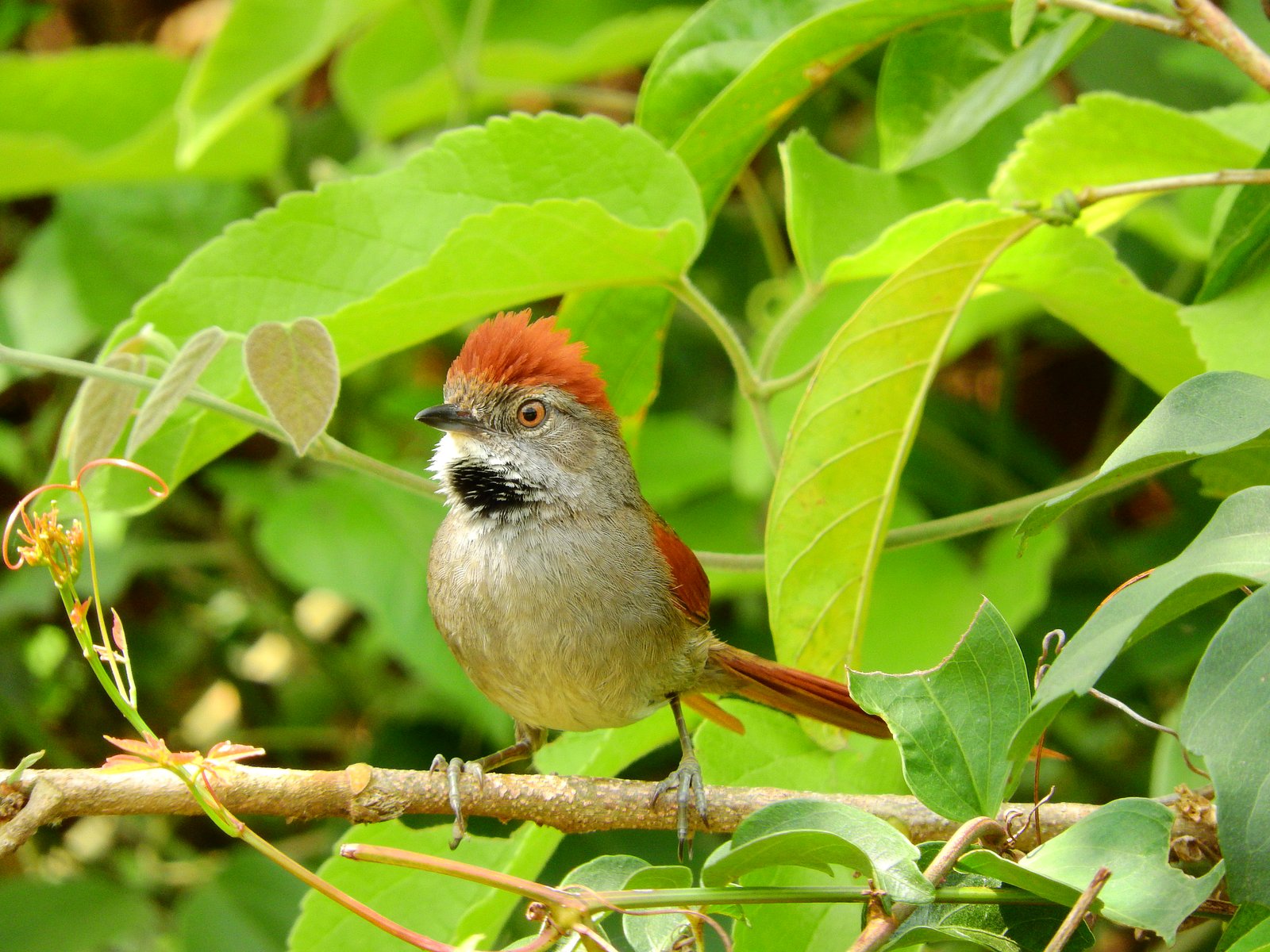
14–16 cm, with a long, graduated tail. The forehead is dark greyish brown, the hindcrown and nape dark rufous, with a thin brown eyestripe. The upperparts are brown with a rufous tinge; the wings and tail are rufous. The throat and breast are grey, the belly paler. The sexes are alike. Juveniles have a brownish-grey crown and an ochre wash below.
Confusion species
Azara's Spinetail Synallaxis azarae is very similar, but lives in the mountains, lacks the grey forehead and has an olive-brown back. Pale-breasted Spinetail Synallaxis albescens has a brown, not rufous, tail and a paler breast, and lives in open grassland. Cinereous-breasted Spinetail Synallaxis hypospodia has an entirely chestnut-rufous crown and a brown tail, and lives in wet savanna.
Habitat
Gallery forest, edges of shrubby and deciduous woodland, thorn scrub, open woodland and savanna with shrubs, in the lowlands and on the lower slopes. It usually forages less than 2 m above the ground for insects. The nest is a ball of twigs, usually up to 2.5 m high and sometimes up to 4 m.
Where the bird is most at home, classified by the vegetation units of the Andes and the west coast.


Range and movements
Absent from Colombia, Ecuador, Peru and the Galápagos. In Bolivia in the east and south: Santa Cruz, the Chaco and the dry valleys at the eastern foot of the Andes south to Tarija. Outside the guide area in eastern Brazil, Paraguay and northern Argentina.
- Resident
- dark = core range, pale = thinly spread
How and when to look
Search Chiquitano dry forest and scrub around Santa Cruz de la Sierra; listen for the two-note song from dense undergrowth along forest edges.
Conservation status
Least Concern. The species also lives in secondary growth and tolerates some disturbance.
Scientific name
Synallaxis frontalis | Pelzeln, 1859
Pelzeln described the species in 1859 and placed it straight away in the genus where it still stands. The genus Synallaxis was introduced in 1818 by Vieillot. The genus name comes from Ancient Greek sunallaxis, 'exchange'. The species name comes from Latin frons, 'forehead', for the dark forehead. The specimen the first description was based on came from Rio São Francisco, Bahia, Brazil.