All species › Passerines › Ovenbirds and woodcreepers › Azara's Spinetail
Azara's Spinetail | Synallaxis azarae
Azara's stekelstaart | Pijuí de Azara | João-de-azara
Azara's Spinetail is the spinetail of forest edges and shrubbery on the middle slopes of the Andes, from Colombia to Bolivia. Its sharp, two-note call sometimes goes on for minutes and is one of the most often heard bird sounds in this landscape. It is heard more than seen.
Voice
A sharp, nasal, two-note call, ket-kweeek, often repeated for minutes. Also scratchy, nasal prrt notes, kweek-kweek and a low, short chur.
Recording: Alain Verneau — CC BY-NC-SA 4.0 · xeno-canto
Identification
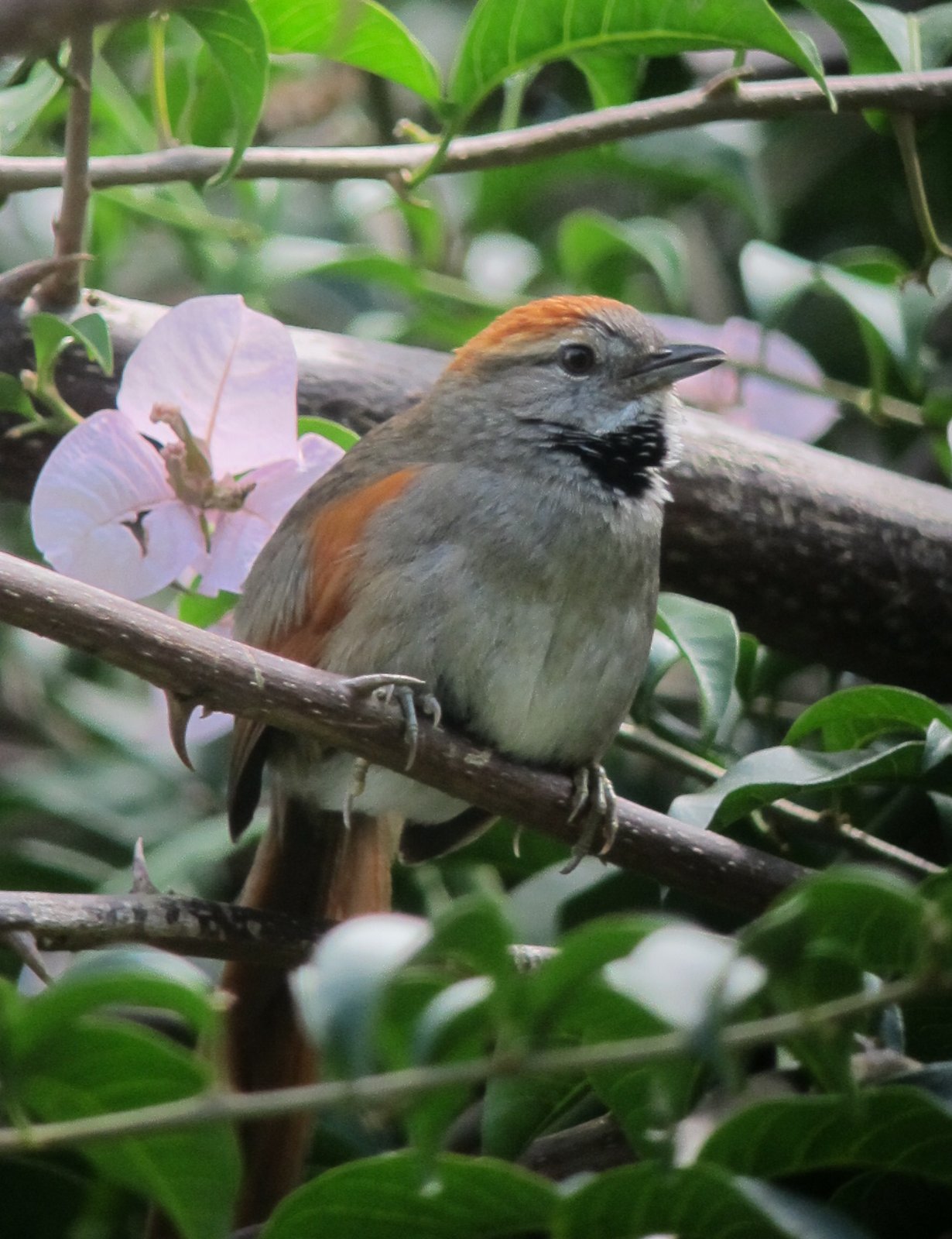
16–18 cm, with a long, graduated tail of pointed feathers. The crown and wings are rufous, the back olive-brown and the face grey. The throat has a dark patch with white flecks, the underparts are grey, paler on the belly. Tail colour and the pattern of head and underparts vary between the many subspecies: in the south the tail is dull chestnut, in Cusco darker and tinged olive-grey. The sexes are alike.
Confusion species
Apurimac Spinetail Synallaxis courseni, only in Apurímac in Peru, is larger and darker grey, with a longer, sooty-brown tail. Rufous Spinetail Synallaxis unirufa is uniformly rufous with black lores and lives in cloud forest. Silvery-throated Spinetail Synallaxis subpudica in the Eastern Andes of Colombia has a silvery-grey throat and a longer tail. Plain-crowned Spinetail Synallaxis gujanensis and Pale-breasted Spinetail Synallaxis albescens live in the lowlands and have a brown crown or a paler breast.
Habitat
Semi-open landscape in humid and drier mountains: forest edges, secondary forest, edges of cloud and elfin forest, bushy pastures, roadsides and thickets along streams; mostly between 1500 and 3500 m, in Ecuador locally down to 900 m and in southern Bolivia mainly lower. It stays low in dense vegetation, foraging for insects. The nest is a large ball of twigs with an entrance tube.
Where the bird is most at home, classified by the vegetation units of the Andes and the west coast.


Range and movements
In Colombia in all three cordilleras. In Ecuador on both slopes and in the valleys of the Andes, also in the south-west. In Peru along almost the entire length of the Andes, including the Marañón valley. In Bolivia along the Andes south to Tarija. Absent from the Galápagos. Outside the guide area in western Venezuela and north-western Argentina.
- Resident
- dark = core range, pale = thinly spread
How and when to look
Listen along roads and trails with shrubby forest edges at middle elevations in the Andes; the call repeated for minutes is often the first sign. Wait quietly by the vegetation; the bird sometimes comes briefly to the edge.
Conservation status
Least Concern. The species benefits from forest edges and secondary growth.
Scientific name
Synallaxis azarae | d'Orbigny, ACVMD, 1838
D'Orbigny, ACVMD described the species in 1838 and placed it straight away in the genus where it still stands. The genus Synallaxis was introduced in 1818 by Vieillot. The genus name comes from Ancient Greek sunallaxis, 'exchange'. The species name honours Félix de Azara (1742–1821), a Spanish military engineer and naturalist who described the birds of Paraguay and the Río de la Plata region. The specimen the first description was based on came from Carcuata, Yungas, Bolivia.