All species › Passerines › Ovenbirds and woodcreepers › Dark-winged Miner
Dark-winged Miner | Geositta saxicolina
Donkervleugelholengraver | Minero alioscuro | Curriqueiro-de-asa-escura
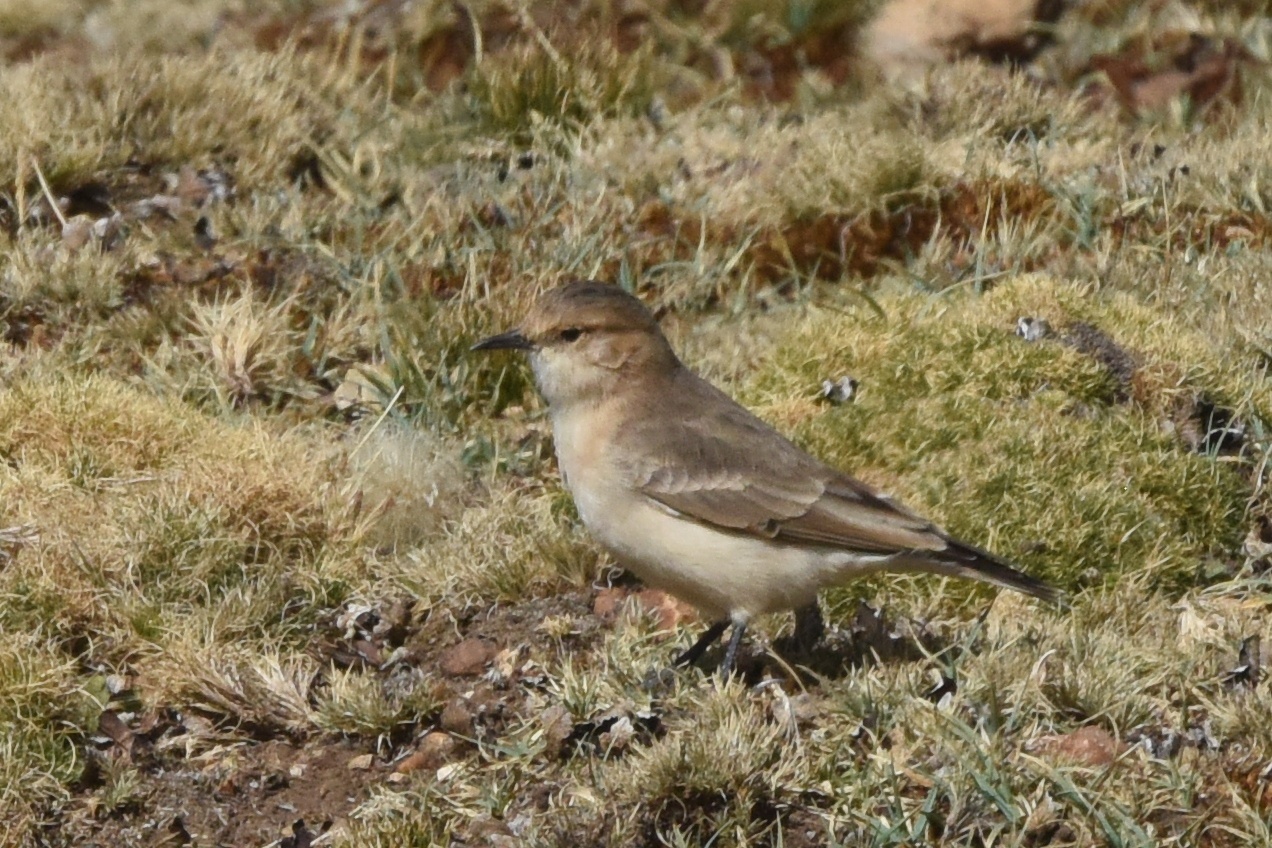
The Dark-winged Miner is a miner endemic to the high puna of central Peru. It lives higher than most of its relatives, on gently sloping grassland with stones up to nearly 5000 m. Its dark wings without a rufous patch separate it from the Common Miner in the same area.
Voice
Imperfectly known. A melodious song, chip notes, short rasping notes and a tirr tirr tirr in flight have been described.
Recording: Meena Haribal — CC BY-NC-SA 3.0 · xeno-canto
Identification
15–16 cm, with a short, black bill with a grey base to the lower mandible, and black legs. The forehead and face are buff, with a pinkish-buff supercilium. The crown and back are mid-brown, and the rump is pale buff. The underparts are buff to pinkish buff, unstreaked. The wings are dark, without a rufous patch; the central tail feathers are black. Juveniles are warmer buff, with dusky scaling on the breast. The sexes are alike.
Confusion species
Common Miner Geositta cunicularia (form juninensis) is paler and greyer, with a rufous wing patch and a paler, rufous tail base. Slender-billed Miner Geositta tenuirostris has a long, thin, decurved bill and rufous in the wings. Ground tyrants (Muscisaxicola) have a straight bill, longer legs and greyer underparts.
Habitat
High puna and altiplano of central Peru, especially gently sloping grassland with stony ground, between about 3700 and 4900 m. It forages on foot for insects. Little is known about its breeding; breeding has been recorded in December, presumably in a chamber at the end of a burrow in the ground.
Where the bird is most at home, classified by the vegetation units of the Andes and the west coast.


Range and movements
Endemic to Peru: in the Andes of the centre of the country, from Pasco to Huancavelica (including Junín and the Lima highlands). Absent from Colombia, Ecuador, Bolivia and the Galápagos.
- Resident
- dark = core range, pale = thinly spread
How and when to look
Look on stony puna grassland above 4000 m, for example around Lake Junín and on the high passes between Lima and Junín. The bird walks over open ground and among cushion plants.
Conservation status
Least Concern. The range is small, but the species is fairly common to common and numbers are considered stable.
Scientific name
Geositta saxicolina | Taczanowski, 1875
Taczanowski described the species in 1875 and placed it straight away in the genus where it still stands. The genus Geositta was introduced in 1837 by Swainson. The genus name combines Greek geō-, 'earth, ground', with Sitta, the nuthatch genus. The species name comes from Latin saxum, 'rock', and -cola, 'dweller': 'rock-dwelling'. The specimen the first description was based on came from Junín, Peru.