All species › Passerines › Ovenbirds and woodcreepers › Greyish Miner
Greyish Miner | Geositta maritima
Grijze holengraver | Minero gris | Curriqueiro-cinzento
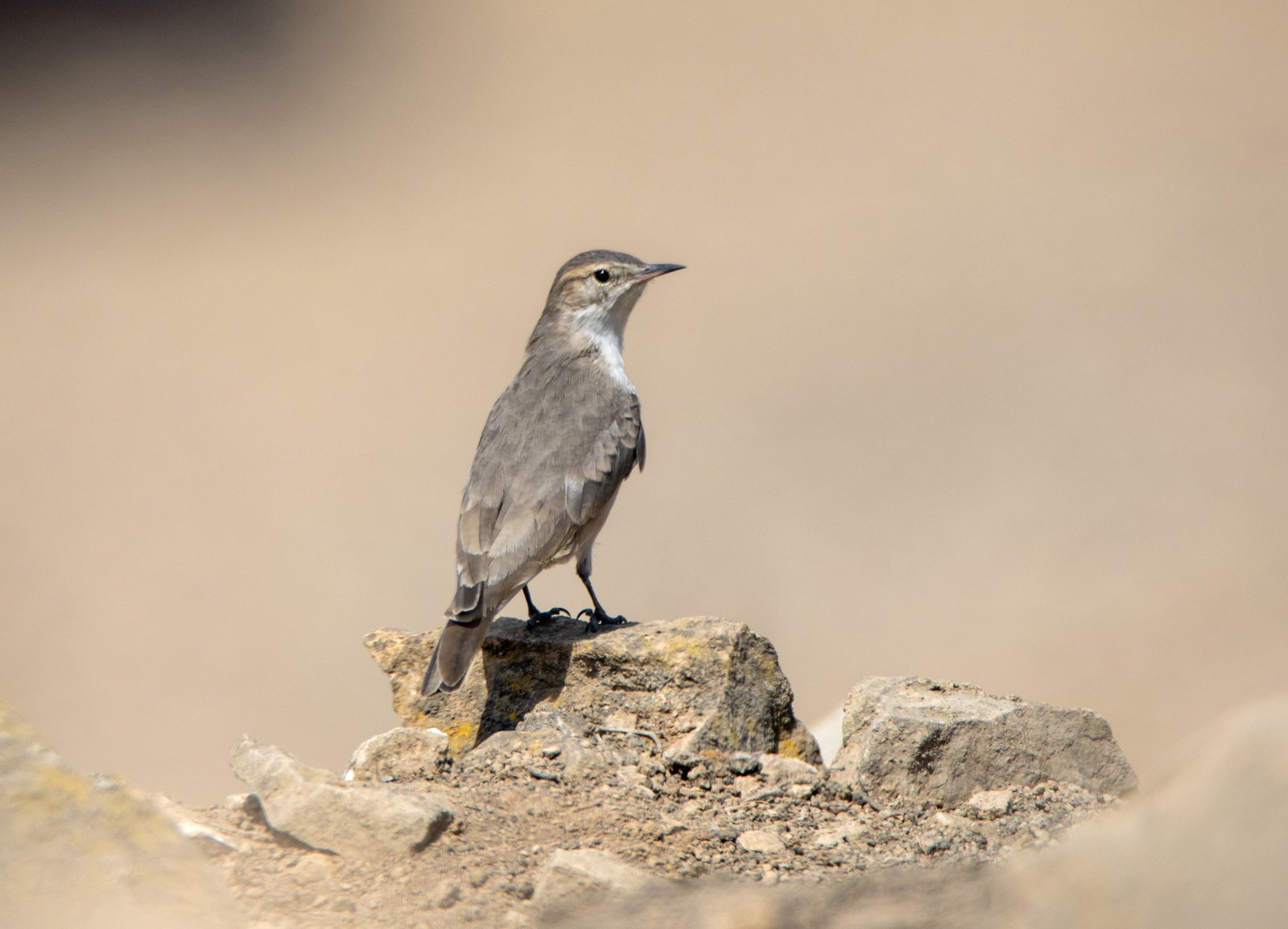
The Greyish Miner is a small, pale miner of the barest parts of the coastal desert of Peru and Chile. It lives in terrain of sand, gravel and rock with hardly any vegetation, where few other birds occur. Unlike most miners it has no rufous in the wings or tail.
Voice
The song is an unmusical te-cherrrr, sometimes followed by a run of ke notes. Calls include plyt-plyt, jyp, a rasping tch-trr and a short, somewhat squeaky kew.
Recording: Niels Krabbe — CC BY-NC-SA 3.0 · xeno-canto
Identification
12–14 cm, with a short, straight, slate-grey to black bill. The face and upperparts are pale greyish brown, with a faint creamy supercilium. The chin and throat are white, and the underparts creamy white with a pinkish-buff wash on the flanks. The wings and tail are greyish brown to dark, without a rufous patch. Juveniles are buffier. The sexes are alike.
Confusion species
Coastal Miner Geositta peruviana is warmer and sandier, with rufous in the wings and tail. Common Miner Geositta cunicularia is browner, with a streaked breast and a rufous wing patch. Ground tyrants (Muscisaxicola) are slimmer, with longer legs and a black tail.
Habitat
Extremely arid, almost unvegetated desert with sand, gravel or rock, mainly in the coastal zone and on the lower western slope; in Peru mostly below 2450 m, rarely up to 3500 m. It forages on foot for insects and other small invertebrates. Only one nest is known; like related species it presumably nests in a chamber at the end of a burrow.
Where the bird is most at home, classified by the vegetation units of the Andes and the west coast.


Range and movements
In Peru in a narrow band along the coast and on the lower western slope, from Ancash south to the Chilean border. Absent from Colombia, Ecuador, Bolivia and the Galápagos. Outside the guide area in northern Chile, south to the Atacama Region.
- Resident
- dark = core range, pale = thinly spread
How and when to look
Look in bare, stony desert along the coastal highway in southern Peru and on the lowest slopes of the western Andes. The bird is as grey as the ground; watch for movement over the bare soil.
Conservation status
Least Concern. The range is fairly large and numbers are considered stable; no direct threats are known.
Scientific name
Geositta maritima | (d'Orbigny, ACVMD & de Lafresnaye, 1837)
D'Orbigny, ACVMD & de Lafresnaye described the species in 1837 as Certhilauda maritima; because it was later moved to another genus, the author and year stand in brackets. The genus Geositta was introduced in 1837 by Swainson. The genus name combines Greek geō-, 'earth, ground', with Sitta, the nuthatch genus. The species name comes from Latin maritimus, 'of the sea, coastal'. The specimen the first description was based on came from Cobija, Antofagasta, Chile.