All species › Passerines › Ovenbirds and woodcreepers › Rufous-banded Miner
Rufous-banded Miner | Geositta rufipennis
Roodbandholengraver | Minero rojizo | Curriqueiro-de-faixa-ruiva
The Rufous-banded Miner is a fairly large, grey miner of dry mountain slopes in the southern Andes. Its name refers to the broad rufous band visible across the wing in flight. In the guide area it lives only in Bolivia.
Voice
The song is a rapid series of buzzy, trilled notes on one pitch, sometimes with faster bursts, given from a boulder or in display flight.
Recording: ignacio escobar — CC BY-NC-SA 4.0 · xeno-canto
Identification
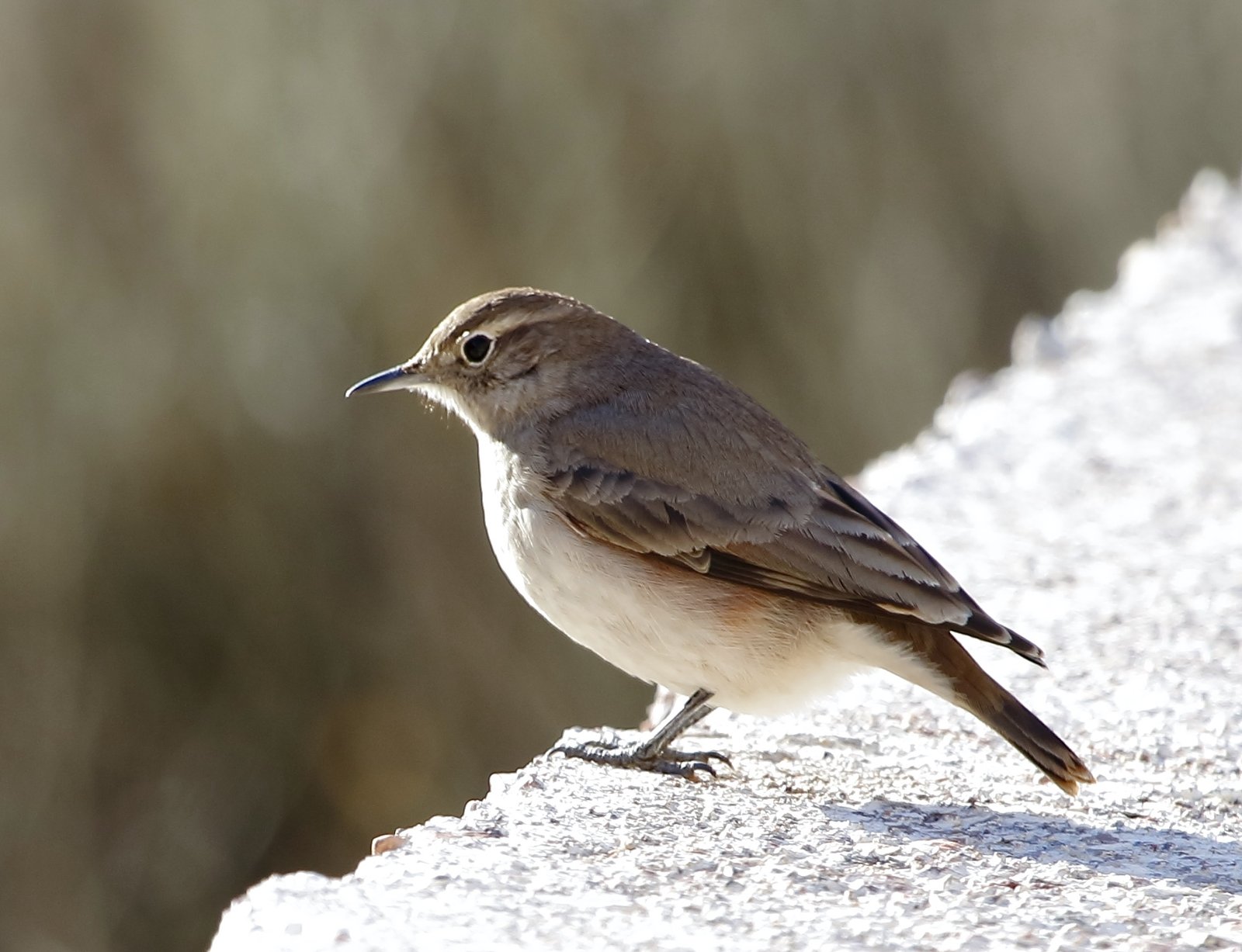
15–17 cm, with a fairly short, slightly decurved, blackish-grey bill and blue-grey legs. The face is brownish grey with a pale supercilium, and the upperparts are dull sandy to greyish olive. The throat is whitish and the breast pale buff and unstreaked. In flight it shows a broad rufous band across the flight feathers and a tail with a rufous base and dark terminal band. The sexes are alike.
Confusion species
Common Miner Geositta cunicularia is smaller and browner, with a streaked breast. Puna Miner Geositta punensis is smaller and paler. Slender-billed Miner Geositta tenuirostris has a long, thin, decurved bill. Ground tyrants (Muscisaxicola) have a straight, thin bill and no rufous in the wing.
Habitat
Dry, rocky slopes, arid montane scrub, puna grassland, flats with scattered vegetation and dry riverbeds, in Bolivia roughly between 3100 and 4400 m. It forages on foot for insects. The nest is in a chamber at the end of a tunnel in an earthen bank or slope, sometimes in a rock crevice; the clutch is two or three eggs, laid in the austral summer.
Where the bird is most at home, classified by the vegetation units of the Andes and the west coast.


Range and movements
In Bolivia in the Andes of the west and southwest of the country. Absent from Colombia, Ecuador, Peru and the Galápagos. Outside the guide area in Chile and Argentina, south to Patagonia.
- Resident
- dark = core range, pale = thinly spread
How and when to look
Look on dry, stony slopes and in dry riverbeds in the highlands of south-western Bolivia. In flight, watch for the rufous wing band.
Conservation status
Least Concern. Numbers are unknown and thought to be declining slowly, but the species is fairly common; overgrazing is a local problem.
Scientific name
Geositta rufipennis | (Burmeister, 1860)
Burmeister described the species in 1860 as Geobamon rufipennis; because it was later moved to another genus, the author and year stand in brackets. The genus Geositta was introduced in 1837 by Swainson. The genus name combines Greek geō-, 'earth, ground', with Sitta, the nuthatch genus. The species name comes from Latin rufus, 'rufous', and penna, 'feather, wing': 'rufous-winged'. The specimen the first description was based on came from Sierra de Tucumán, Argentina.