All species › Passerines › Ovenbirds and woodcreepers › Thick-billed Miner
Thick-billed Miner | Geositta crassirostris
Diksnavelholengraver | Minero piquigrueso | Curriqueiro-de-bico-grosso
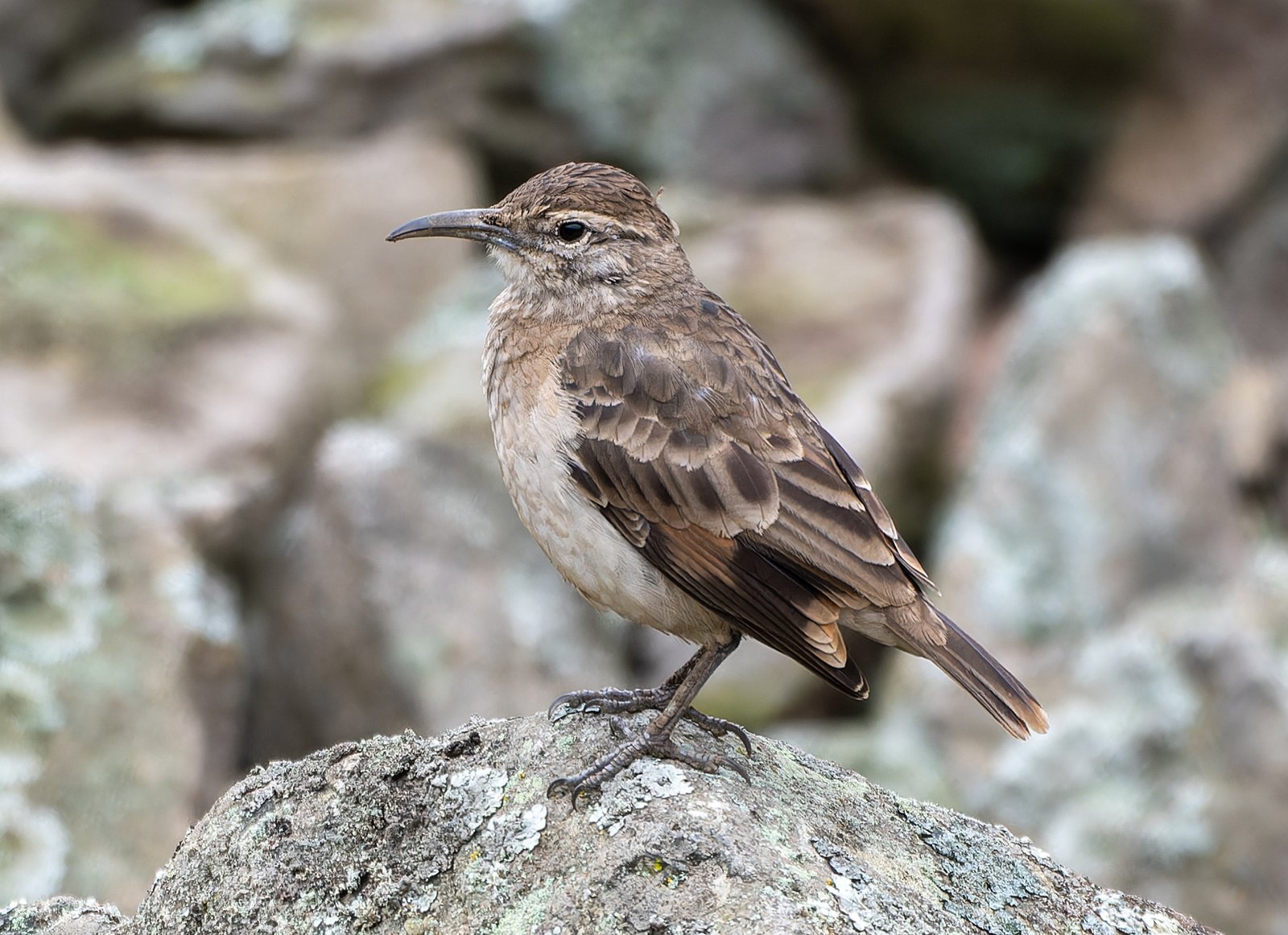
The Thick-billed Miner is the largest miner and is endemic to Peru. It lives on dry, rocky slopes with cacti on the western slope of the Andes and in the lomas, the fog hills of the coastal desert. Its heavy, decurved bill separates it from all other miners.
Voice
The song is a forceful, accelerating series of cueew notes that can turn harsher. The call is a mewing note that first rises and then falls.
Recording: Nick Athanas — CC BY-NC-SA 3.0 · xeno-canto
Identification
18–19 cm, with a heavy, decurved bill: the upper mandible dark, the lower blue-grey. The upperparts are brown to greyish brown, and the face pale with a creamy supercilium. The underparts are pale buff. The flight feathers and tail are largely rufous, showing in flight as a broad rufous wing patch and tail. The sexes are alike.
Confusion species
Common Miner Geositta cunicularia is much smaller, with a short, thin bill and a streaked breast. Greyish Miner Geositta maritima is small and grey, without rufous in the wings. White-throated Earthcreeper Upucerthia albigula has a longer, thinner, more strongly decurved bill, a longer tail that is often cocked, and a white throat.
Habitat
Dry, rocky slopes with scattered shrubs and columnar cacti on the western slope of the Andes, roughly between 1900 and 3550 m, and the lomas and coastal hills between about 300 and 800 m. It forages on the ground and among rocks for insects and other invertebrates. Little is known about its breeding; like other miners it presumably nests in a burrow in the ground.
Where the bird is most at home, classified by the vegetation units of the Andes and the west coast.


Range and movements
Endemic to Peru: on the western slope of the Andes and in the coastal hills from the centre of the country (including Lima department) south to the southwest. Absent from Colombia, Ecuador, Bolivia and the Galápagos.
- Resident
- dark = core range, pale = thinly spread
How and when to look
Look in the lomas north of Lima, such as Lomas de Lachay, and on cactus slopes along the roads climbing from the coast up the western slope. The bird often walks among boulders and sings from a rock or cactus.
Conservation status
Least Concern. Numbers are unknown and thought to be declining, but no direct threats are known; the lomas are locally under pressure from grazing and building.
Scientific name
Geositta crassirostris | Sclater, 1866
Sclater described the species in 1866 and placed it straight away in the genus where it still stands. The genus Geositta was introduced in 1837 by Swainson. The genus name combines Greek geō-, 'earth, ground', with Sitta, the nuthatch genus. The species name comes from Latin crassus, 'thick', and rostrum, 'bill': 'thick-billed'. The specimen the first description was based on came from Lima, Peru.