All species › Passerines › Ovenbirds and woodcreepers › Campo Miner
Campo Miner | Geositta poeciloptera
Camposholengraver | Minero brasileño | Andarilho
The Campo Miner is the smallest miner and the only one that lives in the cerrado of central South America. It is tied to short, open grassland and seeks out recently burned patches. In the guide area it occurs only very locally in the far east of Bolivia.
Voice
The song, given in display flight high above the grassland, is a high, rolling, hurried series of notes lasting fifteen to twenty seconds. The flight call is a short pit-pit.
Recording: Luiz Fernando Matos — CC BY-NC-SA 4.0 · xeno-canto
Identification
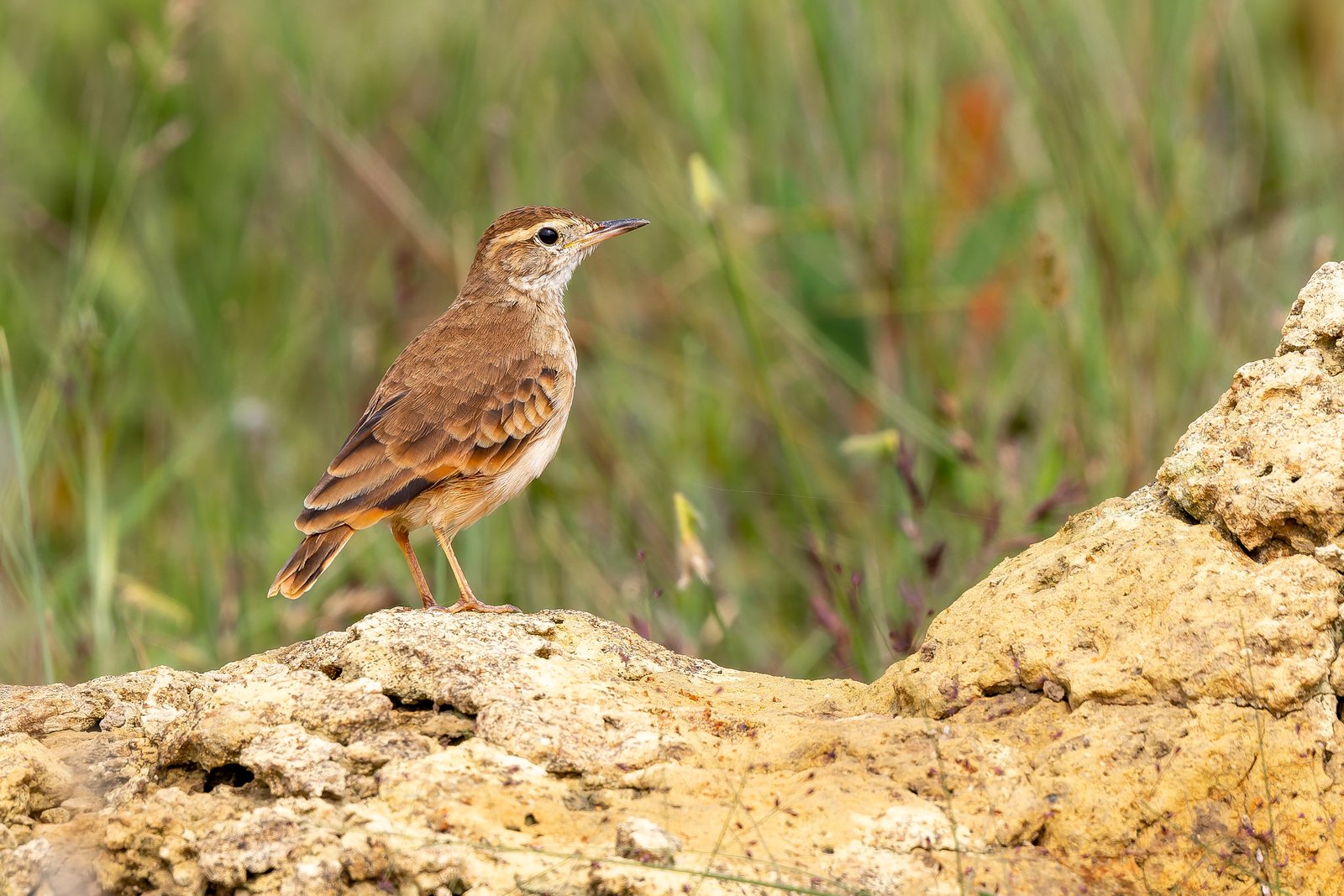
11–12 cm, compact, with a short tail and a short, slightly decurved bill. The upperparts are dull greyish brown, and the face rufous-brown with a buffy supercilium. The throat is whitish, the upper breast buff with brown flecks and the flanks pale rufous. In flight it shows a chestnut-rufous band across the wing; the tail is rufous with a dark terminal band. The sexes are alike.
Confusion species
Pipits (Anthus) in the same grassland are slimmer, with a thin, straight bill, more heavily streaked upperparts and whitish outer tail feathers. No other miners occur in the cerrado.
Habitat
Open, short grassland (campo limpo) and cerrado with few or no trees, preferably shortly after a fire; in Brazil between about 500 and 1250 m. It forages on foot for insects on bare ground. The few known nests were in a side chamber of an armadillo burrow, lined with dry grass and hair; breeding takes place at least in September and October.
Where the bird is most at home, classified by the vegetation units of the Andes and the west coast.

Range and movements
In Bolivia only in north-eastern Santa Cruz, in the cerrado along the Brazilian border. Absent from Colombia, Ecuador, Peru and the Galápagos. Outside the guide area in southern and central Brazil, from Mato Grosso to Bahia and Paraná; a vagrant to Paraguay.
How and when to look
In the guide area, look in open, short cerrado grassland in north-eastern Santa Cruz, especially on recently burned flats. Watch for the display flight with its long, rolling song.
Conservation status
Vulnerable. Numbers are thought to be declining rapidly as cerrado grassland is converted to cropland, cattle pasture and plantations of non-native trees, and the species depends on a regular fire regime.
Scientific name
Geositta poeciloptera | (Wied-Neuwied, 1830)
Wied-Neuwied described the species in 1830 as Anthus poecilopterus; because it was later moved to another genus, the author and year stand in brackets. The genus Geositta was introduced in 1837 by Swainson. The genus name combines Greek geō-, 'earth, ground', with Sitta, the nuthatch genus. The species name comes from Greek poikilos, 'variegated', and pteron, 'wing': 'variegated-winged'. The specimen the first description was based on came from Minas Gerais–Bahia border, Brazil.