All species › Passerines › Ovenbirds and woodcreepers › Puna Miner
Puna Miner | Geositta punensis
Punaholengraver | Minero puneño | Curriqueiro-da-puna
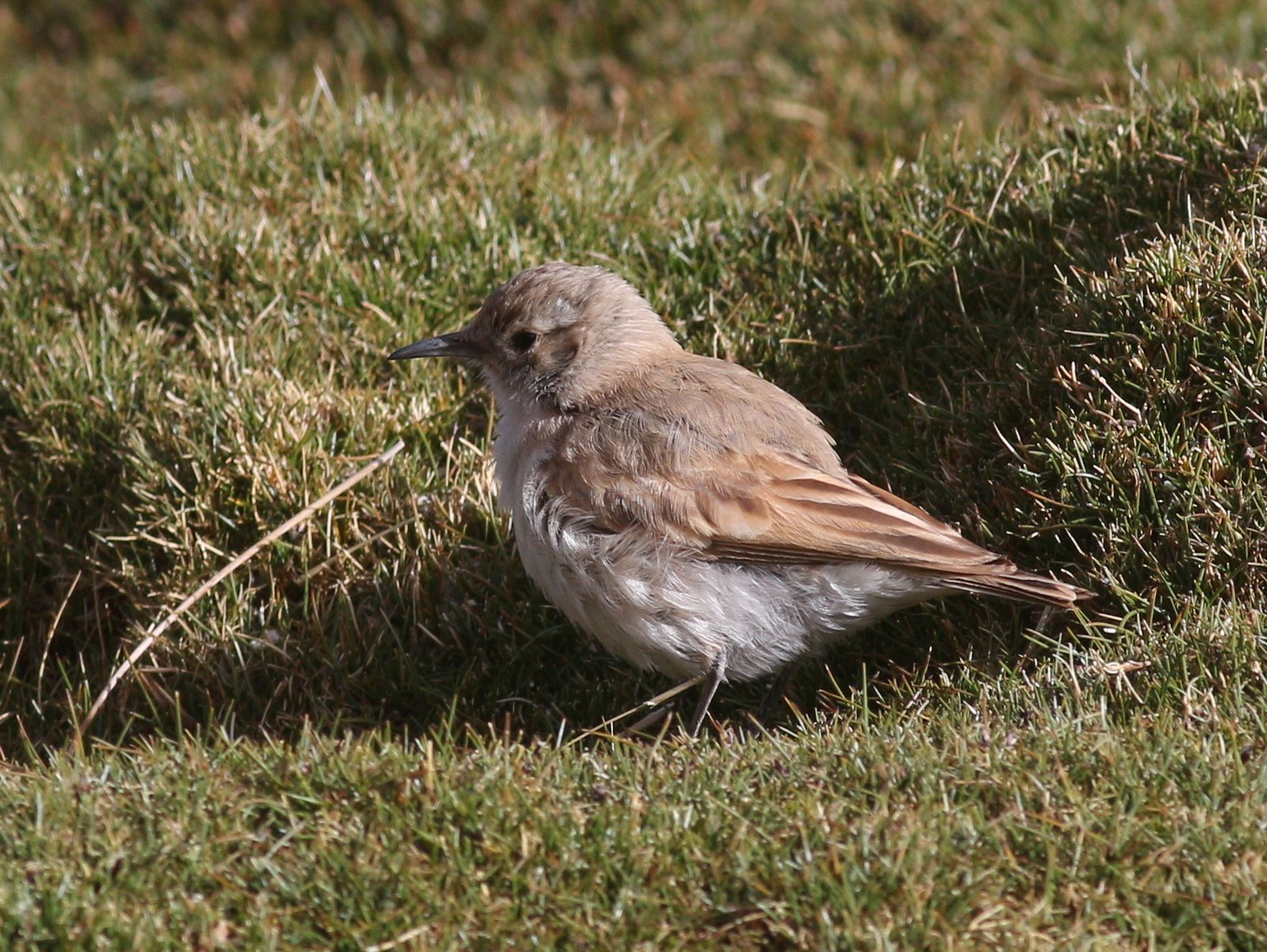
The Puna Miner is a small, pale miner of the driest and barest parts of the altiplano. It resembles a pale, unstreaked Common Miner and runs quickly among grass tussocks, stones and bare sandy flats. It often nests in the abandoned burrows of tuco-tucos, burrowing rodents.
Voice
The song, given in display flight, is a shrill series of rising and falling notes with faster, chattering passages. The call is a short, sharp, rich note.
Recording: Niels Krabbe — CC BY-NC-SA 4.0 · xeno-canto
Identification
13–14 cm, with a short, slightly decurved, blackish bill with a blue-grey base. The upperparts are pale sandy brown, and the face greyish brown with a buffy supercilium. The underparts are pale buffy white, unstreaked, with a tawny wash on the flanks. In flight the wings and tail show a rufous base; the tail has a dark terminal band. The sexes are alike.
Confusion species
Common Miner Geositta cunicularia is slightly larger and darker, with a streaked or spotted breast. Rufous-banded Miner Geositta rufipennis is larger and greyer, with a heavier bill. Slender-billed Miner Geositta tenuirostris has a long, thin, decurved bill. Ground tyrants (Muscisaxicola) have a straight bill and a black tail.
Habitat
Dry puna and altiplano with bare, sandy or stony flats and scattered grass tussocks, also the edges of salt flats and open slopes above shrubby ravines; mostly between 3200 and 4600 m, locally up to 5000 m. It forages on foot for insects. It breeds from about October to January, usually in tuco-tuco burrows in dry, sandy soil; the clutch is two or three eggs.
Where the bird is most at home, classified by the vegetation units of the Andes and the west coast.


Range and movements
In Peru only in the far south, on the altiplano of Puno, Moquegua and Tacna. In Bolivia on the altiplano in the west of the country. Absent from Colombia, Ecuador and the Galápagos. Outside the guide area in northern Chile and north-western Argentina.
- Resident
- dark = core range, pale = thinly spread
How and when to look
Look on the barest, sandy flats of the altiplano, for example around salt flats and along roads in south-western Bolivia. The bird is uncommon to locally fairly common and often runs off rather than flushing.
Conservation status
Least Concern. The range is large and numbers are considered stable; the species coexists with extensive grazing on the altiplano.
Scientific name
Geositta punensis | Dabbene, 1917
Dabbene described the species in 1917 and placed it straight away in the genus where it still stands. The genus Geositta was introduced in 1837 by Swainson. The genus name combines Greek geō-, 'earth, ground', with Sitta, the nuthatch genus. The species name refers to the puna, the high grassland of the central Andes. The specimen the first description was based on came from La Quiaca, Jujuy, Argentina.