All species › Passerines › Tanagers and allies › Dotted Tanager
Dotted Tanager | Ixothraupis varia
Stippentangare | Tangara manchada | Saíra-carijó
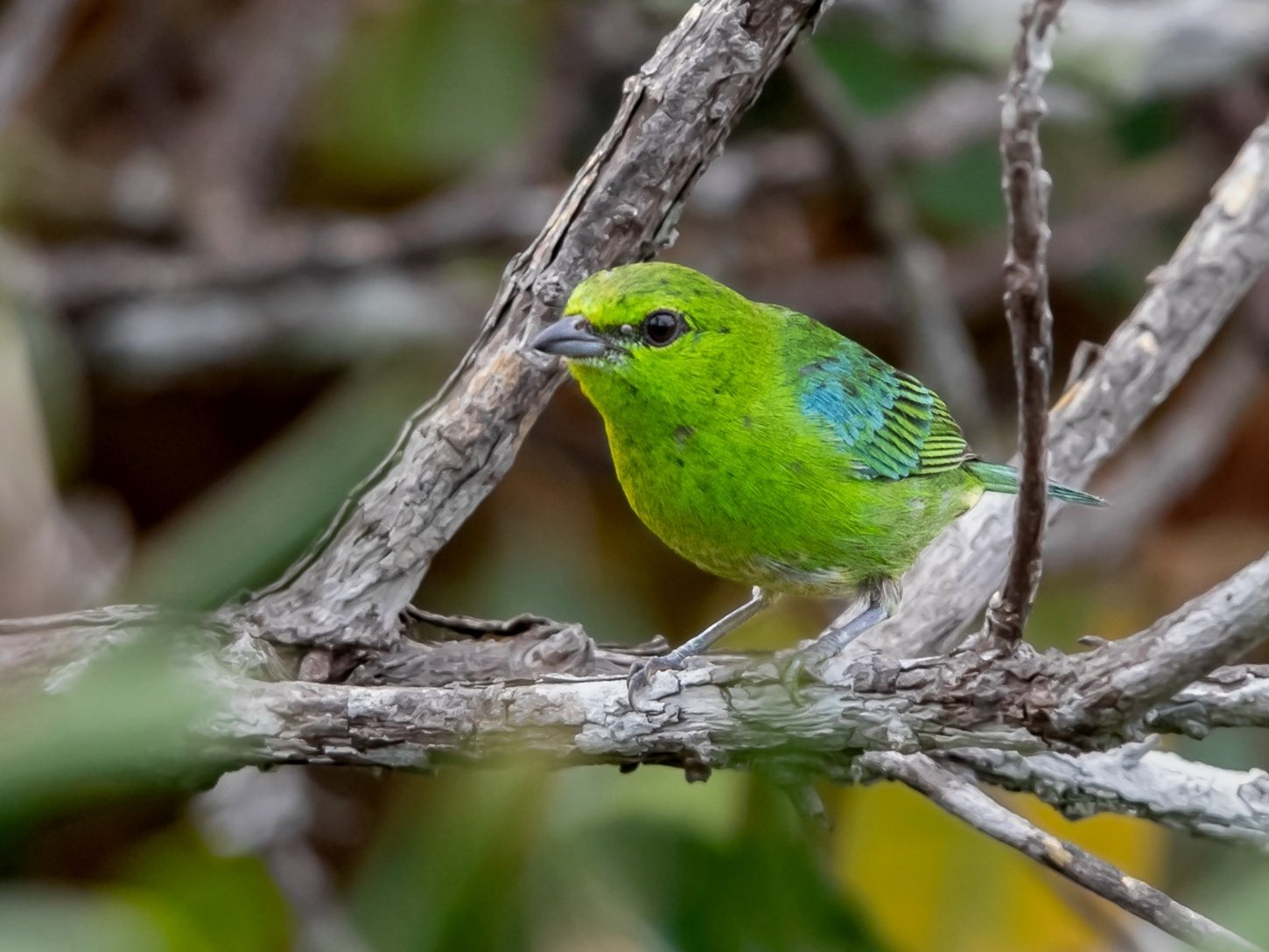
The Dotted Tanager is a small, green tanager with fine black dots of northeastern Amazonia and the Guianas. It lives in the canopy of lowland forest, often on nutrient-poor sandy soils, and travels with mixed flocks; in the guide area it occurs only at the far eastern edge and is rare and local.
Voice
Fairly quiet. Gives thin, high tsit notes, similar to those of related tanagers.
Recording: JAYRSON ARAUJO DE OLIVEIRA — CC BY-NC-SA 4.0 · xeno-canto
Identification
11 cm, with a short, dark bill. The plumage is bright green, with small black dots on head, back and breast that are finer and sparser on the underparts. The wing coverts and flight feathers have blue edges. No clear eye-ring. The female is slightly duller and less dotted. Juveniles are plainer green.
Confusion species
Yellow-bellied Tanager Ixothraupis xanthogastra is larger, with coarser black spots and a yellow belly. Spotted Tanager Ixothraupis punctata has larger black spots, a whitish belly and a yellowish tinge on the head. Speckled Tanager Ixothraupis guttata has yellow lores and white, black-spotted underparts and in the guide area occurs mainly in Colombia.
Habitat
Canopy and edges of humid lowland forest, especially forest and scrubby woodland on nutrient-poor white-sand soils, also edges of clearings, mostly below about 500 m. It forages in pairs or alone with mixed flocks for small fruit and insects on leaves and thin twigs.
Where the bird is most at home, classified by the vegetation units of the Andes and the west coast.


Range and movements
In Colombia very locally in eastern Amazonia, near the borders with Venezuela and Brazil. In Peru only a few records in the northeast. Does not occur in Ecuador, Bolivia or on the Galápagos. Outside the guide area in southern Venezuela, the Guianas and northern Amazonian Brazil.
- Resident
- dark = core range, pale = thinly spread
How and when to look
Search mixed flocks in the canopy of white-sand forest in eastern Colombian Amazonia; the birds are small, green and stay high, and are often noticed only by their dots and blue wing edges.
Conservation status
Least Concern. Generally scarce and local; its habitat is still largely intact.
Scientific name
Ixothraupis varia | (Müller, 1776)
Müller described the species in 1776 as Tanagra varia; because it was later moved to another genus, the author and year stand in brackets. The genus Ixothraupis was introduced in 1851 by Bonaparte. The genus name combines Greek ixos, 'mistletoe', with thraupis, an unidentified small bird. The species name comes from Latin varius, 'variegated, varied'. The specimen the first description was based on came from Cayenne, French Guiana.