All species › Passerines › Tanagers and allies › Chestnut-bellied Mountain Tanager
Chestnut-bellied Mountain Tanager | Dubusia castaneoventris
Bruinbuikbergtangare | Tangara montana ventricastaña | Sanhaço-montanhês-de-barriga-castanha
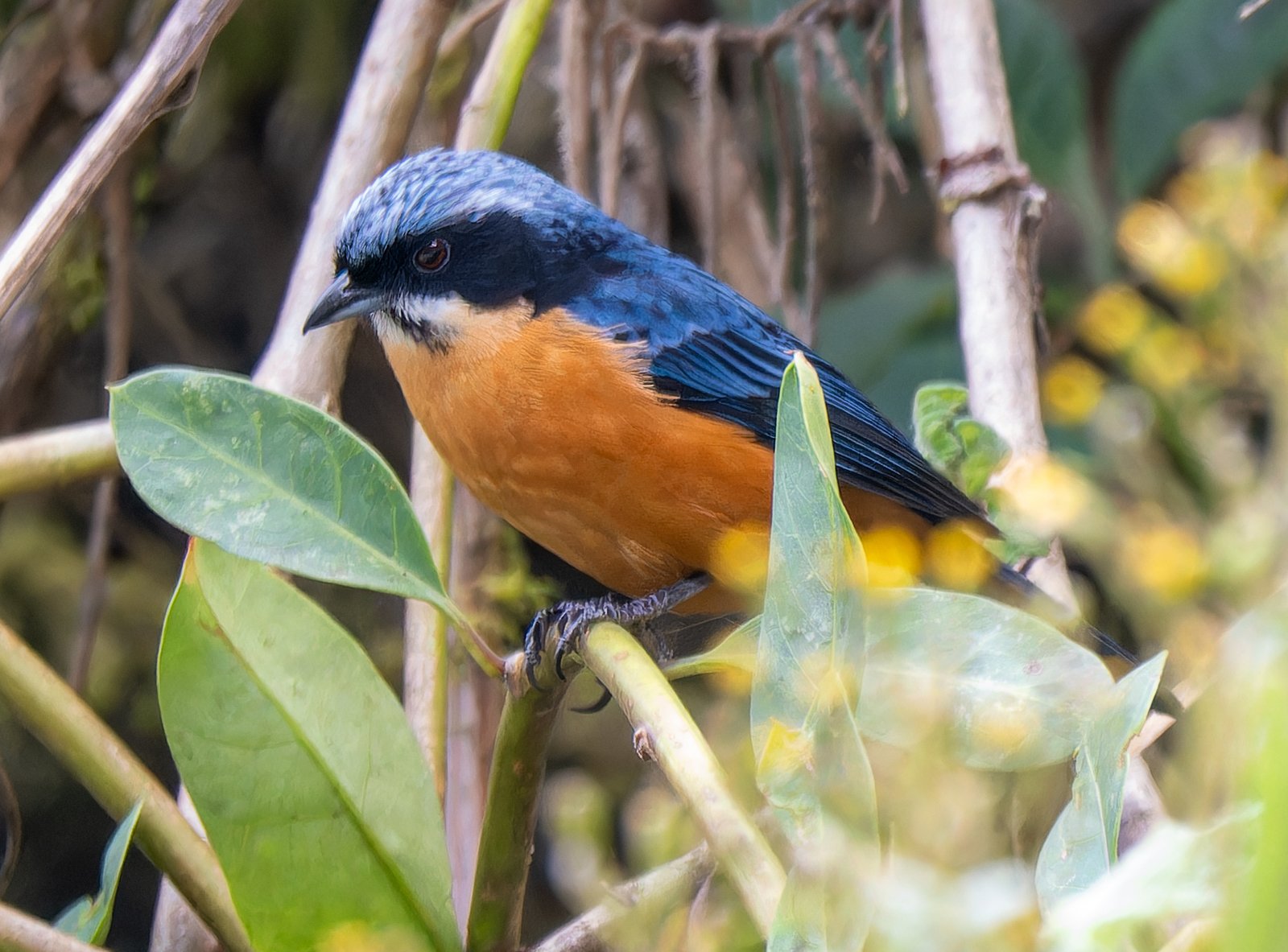
The Chestnut-bellied Mountain Tanager is a small mountain tanager of cloud forest on the eastern slope of the Andes in Peru and Bolivia, dark blue above with a blackish face, a pale blue moustachial stripe and chestnut underparts. It searches mossy branches thoroughly for insects and travels with mixed flocks.
Voice
Gives high, thin tsit notes; the song is a rapid series of high notes.
Recording: Jacob Wijpkema — CC BY-NC-SA 4.0 · xeno-canto
Identification
16 cm, with a short, pointed bill. The upperparts are dark indigo blue, with paler blue lesser wing coverts. The face and sides of the throat are blackish, with a short, pale blue moustachial stripe below the cheek. The underparts are plain chestnut to rufous. The sexes are alike. Juveniles are duller and browner above.
Confusion species
Golden-collared Tanager Iridosornis jelskii also has chestnut underparts, but has a yellow band across the hindcrown and no blue moustachial stripe. Blue-backed Conebill Conirostrum sitticolor is smaller, with a black head and throat and a fine, pointed bill. Rusty Flowerpiercer Diglossa sittoides has rufous underparts, but a grey-blue back without a black face and a hooked bill.
Habitat
Humid cloud forest and upper montane forest, elfin forest and forest edges up to the tree line, mostly from about 2400 to 3400 m. It searches mossy branches and leaves at mid-height to low for insects, often in mixed flocks with brushfinches, hemispinguses and tanagers. Little is known about the nest.
Where the bird is most at home, classified by the vegetation units of the Andes and the west coast.


Range and movements
Does not occur in Colombia, Ecuador or on the Galápagos. In Peru on the eastern slope of the Andes from the north, south of the Marañón, to Puno in the south-east. In Bolivia on the eastern slope in La Paz and Cochabamba. Not known outside the guide area.
- Resident
- dark = core range, pale = thinly spread
How and when to look
Search mixed flocks in cloud forest on the eastern slope, for example along the Manu road in Cusco and in the Yungas above La Paz; look for a small blue bird with a chestnut belly searching along mossy branches.
Conservation status
Least Concern. Fairly common in suitable forest; sensitive to deforestation on the eastern slope.
Scientific name
Dubusia castaneoventris | (Sclater, 1851)
Sclater described the species in 1851 as Calliste castaneoventris; because it was later moved to another genus, the author and year stand in brackets. The genus Dubusia was introduced in 1850 by Bonaparte. The genus name honours the Belgian politician and ornithologist Bernard du Bus de Gisignies (1808–1874). The species name comes from Latin castaneus, 'chestnut', and venter, 'belly': chestnut-bellied. The specimen the first description was based on came from Bolivia.