All species › Passerines › Tanagers and allies › Buff-banded Mountain Tanager
Buff-banded Mountain Tanager | Dubusia taeniata
Zilverbrauwbergtangare | Tangara montana pechianteada | Sanhaço-montanhês-de-faixa-ocre
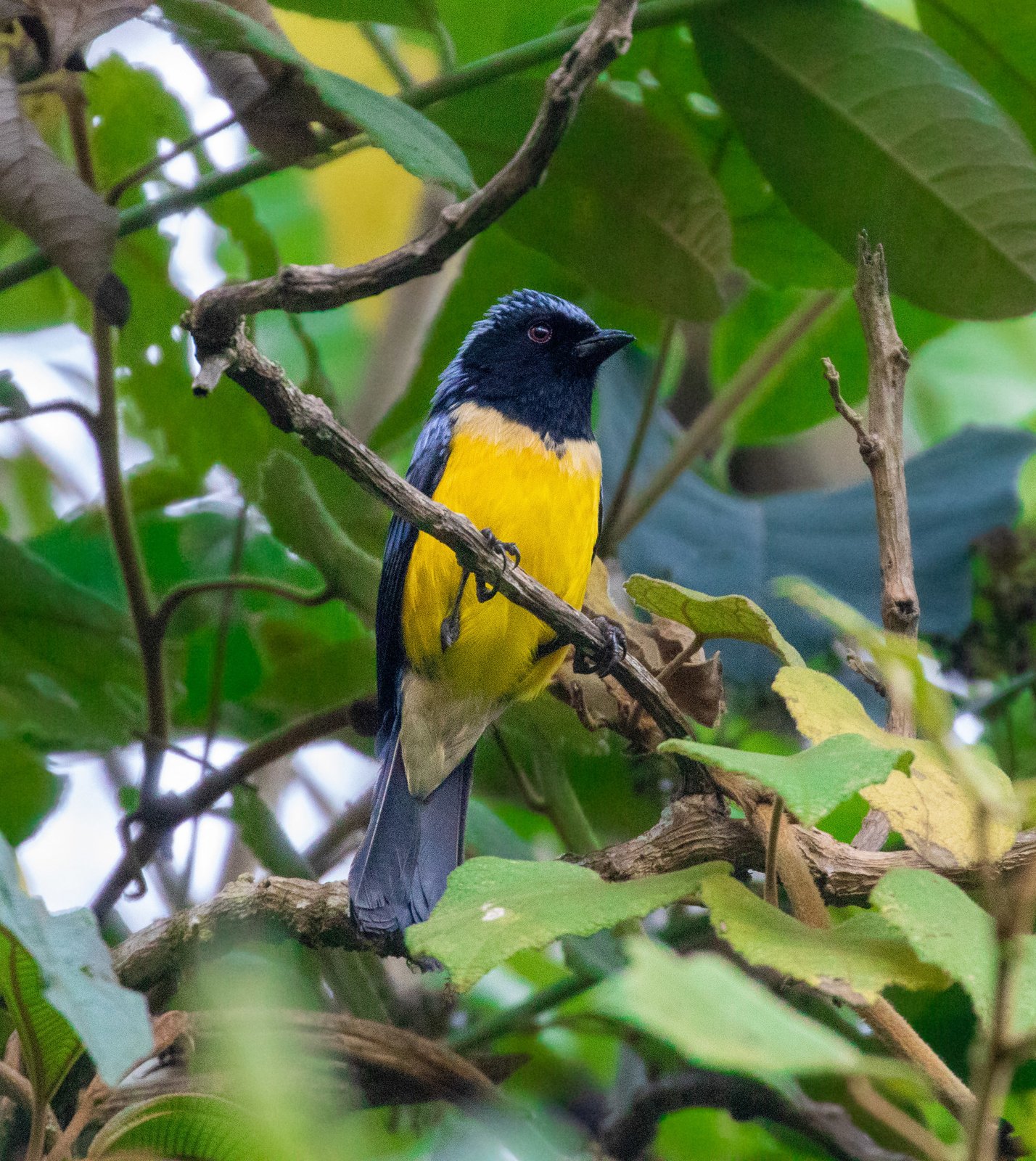
The Buff-banded Mountain Tanager is a mountain tanager of the highest montane forest in the northern Andes, with a black head and throat, a long silvery-blue eyebrow and yellow underparts with a buff band across the breast. It usually lives alone or in pairs in the understorey and often gives a clear, two-noted whistle.
Voice
The song is a clear, somewhat plaintive two-part whistle, feeee-bay, the second note lower; also short, hard calls.
Recording: Daan van der Hoeven — CC BY-NC-SA 4.0 · xeno-canto
Identification
20 cm. Head, throat and upper breast are black, with a long, silvery pale blue, faintly streaked eyebrow from above the eye to the nape. The upperparts are dark blue, with paler blue lesser wing coverts. Below the black throat a buff band crosses the breast; the rest of the underparts is yellow, the undertail coverts buff-brown. The sexes are alike. Juveniles are duller, with a less distinct eyebrow.
Confusion species
Hooded Mountain Tanager Buthraupis montana is much larger, with a red iris, a blue back and no pale eyebrow. Blue-winged Mountain Tanager Anisognathus somptuosus has a yellow crown patch, no pale eyebrow and no buff breast band. Lacrimose Mountain Tanager Anisognathus lacrymosus has yellow spots near the eye and is ochre-yellow below without a black throat. South of the Marañón in Peru lives the related Dubusia stictocephala, with a streaked crown, which was formerly included in this species.
Habitat
Humid upper montane forest, cloud forest, elfin forest and shrubbery at the tree line, often with Chusquea bamboo, mostly from about 2500 to 3600 m. It searches low to mid-height in dense vegetation for insects and also eats berries; it sometimes joins mixed flocks. Little is known about the nest.
Where the bird is most at home, classified by the vegetation units of the Andes and the west coast.


Range and movements
In Colombia in the three Andean ranges, but not in the Sierra Nevada de Santa Marta or the Sierra de Perijá, where the related Dubusia carrikeri lives. In Ecuador on both slopes of the Andes. In Peru only in the far north, north and west of the Marañón. Does not occur in Bolivia or on the Galápagos. Outside the guide area in the Andes of western Venezuela.
- Resident
- dark = core range, pale = thinly spread
How and when to look
Listen at the tree line for the two-noted whistle, for example in Ecuador along the Papallacta Pass and at Yanacocha and in Colombia at Chingaza and Los Nevados; the bird often sings from dense cover and then shows briefly on a branch.
Conservation status
Least Concern. Rather scarce but widespread in high-elevation forest; sensitive to deforestation and fires at the tree line.
Scientific name
Dubusia taeniata | (Boissonneau, 1840)
Boissonneau described the species in 1840 as Tanagra (Tachyphonus) taeniata; because it was later moved to another genus, the author and year stand in brackets. The genus Dubusia was introduced in 1850 by Bonaparte. The genus name honours the Belgian politician and ornithologist Bernard du Bus de Gisignies (1808–1874). The species name comes from Latin taeniatus, 'banded', from Greek tainia, 'band, ribbon', after the pale breast band. The specimen the first description was based on came from Bogotá, Colombia.