All species › Passerines › Tanagers and allies › Little Inca Finch
Little Inca Finch | Incaspiza watkinsi
Kleine incagors | Incaspiza chico | Tico-tico-inca-pequeno
The Little Inca Finch is the smallest inca finch and lives lower than the other species, in the hot, dry middle Marañón valley of northern Peru. It differs from its relatives in its brown, black-streaked back. Its small range lies in a valley where much of the dry scrub has given way to farming.
Voice
The song is a high, thin, rather weak series of notes, sometimes with a short trill. The call is a thin tseet.
Recording: Jerome Fischer — CC BY-NC-SA 4.0 · xeno-canto
Identification
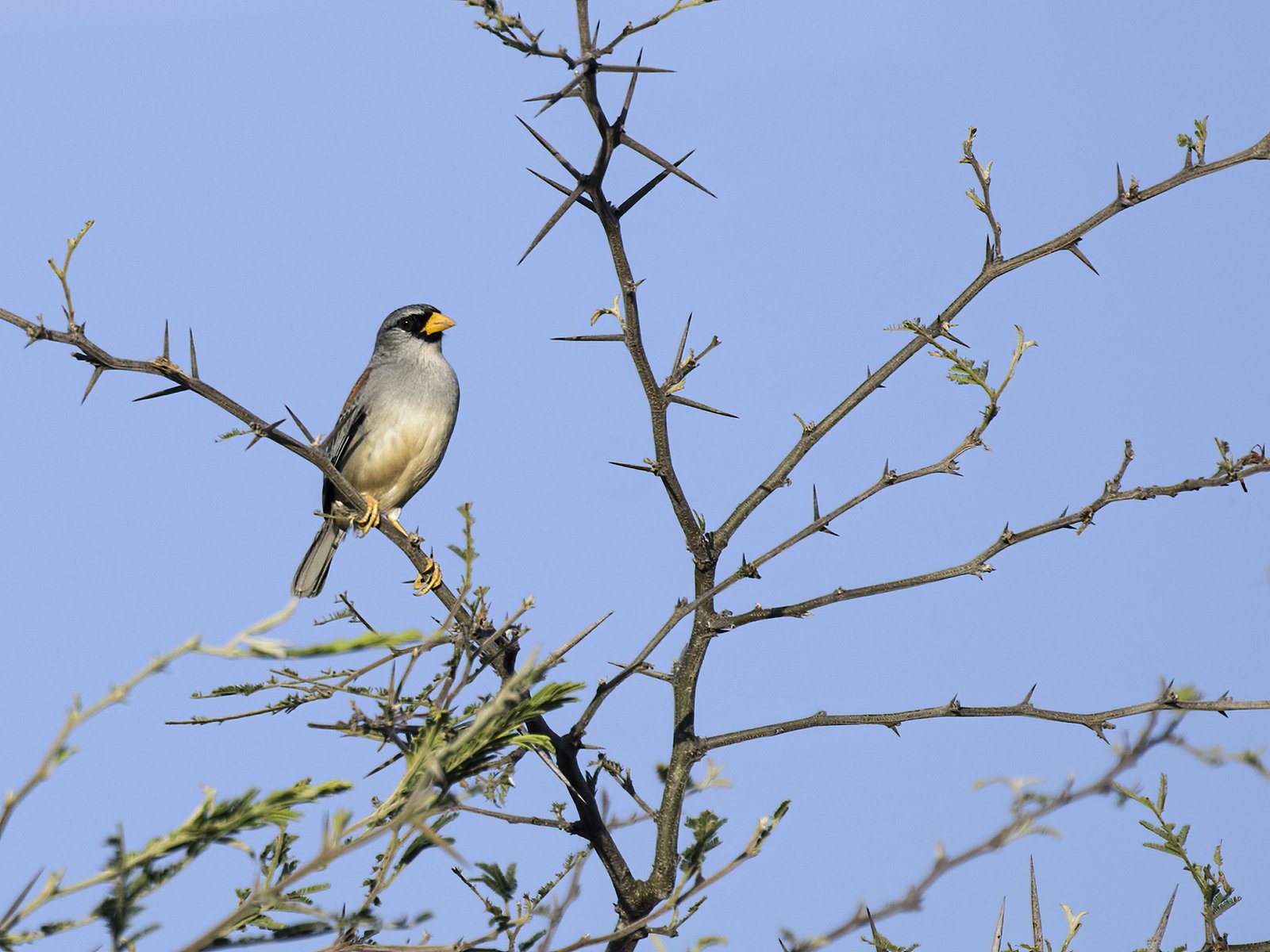
13 cm, with a conical, orange bill with a dark culmen. The lores and chin are black. The head, neck and breast are grey, the belly whitish. The back is brown with black streaks; the wings are grey with rufous edges. The tail is dark with white outer tail feathers. The sexes are similar. Young birds are duller and browner.
Confusion species
Buff-bridled Inca Finch Incaspiza laeta is larger, has a buff-yellow malar stripe and an unstreaked rufous back, and lives higher. Grey-winged Inca Finch Incaspiza ortizi and Rufous-backed Inca Finch Incaspiza personata are much larger and live higher. Female seedeaters such as Lined Seedeater Sporophila lineola are smaller, plain olive-brown, and lack the grey head and black face.
Habitat
Dry scrub with cacti and scattered trees on the valley floor and lower slopes, also along field edges, roughly between 400 and 1200 m. It feeds on the ground and low in shrubs on seeds and insects. Little is known about the nest.
Where the bird is most at home, classified by the vegetation units of the Andes and the west coast.


Range and movements
In Peru in the middle Marañón valley and its side valleys in Cajamarca and Amazonas, including around Jaén and Bagua. Absent from Colombia, Ecuador, Bolivia and the Galápagos. Does not occur outside the guide area.
- Resident
- dark = core range, pale = thinly spread
How and when to look
Search around Bagua Grande and Jaén in patches of dry scrub with cacti, early in the morning when the birds sing and before it gets hot.
Conservation status
Vulnerable. The range is small and the dry scrub on the valley floor is being converted to rice fields, other irrigated farming and pasture; planned dams on the Marañón could also destroy habitat.
Scientific name
Incaspiza watkinsi | Chapman, 1925
Chapman described the species in 1925 and placed it straight away in the genus where it still stands. The genus Incaspiza was introduced in 1898 by Ridgway. The genus name combines the Incas with Greek spiza, 'finch'. The species name honours Charles Watkins (active around 1912), a British collector in Peru. The specimen the first description was based on came from Perico, Río Chinchipe, Cajamarca, Peru.