All species › Passerines › Ovenbirds and woodcreepers › Double-banded Greytail
Double-banded Greytail | Xenerpestes minlosi
Bandgrijsstaart | Colagrís norteño | Rabo-cinzento-de-duas-barras
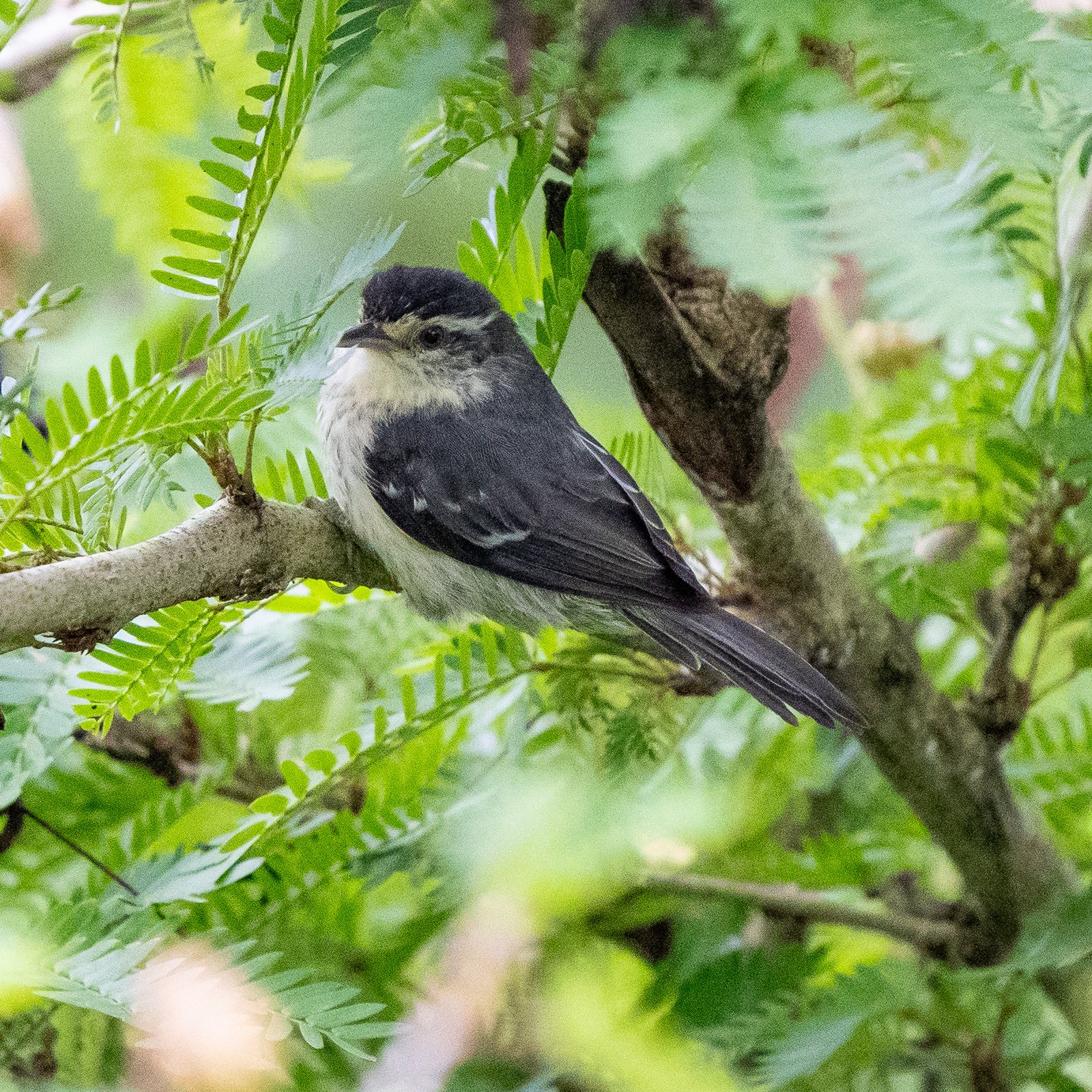
The Double-banded Greytail is a small, grey ovenbird with a black crown and two white wingbars, of the canopy of humid forests west of the Andes. It searches the foliage like a warbler, usually in mixed flocks. Its range extends from Panama to north-western Ecuador.
Voice
A high, thin, dry trill, and high, sharp calls.
Recording: Mitch Lysinger — CC BY-NC-SA 4.0 · xeno-canto
Identification
10–11 cm, small, with a short, pointed bill and a short, grey tail. The crown is black, with a white eyebrow. The upperparts are dark grey, the wings with two clear white wingbars. The underparts are whitish, faintly streaked grey on the throat and breast. The sexes are alike.
Confusion species
Lesser Greenlet Pachysylvia decurtata has a grey head with a white eye-ring, an olive-green back and no wingbars. Female antwrens are browner or more olive and lack the black crown with a white eyebrow. Equatorial Greytail Xenerpestes singularis has a rufous-streaked forecrown and no wingbars, and lives only on the east slope of the Andes.
Habitat
The canopy and edges of humid lowland and foothill forest, also tall secondary forest, from the lowlands up to about 1000 m. It forages in mixed flocks, often hanging from branch tips, among leaves and vines for insects. Little is known about the nest.
Where the bird is most at home, classified by the vegetation units of the Andes and the west coast.


Range and movements
Colombia: in the Pacific lowlands and foothills of the Chocó, and north and east into northern Antioquia and the middle Magdalena valley. Ecuador: in the north-west, mainly in Esmeraldas. Absent from Peru, Bolivia and the Galápagos. Outside the guide area in eastern Panama.
- Resident
- dark = core range, pale = thinly spread
How and when to look
Along roads and forest edges in the lowlands of Esmeraldas and the Colombian Chocó the species follows mixed flocks through the canopy; on a bird feeding low at the forest edge the black crown and white wingbars are the first features to show.
Conservation status
Least Concern. Deforestation in the Chocó and north-western Ecuador may reduce numbers locally.
Scientific name
Xenerpestes minlosi | Berlepsch, 1886
Berlepsch described the species in 1886 and placed it straight away in the genus where it still stands. He introduced the genus Xenerpestes in that same work. The genus name comes from Greek xenos, 'stranger', and herpēstēs, 'creeper' (from herpō, 'to crawl'). The species name honours Emilio José Minlos (1856–1901), Venezuelan-German merchant and collector in Bucaramanga (Colombia). The specimen the first description was based on came from Near Bucaramanga, Colombia.