All species › Passerines › Ovenbirds and woodcreepers › Equatorial Greytail
Equatorial Greytail | Xenerpestes singularis
Streepkopgrijsstaart | Colagrís ecuatorial | Rabo-cinzento-equatoriano
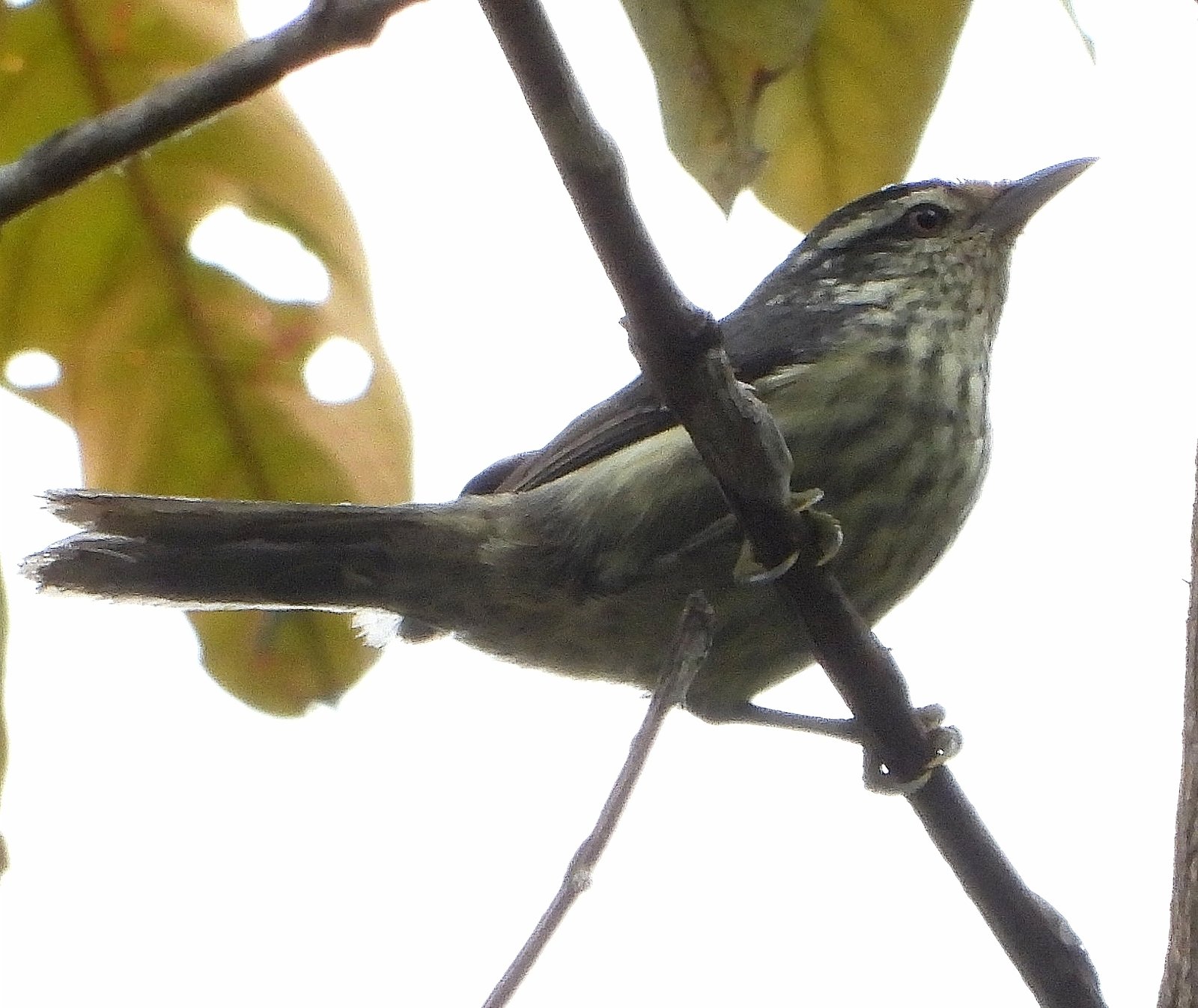
The Equatorial Greytail is a small, grey ovenbird of the canopy of montane forests on the east slope of the Andes in Ecuador and northern Peru. It moves through the foliage like a warbler, in mixed flocks. The species is local and scarce in most areas.
Voice
A high, dry, fast trill, and high, thin calls.
Recording: Paul Coopmans — CC BY-NC-SA 4.0 · xeno-canto
Identification
11–12 cm, small, with a short, pointed bill and a short, grey tail. The forecrown is rufous with fine black streaks; behind it the crown is grey with dark streaks. A narrow, whitish eyebrow. The upperparts are plain grey, the wings without wingbars. The underparts are whitish, finely streaked grey on the throat and breast. The sexes are alike.
Confusion species
Ash-browed Spinetail Cranioleuca curtata is larger, with a rufous crown, rufous wings and a rufous tail. Streaked Xenops Xenops rutilans has an upturned bill, a white malar stripe and a rufous tail. Double-banded Greytail Xenerpestes minlosi has a black crown and two white wingbars, and lives only west of the Andes.
Habitat
The canopy and edges of humid montane forest and upper foothill forest on the east slope, roughly between 1000 and 1700 m. It forages in mixed flocks, often hanging, among leaves, vines and mossy branches for insects. Little is known about the nest.
Where the bird is most at home, classified by the vegetation units of the Andes and the west coast.


Range and movements
Ecuador: on the east slope of the Andes, locally throughout. Peru: on the east slope in the north, in Amazonas and San Martín, locally in Cajamarca. Absent from Colombia, Bolivia and the Galápagos. Endemic to the guide area.
- Resident
- dark = core range, pale = thinly spread
How and when to look
In the forests around Wildsumaco in Napo province, Ecuador, the species can be found in mixed flocks in the canopy; look for a small, grey bird searching the foliage like a warbler.
Conservation status
Least Concern. The range is small and the species is local; deforestation on the east slope may reduce numbers locally.
Scientific name
Xenerpestes singularis | (Taczanowski & Berlepsch, 1885)
Taczanowski & Berlepsch described the species in 1885 as Synallaxis singularis; because it was later moved to another genus, the author and year stand in brackets. The genus Xenerpestes was introduced in 1886 by Berlepsch. The genus name comes from Greek xenos, 'stranger', and herpēstēs, 'creeper' (from herpō, 'to crawl'). The species name is Latin singularis, 'unique' or 'remarkable'. The specimen the first description was based on came from Mapoto, near Ambato, Ecuador.