All species › Passerines › Tanagers and allies › Drab Seedeater
Drab Seedeater | Sporophila simplex
Vaalbruin dikbekje | Semillero simple | Papa-capim-pardo
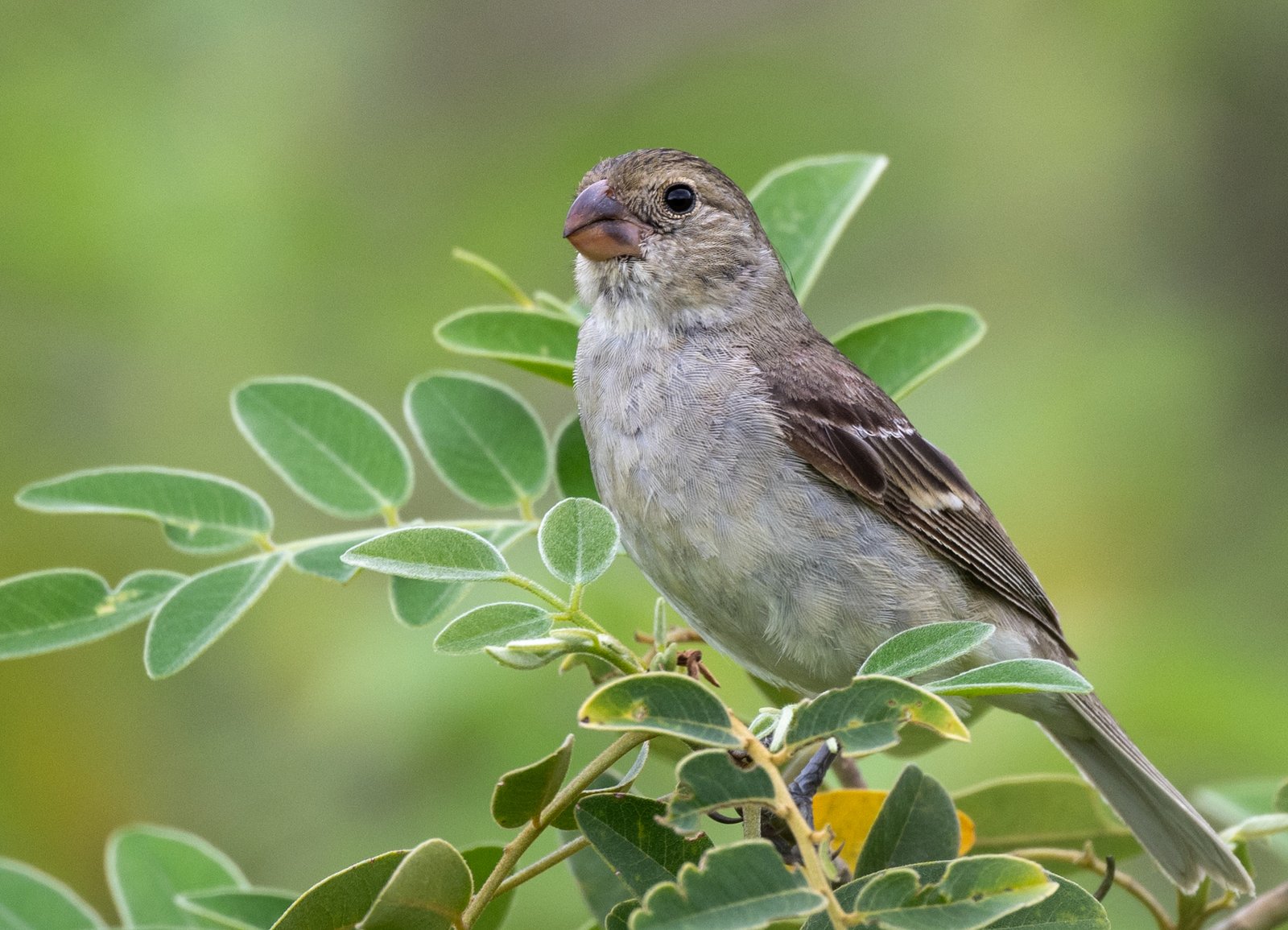
The Drab Seedeater is an inconspicuous grey-brown seedeater of dry scrub and valleys in south-western Ecuador and western Peru. Unlike most seedeaters, male and female look very similar. Two pale wing bars are the main feature.
Voice
The song is a short, thin series of whistles and hissing notes, simpler than in most seedeaters. The call is a soft tseep.
Recording: Paul Coopmans — CC BY-NC-SA 4.0 · xeno-canto
Identification
11 cm, with a short, thick, yellowish to horn-coloured bill. The male is uniform grey-brown above and paler below, with a whitish throat and belly, two distinct pale wing bars and a small white wing speculum. The female is slightly browner and less grey. Juveniles resemble the female.
Confusion species
Females of Chestnut-throated Seedeater Sporophila telasco have streaked upperparts and no distinct wing bars. Parrot-billed Seedeater Sporophila peruviana has a much heavier bill; females are browner, with narrower wing bars. Plain-colored Seedeater Catamenia inornata lives higher in the Andes, is greyer and has rufous undertail coverts. Females of Blue-black Grassquit Volatinia jacarina have a streaked breast.
Habitat
Dry scrub, thorn scrub, rank growth and field edges in dry valleys and on dry slopes, often near water; from about 500 to 2500 m, in south-western Ecuador also lower. It eats seeds of grasses and herbs, usually in pairs or small groups, sometimes together with other seed-eating birds. The nest is a cup in a shrub.
Where the bird is most at home, classified by the vegetation units of the Andes and the west coast.


Range and movements
In Ecuador in the south-west, mainly in Loja and El Oro. In Peru on the western slope of the Andes and in dry interior valleys such as the Marañón valley, south to the south of the country. Absent from Colombia, Bolivia and the Galápagos. Does not occur outside the guide area.
- Resident
- dark = core range, pale = thinly spread
How and when to look
Search dry, scrubby valleys in Loja province in Ecuador and the western slopes in northern Peru, preferably in the morning along field edges and streams.
Conservation status
Least Concern. The range is limited, but the species also lives in farmland and secondary scrub.
Scientific name
Sporophila simplex | (Taczanowski, 1874)
Taczanowski described the species in 1874 as Spermophila simplex; because it was later moved to another genus, the author and year stand in brackets. The genus Sporophila was introduced in 1844 by Cabanis. The genus name combines Greek sporos, 'seed', and philos, 'fond of'. The species name comes from Latin simplex, 'plain', for the unmarked plumage. The specimen the first description was based on came from Lima, Peru.