All species › Passerines › Tanagers and allies › Chestnut-bellied Seedeater
Chestnut-bellied Seedeater | Sporophila castaneiventris
Roodbuikdikbekje | Semillero ventricastaño | Caboclinho-de-peito-castanho
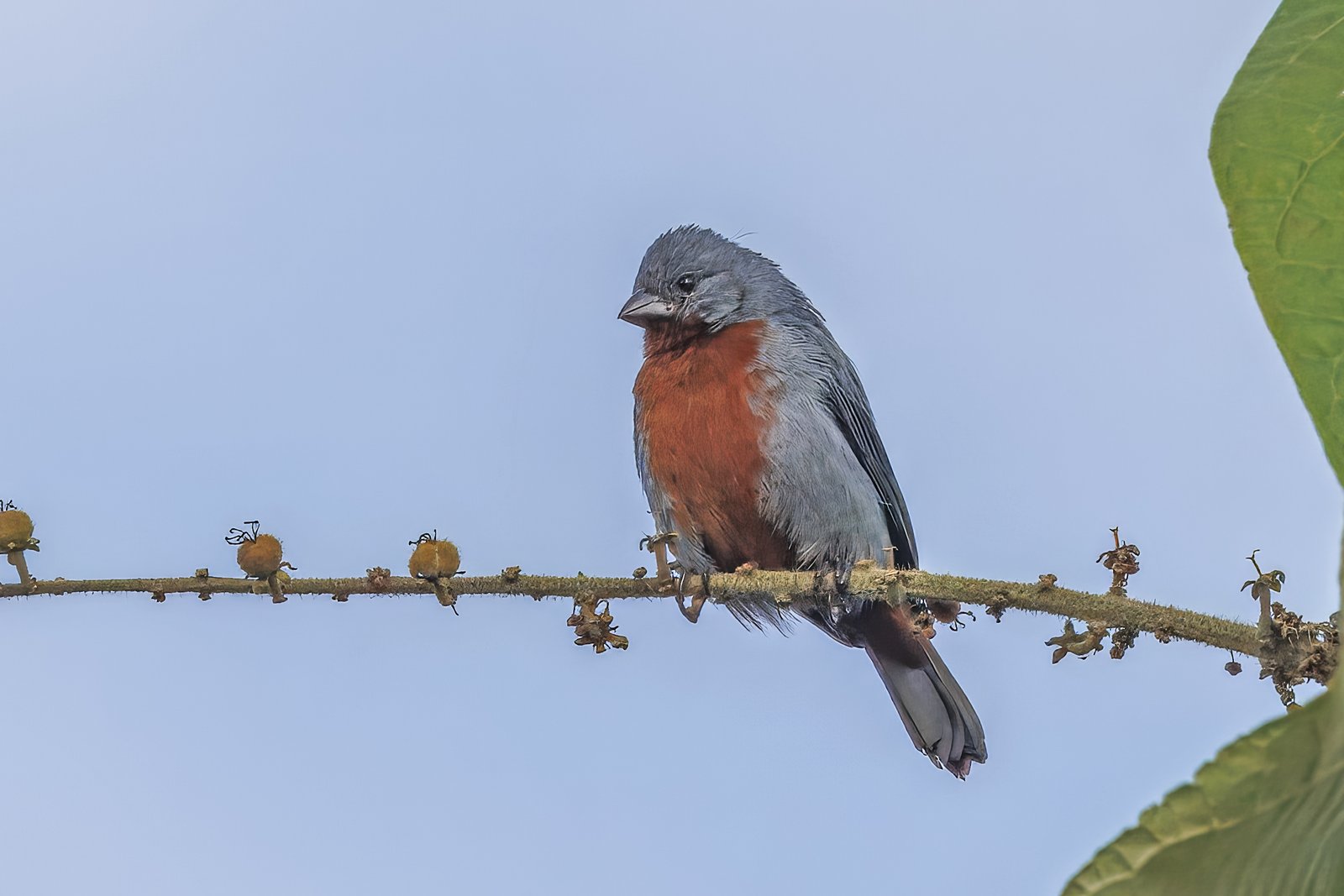
The Chestnut-bellied Seedeater is a small blue-grey seedeater with a chestnut central stripe down the underparts. It is the most numerous seedeater of grassy places in the Amazonian lowlands, from Colombia to Bolivia. It lives mainly along rivers, in clearings and in pastures.
Voice
The song is a fast, varied series of clear whistles and trills, often long sustained. The call is a soft tchew.
Recording: Juan Freile — CC BY-NC-SA 4.0 · xeno-canto
Identification
10 cm, with a short, blackish bill. The male is blue-grey, with a chestnut throat, breast and centre of the belly; the grey flanks enclose the chestnut. A white wing speculum is absent or very small. The female is olive-brown above and paler buff-brown below, without markings, with a dark bill. Young males first acquire scattered grey and rufous feathers in a brown plumage.
Confusion species
Ruddy-breasted Seedeater Sporophila minuta has a grey-brown back, a rufous rump, a white wing speculum and entirely rufous underparts, and lives north and west of Amazonia. Tawny-bellied Seedeater Sporophila hypoxantha has paler, tawny underparts and a tawny rump. Rufous-rumped Seedeater Sporophila hypochroma has a grey head and back and entirely chestnut underparts and rump. Females cannot be reliably told from those of other small seedeaters in the field; look for males nearby.
Habitat
Grass and rank growth along rivers and lakes, on river islands, in pastures, along roads and in clearings and forest edges in the lowlands, mostly below 800 m, locally to 1200 m. It eats mainly grass seeds, often in small flocks and together with other seedeaters. The nest is a small, shallow cup in a shrub or in tall grass.
Where the bird is most at home, classified by the vegetation units of the Andes and the west coast.


Range and movements
In Colombia in the lowlands east of the Andes, mainly in Amazonia (Caquetá, Putumayo, Amazonas) and the southern Llanos. In Ecuador throughout the eastern lowlands. In Peru in the Amazonian lowlands. In Bolivia in the northern and central lowlands (Pando, Beni, northern La Paz, Cochabamba and Santa Cruz). Absent from the Galápagos. Outside the guide area in western Brazil, southern Venezuela and the Guianas.
- Resident
- dark = core range, pale = thinly spread
How and when to look
Search riverbanks with tall grass, river islands and pastures near villages in the Amazonian lowlands. Singing males often perch on a shrub or a wire.
Conservation status
Least Concern. The species is numerous and benefits from deforestation and clearings; locally it is trapped as a cage bird.
Scientific name
Sporophila castaneiventris | Cabanis, 1849
Cabanis described the species in 1849 and placed it straight away in the genus where it still stands. The genus Sporophila was introduced in 1844 by Cabanis. The genus name combines Greek sporos, 'seed', and philos, 'fond of'. The species name comes from Latin castaneus, 'kastanjebruin', en venter, 'buik', for the chestnut belly. The specimen the first description was based on came from Cumaka, Guyana.