All species › Passerines › Tanagers and allies › Ruddy-breasted Seedeater
Ruddy-breasted Seedeater | Sporophila minuta
Dwergdikbekje | Semillero pechirrufo | Caboclinho-lindo
The Ruddy-breasted Seedeater is a small seedeater of grassland and rank growth, from Mexico to northern South America. The male is grey above, with a rufous rump and rufous underparts from throat to undertail. In the guide area it lives mainly in Colombia and locally in north-western Ecuador.
Voice
The song is a simple, clear series of whistles, often rising and with a plaintive quality. The call is a sharp chip or chink.
Recording: Olivier SWIFT — CC BY-NC-SA 4.0 · xeno-canto
Identification
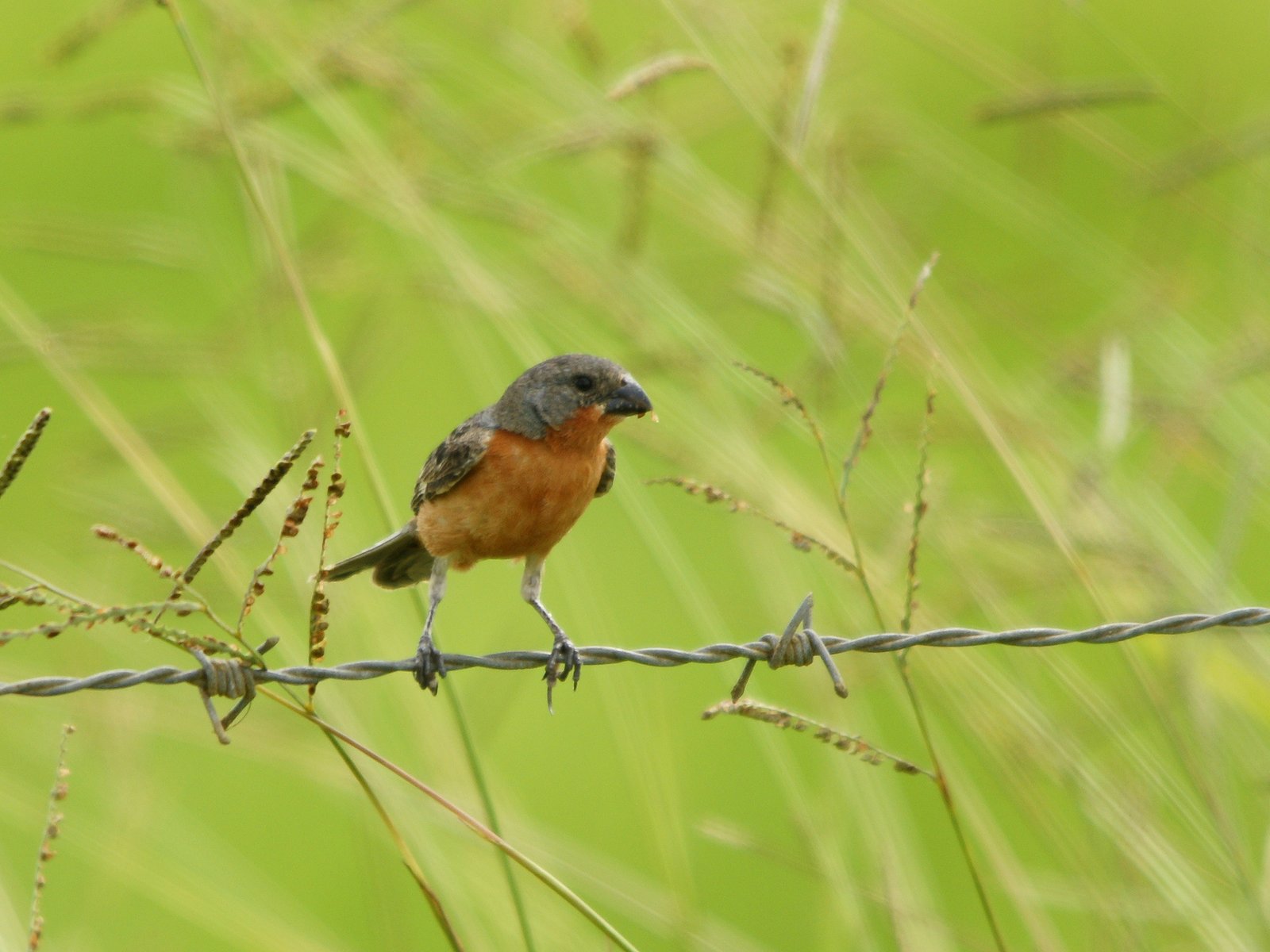
10 cm, with a short, thick, blackish bill. The male has a grey to grey-brown head and back, a rufous rump, dark wings with a white wing speculum and entirely rufous underparts. The female is buff-brown above and paler ochre below, unstreaked, with a horn-coloured bill. Young males resemble the female and gradually acquire grey and rufous feathers.
Confusion species
Chestnut-bellied Seedeater Sporophila castaneiventris is bluer grey, with grey flanks beside the chestnut central stripe and a grey rump, and lives in the Amazonian lowlands. Tawny-bellied Seedeater Sporophila hypoxantha has paler, tawny underparts and in the guide area occurs only in Bolivia. Females closely resemble those of other small seedeaters, such as Yellow-bellied Seedeater Sporophila nigricollis, but are warmer buff-brown below.
Habitat
Grassland, savanna, pastures, field edges, roadsides and clearings with scrub, often in damp terrain; from sea level to about 1500 m, in Colombia locally higher. It eats mainly grass seeds and forms flocks outside the breeding season, sometimes with other seedeaters. The nest is a small cup in a shrub or in tall grass.
Where the bird is most at home, classified by the vegetation units of the Andes and the west coast.


Range and movements
In Colombia widespread in the Caribbean lowlands, the Magdalena and Cauca valleys and the Llanos, locally also on the Pacific side. In Ecuador only locally in the north-west (Esmeraldas and western Imbabura). Absent from Peru, Bolivia and the Galápagos. Outside the guide area from Mexico through Central America to Venezuela, the Guianas, Trinidad and northern Brazil.
- Resident
- dark = core range, pale = thinly spread
How and when to look
In Colombia, search grassy pastures and savannas in the Llanos and the Caribbean lowlands, especially in the rainy season, when males sing from a shrub or a tall grass stem.
Conservation status
Least Concern. The species is widespread and benefits from deforestation; locally it is trapped as a cage bird.
Scientific name
Sporophila minuta | (Linnaeus, 1758)
Linnaeus described the species in 1758 as Loxia minuta; because it was later moved to another genus, the author and year stand in brackets. The genus Sporophila was introduced in 1844 by Cabanis. The genus name combines Greek sporos, 'seed', and philos, 'fond of'. The species name comes from Latin minutus, 'small'. The specimen the first description was based on came from Suriname.