All species › Passerines › Tanagers and allies › Black-and-tawny Seedeater
Black-and-tawny Seedeater | Sporophila nigrorufa
Zwart-rood dikbekje | Semillero rojinegro | Caboclinho-do-sertão
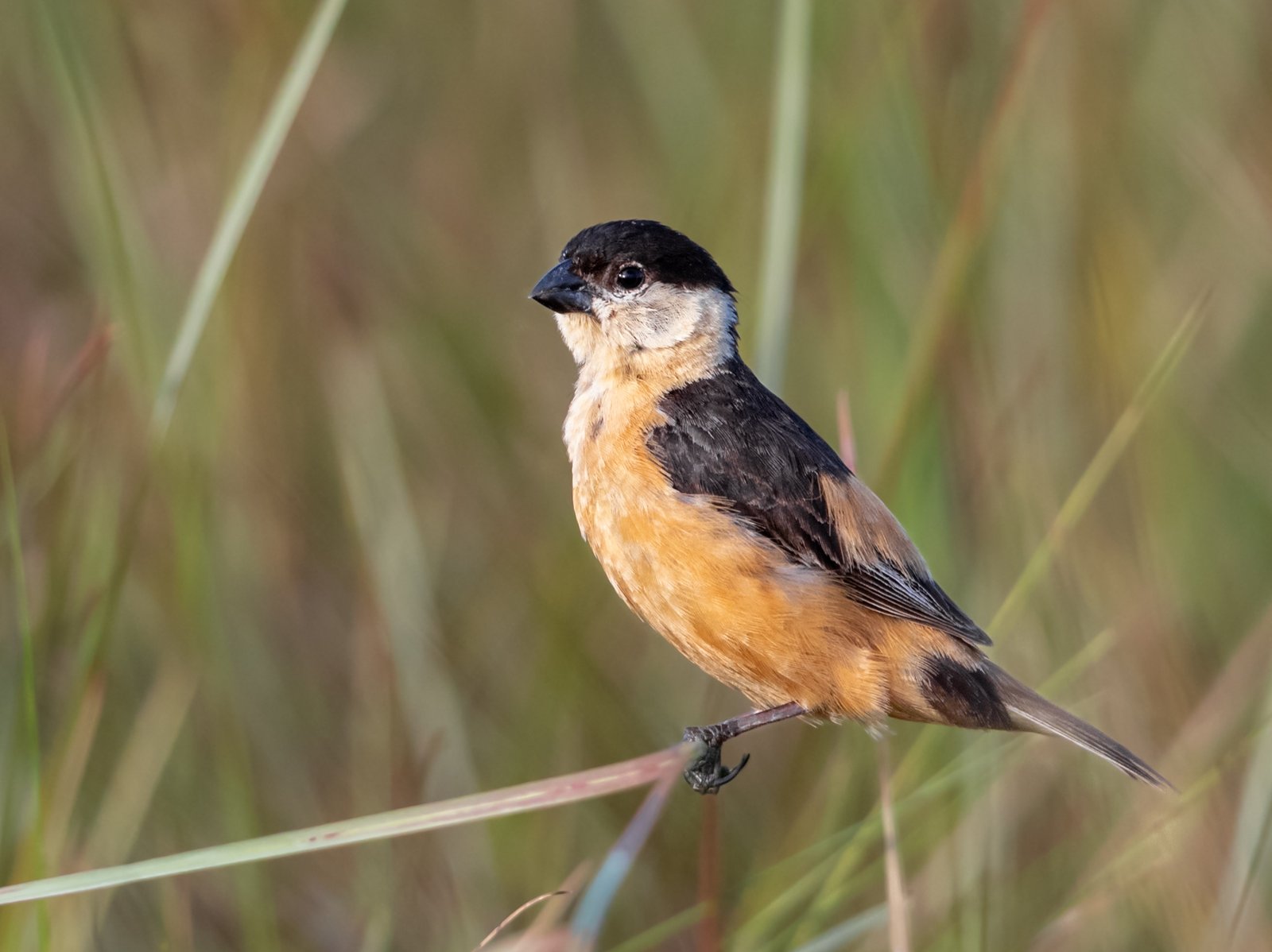
The Black-and-tawny Seedeater is a small, rare seedeater of wet grassland at the edge of cerrado and Chiquitano dry forest, in eastern Bolivia and adjacent western Brazil. The male is black above and cinnamon to rufous below. The range is small and its ecology poorly known.
Voice
The song is a series of clear, varied whistles and trills, as in related seedeaters; it has been little described.
Recording: Sjoerd Mayer — CC BY-NC-SA 3.0 · xeno-canto
Identification
10 cm, with a short, thick, blackish bill. The male has a black crown, nape, back, wings and tail, with a white wing speculum; the cheeks, throat, underparts and rump are cinnamon to rufous. The female is brown above and paler buff-brown below, with a horn-coloured bill, as in related seedeaters. Young males resemble the female.
Confusion species
Tawny-bellied Seedeater Sporophila hypoxantha has a grey, not black, crown and back. Rufous-rumped Seedeater Sporophila hypochroma has a grey head and back and darker chestnut underparts. Chestnut-bellied Seedeater Sporophila castaneiventris is blue-grey, with a chestnut central stripe. Females of this group cannot be reliably told apart in the field.
Habitat
Wet and seasonally flooded grassland with tall grass, often interspersed with cerrado and dry forest, in the lowlands, roughly between 200 and 600 m. It eats mainly grass seeds. It breeds in the rainy season; the nest is a small cup low in grass or scrub.
Where the bird is most at home, classified by the vegetation units of the Andes and the west coast.


Range and movements
In Bolivia in the eastern lowlands, mainly in eastern Santa Cruz (Chiquitanía and the surroundings of Noel Kempff Mercado) and locally in Beni. Absent from Colombia, Ecuador, Peru and the Galápagos. Outside the guide area in western Mato Grosso in Brazil.
- Resident
- dark = core range, pale = thinly spread
How and when to look
Search wet grassland in eastern Santa Cruz in the rainy season (roughly November–March), when singing males perch on tall grass stems or low shrubs. Outside the breeding season the species has rarely been recorded.
Conservation status
Vulnerable. The small range is threatened by the conversion of grassland to farmland, by burning and by trapping for the cage-bird trade.
Scientific name
Sporophila nigrorufa | (d'Orbigny, ACVMD & de Lafresnaye, 1837)
D'Orbigny, ACVMD & de Lafresnaye described the species in 1837 as Pyrrhula nigro-rufa; because it was later moved to another genus, the author and year stand in brackets. The genus Sporophila was introduced in 1844 by Cabanis. The genus name combines Greek sporos, 'seed', and philos, 'fond of'. The species name comes from Latin niger, 'zwart', en rufus, 'roodbruin', for the black-and-rufous plumage. The specimen the first description was based on came from Chiquitos, Santa Cruz, Bolivia.