All species › Passerines › Tanagers and allies › Tawny-bellied Seedeater
Tawny-bellied Seedeater | Sporophila hypoxantha
Okerbuikdikbekje | Capuchino canela | Caboclinho-de-barriga-vermelha
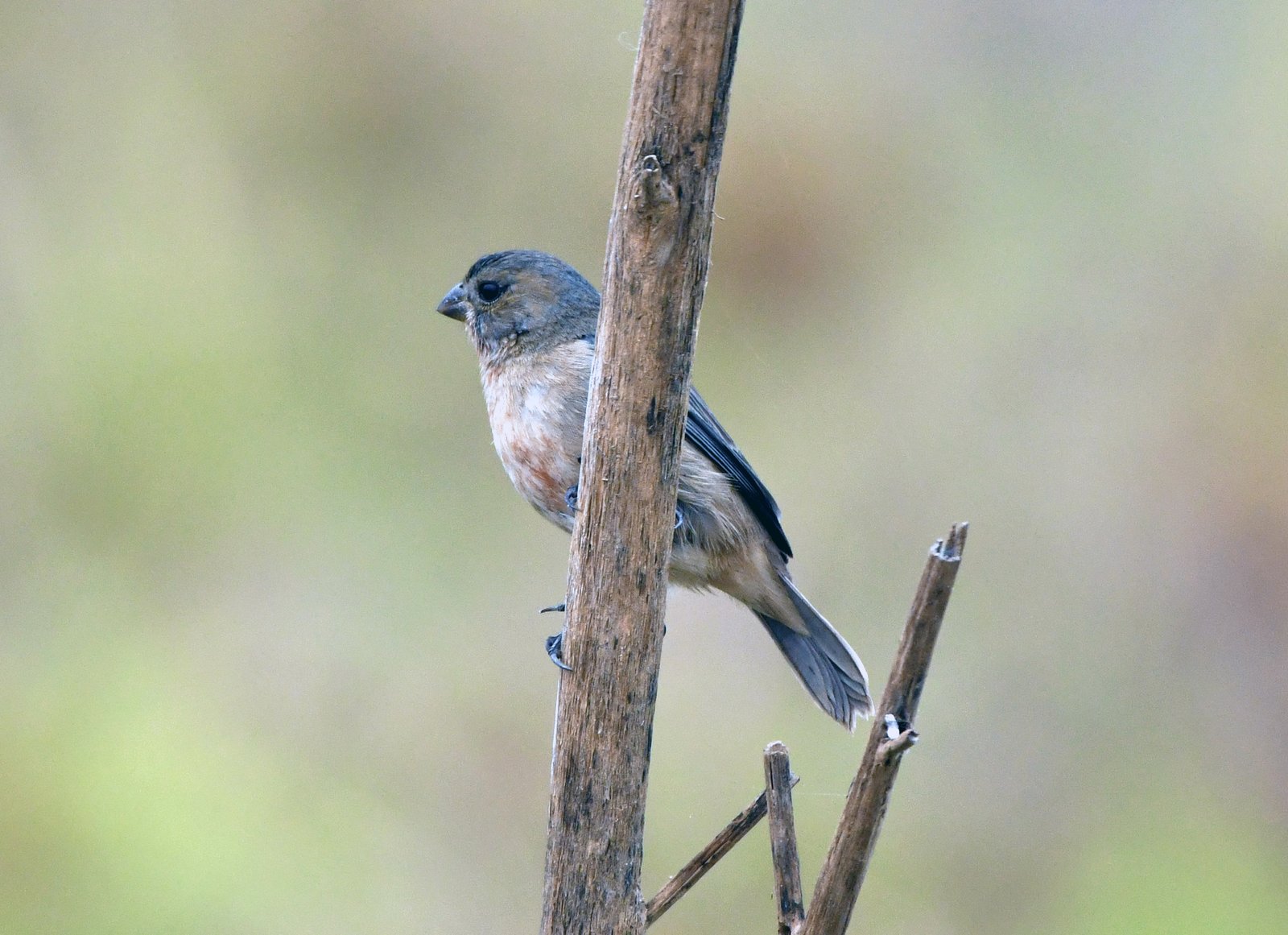
The Tawny-bellied Seedeater belongs to the capuchinos, a group of seedeaters of the grasslands of southern South America. The male is grey, with tawny underparts and rump. In the guide area it lives in the lowlands of Bolivia, where birds breed and where birds from the south also stay during the austral winter.
Voice
The song is a clear, varied series of whistles and trills with repeated motifs. The call is a soft tchew.
Recording: Jacob Wijpkema — CC BY-NC-SA 4.0 · xeno-canto
Identification
10 cm, with a short, thick, dark bill. The male has a grey crown, nape and back, dark wings with a white wing speculum, and a tawny to cinnamon throat, underparts and rump; the underparts are often slightly paler towards the belly. The female is brown above and paler buff-brown below, without markings. Young males resemble the female.
Confusion species
Dark-throated Seedeater Sporophila ruficollis has a dark brown to blackish throat and upper breast. Rufous-rumped Seedeater Sporophila hypochroma is darker chestnut below. Black-and-tawny Seedeater Sporophila nigrorufa has a black crown and back. Ibera Seedeater Sporophila iberaensis has a dark throat and collar and an olive-brown back. Females of this group cannot be reliably told apart in the field.
Habitat
Wet and dry grassland, savanna and marsh edges with tall grass, also pastures; in the lowlands, mostly below 800 m. It eats mainly grass seeds, which it plucks from the stems. The nest is a small cup low in grass or in a shrub.
Where the bird is most at home, classified by the vegetation units of the Andes and the west coast.


Range and movements
In Bolivia in the savannas of Beni and the lowlands of Santa Cruz, where the species breeds; in the austral winter migrants from the south join them. In Peru possibly a rare winter visitor in the south-east. Absent from Colombia, Ecuador and the Galápagos. Outside the guide area it breeds in Paraguay, northern Argentina, Uruguay and southern Brazil, and also winters in central Brazil.
- Resident
- dark = core range, pale = thinly spread
How and when to look
Search the savannas of Beni and wet grassland in Santa Cruz, especially in the rainy season, when males sing from tall grass stems. In the austral winter mixed flocks of capuchinos feed in tall grass.
Conservation status
Least Concern. The species is trapped for the cage-bird trade and loses habitat through the conversion of grassland to farmland and through burning.
Scientific name
Sporophila hypoxantha | Cabanis, 1851
Cabanis described the species in 1851 and placed it straight away in the genus where it still stands. The genus Sporophila was introduced in 1844 by Cabanis. The genus name combines Greek sporos, 'seed', and philos, 'fond of'. The species name comes from Greek hupo, 'onder', en xanthos, 'geel', for the tawny-yellow underparts. The specimen the first description was based on came from Montevideo, Uruguay.