All species › Jacamars and puffbirds › Jacamars › Dusky-backed Jacamar
Dusky-backed Jacamar | Brachygalba salmoni
Zwartrugglansvogel | Jacamará dorsioscuro | Ariramba-de-dorso-escuro
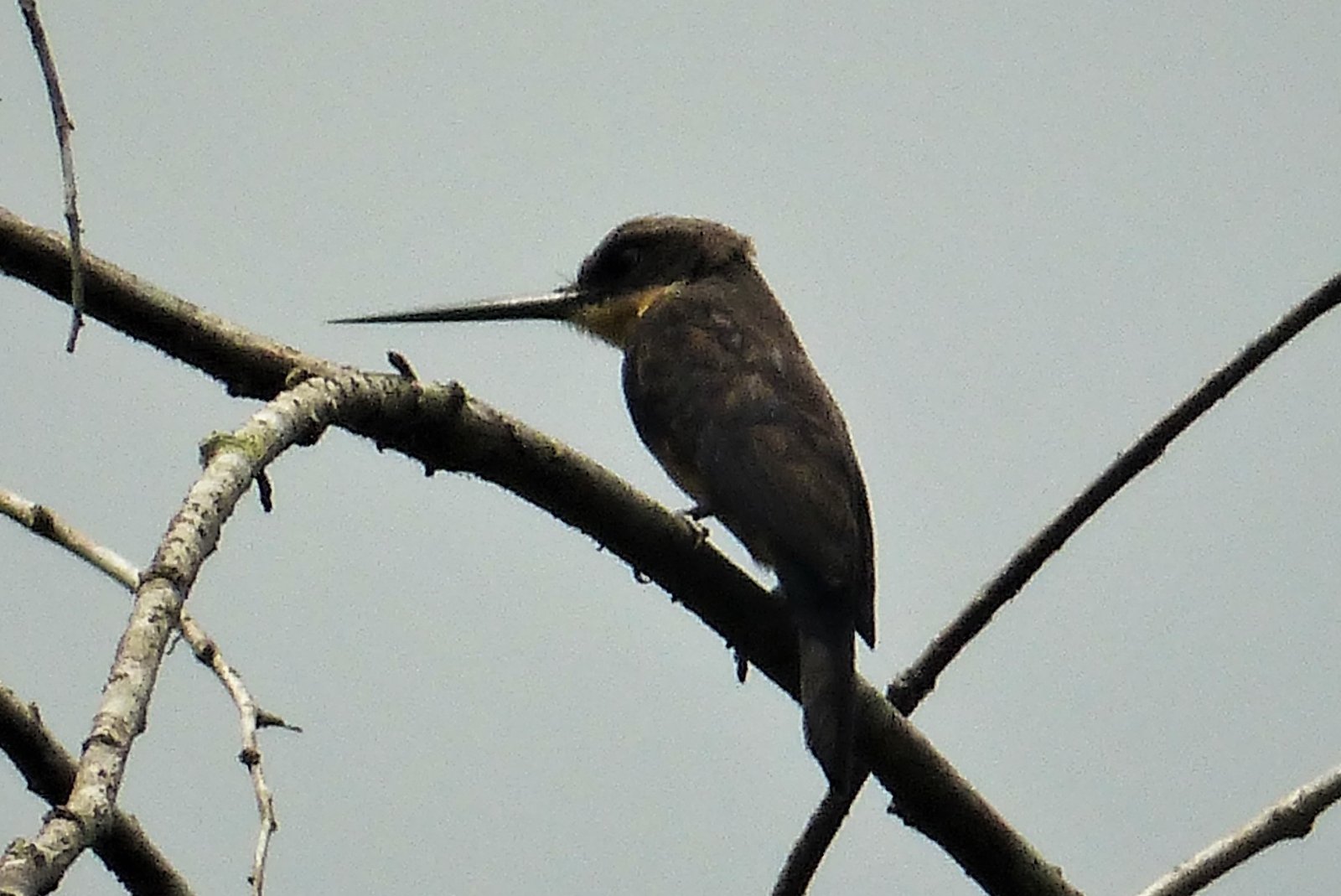
The Dusky-backed Jacamar is a small, dark jacamar with a cinnamon belly, found in humid forest in north-western Colombia and eastern Panama. It lives in pairs or family groups that hunt flying insects from branches along clearings and stream banks. An isolated population in northern Bolívar was formerly regarded as a separate subspecies.
Voice
The call is a rising sweet or feet, sometimes extended into a longer series. The song is more complex and varied.
Recording: Iván Lau — CC BY-NC-SA 4.0 · xeno-canto
Identification
17–18 cm, with a long, straight black bill and a fairly short tail. The upperparts, breast and flanks are dark greenish black, bluish in worn birds. The cheeks are sooty. The belly and lower breast are cinnamon. The male has a white or whitish throat, the female a buff throat.
Confusion species
Rufous-tailed Jacamar Galbula ruficauda is larger and glossy green, with a longer tail with rufous outer feathers. Great Jacamar Jacamerops aureus is much larger, with a thick, decurved bill and glossy golden-green upperparts.
Habitat
Humid primary and secondary forest, mainly at edges such as clearings and stream banks, less in the forest interior, from the lowlands up to about 700 m. It sallies from a branch for flying insects, often in pairs or small family groups. The nest is presumably a tunnel in an earth bank, but has not yet been described.
Where the bird is most at home, classified by the vegetation units of the Andes and the west coast.


Range and movements
In Colombia in northern Chocó, northern Antioquia and southern Córdoba, with an isolated population in northern Bolívar. Absent from Ecuador, Peru, Bolivia and the Galápagos. Outside the guide area in Darién in eastern Panama.
- Resident
- dark = core range, pale = thinly spread
How and when to look
Search streams, forest edges and clearings in the lowlands of northern Chocó and northern Antioquia for pairs on branches above the water or at the forest edge.
Conservation status
Least Concern. The range is small, and the isolated population in Bolívar may be vulnerable to forest loss.
Scientific name
Brachygalba salmoni | Sclater & Salvin, 1879
Sclater & Salvin described the species in 1879 and placed it straight away in the genus where it still stands. The genus Brachygalba was introduced in 1854 by Bonaparte. The genus name combines Greek brakhus, 'short', with Galbula, the jacamar genus. The species name salmoni honours Thomas Knight Salmon (1841–1878), British engineer, state engineer in Colombia from 1870 to 1877, naturalist, collector and oologist. The specimen the first description was based on came from Nechí River, Antioquia, Colombia.