All species › Jacamars and puffbirds › Jacamars › Great Jacamar
Great Jacamar | Jacamerops aureus
Grote glansvogel | Jacamar grande | Jacamaraçu
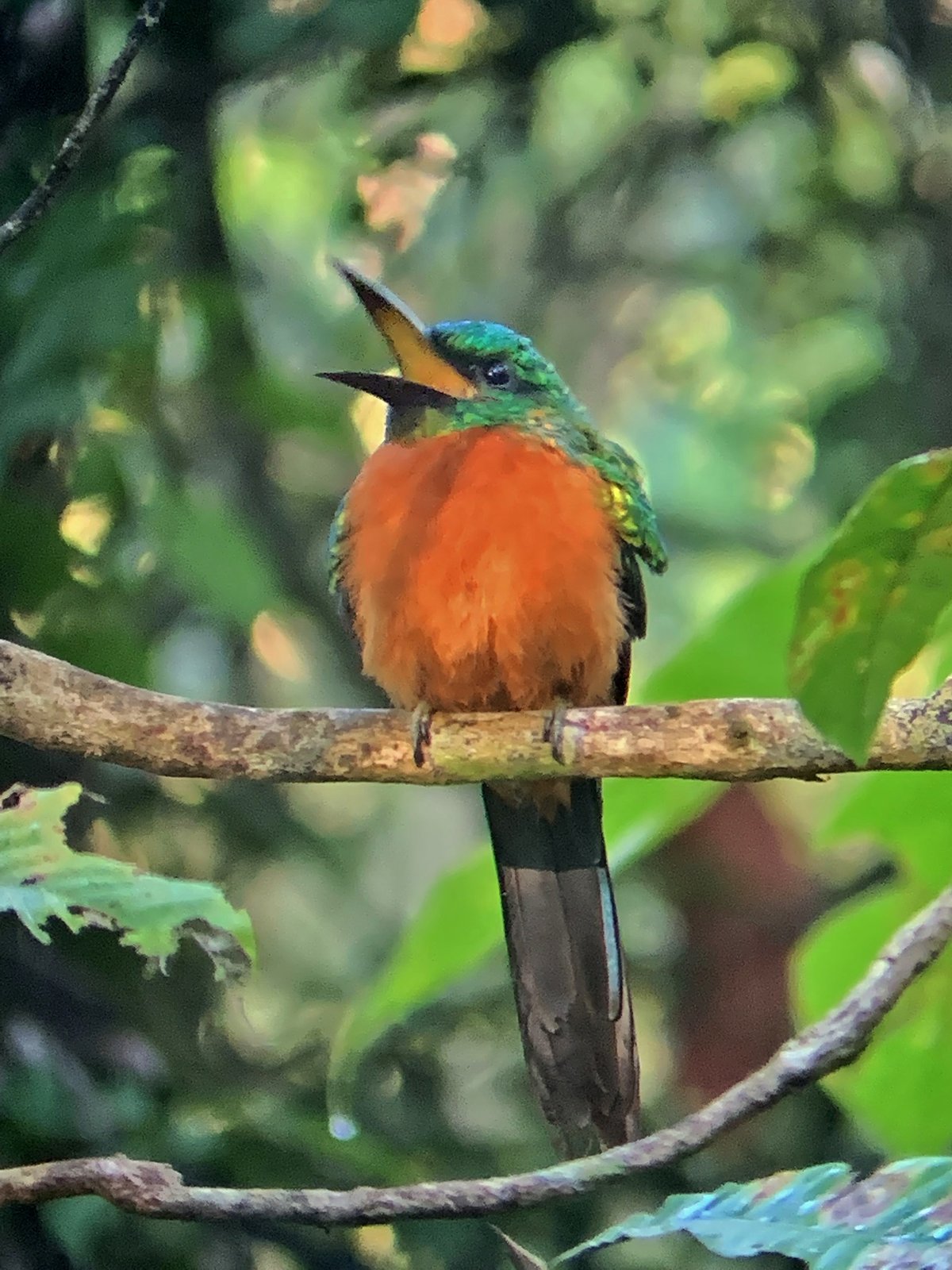
The Great Jacamar is the largest jacamar, with a thick, slightly decurved bill that recalls a trogon or motmot more than the thin, needle-like bill of other jacamars. It sits motionless and upright for long periods at mid-level in the interior of humid lowland forest. Often only its long, plaintive whistle reveals its presence.
Voice
A long, loud, plaintive whistle that rises and falls again, like wheeee-eeuw, with a somewhat catlike quality; also short kyow calls.
Recording: GABRIEL LEITE — CC BY-NC-SA 4.0 · xeno-canto
Identification
25–30 cm, with a heavy, black, slightly decurved bill and a long, graduated tail. The upperparts are glossy metallic green with a golden or coppery sheen. The underparts are rufous to cinnamon. The male has a white band across the lower throat, which the female lacks. The underside of the tail is blue-black.
Confusion species
Rufous-tailed Jacamar Galbula ruficauda and other Galbula species are much smaller and slimmer, with a thin, straight bill. Trogons (Trogon) also sit still and upright, but have a short, broad bill and a tail with white bars or edges. Dusky-backed Jacamar Brachygalba salmoni is much smaller and darker.
Habitat
The interior of tall, humid primary forest, also várzea forest and forest along streams, from the lowlands up to about 800 m, locally higher in the foothills. It sits still at mid-level for long periods and takes large insects such as butterflies, wasps, beetles and cicadas, snatched from leaves or caught in the air. It nests in a cavity in an arboreal termite nest.
Where the bird is most at home, classified by the vegetation units of the Andes and the west coast.


Range and movements
In Colombia in the Pacific lowlands, in the north, and east of the Andes. In Ecuador in the north-west and the eastern lowlands. In Peru in the Amazonian lowlands. In Bolivia in the north and the lowlands at the foot of the Andes. Absent from the Galápagos. Outside the guide area from Costa Rica to the Guianas and Amazonian Brazil.
- Resident
- dark = core range, pale = thinly spread
How and when to look
In undisturbed lowland forest, listen for the long, plaintive whistles and then search at mid-level along the trunks; the bird often sits for minutes without moving.
Conservation status
Least Concern. The species depends on undisturbed forest and disappears where forest is cleared or heavily fragmented.
Scientific name
Jacamerops aureus | (Müller, 1776)
Müller described the species in 1776 as Alcedo aurea; because it was later moved to another genus, the author and year stand in brackets. The genus Jacamerops was introduced in 1830 by Lesson. The genus name combines French jacamar (according to some sources from a Tupi-Guaraní name recorded by Marcgrave) with Greek merops, 'bee-eater'. The species name is the Latin adjective aureus, 'golden'. The specimen the first description was based on came from Berbice, Guyana.