All species › Jacamars and puffbirds › Jacamars › White-eared Jacamar
White-eared Jacamar | Galbalcyrhynchus leucotis
Kortstaartglansvogel | Jacamará orejiblanco | Ariramba-de-orelha-branca
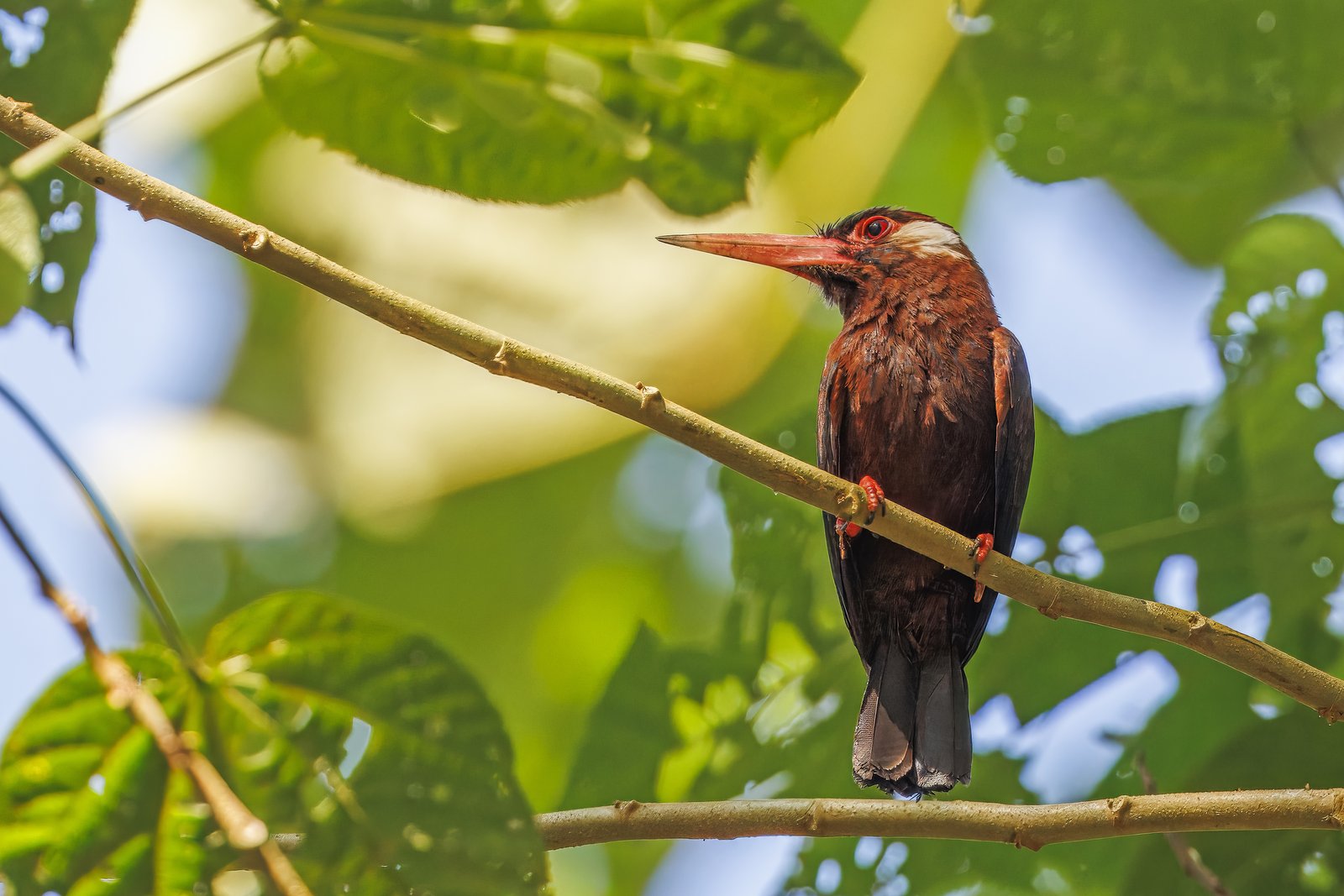
The White-eared Jacamar is a stocky, chestnut jacamar with a thick pink bill and a white ear patch, found along riverbanks and lakes in western Amazonia. It lives in groups of two to six birds that perch close together on open branches above the water. With its short tail and heavy bill it differs markedly from the slender Galbula jacamars.
Voice
High, sharp, rising whistles, like peeeeyr, and short trills; groups often call together.
Recording: Guilherme de Melo Becher — CC BY-NC-SA 4.0 · xeno-canto
Identification
19–21 cm, with a heavy, long, pink to salmon-red bill and a short tail. The body is deep chestnut. The crown is blackish brown, and behind the eye there is a conspicuous white ear patch. The wings and tail are dark, blackish with a green gloss. The legs are pink. The sexes are alike.
Confusion species
Purus Jacamar Galbalcyrhynchus purusianus is similar but lacks the white ear patch, has a paler, rufous-chestnut head and lives south of the Amazon. Galbula jacamars such as Rufous-tailed Jacamar Galbula ruficauda are slimmer and glossy green, with a thin black bill and a long tail.
Habitat
Edges of várzea forest, banks of rivers, oxbow lakes and side channels, and palm swamps, in the lowlands up to about 400 m. It perches on open branches along the water and sallies for flying insects such as butterflies, dragonflies and wasps. It nests in a tunnel in a termite nest or an earth bank.
Where the bird is most at home, classified by the vegetation units of the Andes and the west coast.


Range and movements
In Colombia in the south-east, in Amazonia. In Ecuador in the eastern lowlands. In Peru in the north-east, north of the Amazon and the Marañón. Absent from Bolivia and the Galápagos. Outside the guide area in western Amazonian Brazil.
- Resident
- dark = core range, pale = thinly spread
How and when to look
Travel by boat along the banks of oxbow lakes and side channels in the eastern lowlands of Ecuador and Peru and watch open branches above the water; groups often perch there close together.
Conservation status
Least Concern. The species has a fairly large range in the Amazonian lowlands, where its riverside habitat is largely intact.
Scientific name
Galbalcyrhynchus leucotis | des Murs, 1845
Des Murs described the species in 1845 and placed it straight away in the genus where it still stands. He introduced the genus Galbalcyrhynchus in that same work. The genus name combines Galbula (jacamars), Alcyone (a kingfisher genus) and Greek rhunkhos, 'bill'. The species name leucotis comes from Greek leukos, 'white', and ous (ōtos), 'ear': 'white-eared'. The specimen the first description was based on came from Bogotá, Colombia.