All species › Pigeons and doves › Doves and pigeons › Eurasian Collared-Dove
Eurasian Collared-Dove | Streptopelia decaocto
Turkse tortel | Tórtola turca | Rola-turca
The Eurasian Collared-Dove originates from southern Asia and spread across Europe in the twentieth century; after releases in the Bahamas it also colonised large parts of North America and the Caribbean. In South America it is established on Trinidad, and an expansion into northern Colombia is expected. In the guide area no established population has yet been confirmed; many reports refer to domestic Barbary Doves.
Voice
A three-part coo with the stress in the middle, coo-COOO-coo, often repeated at length from a roof, aerial or branch. On landing a nasal kwairr.
Recording: Lionel Triboulin — CC0 1.0 · xeno-canto
Identification
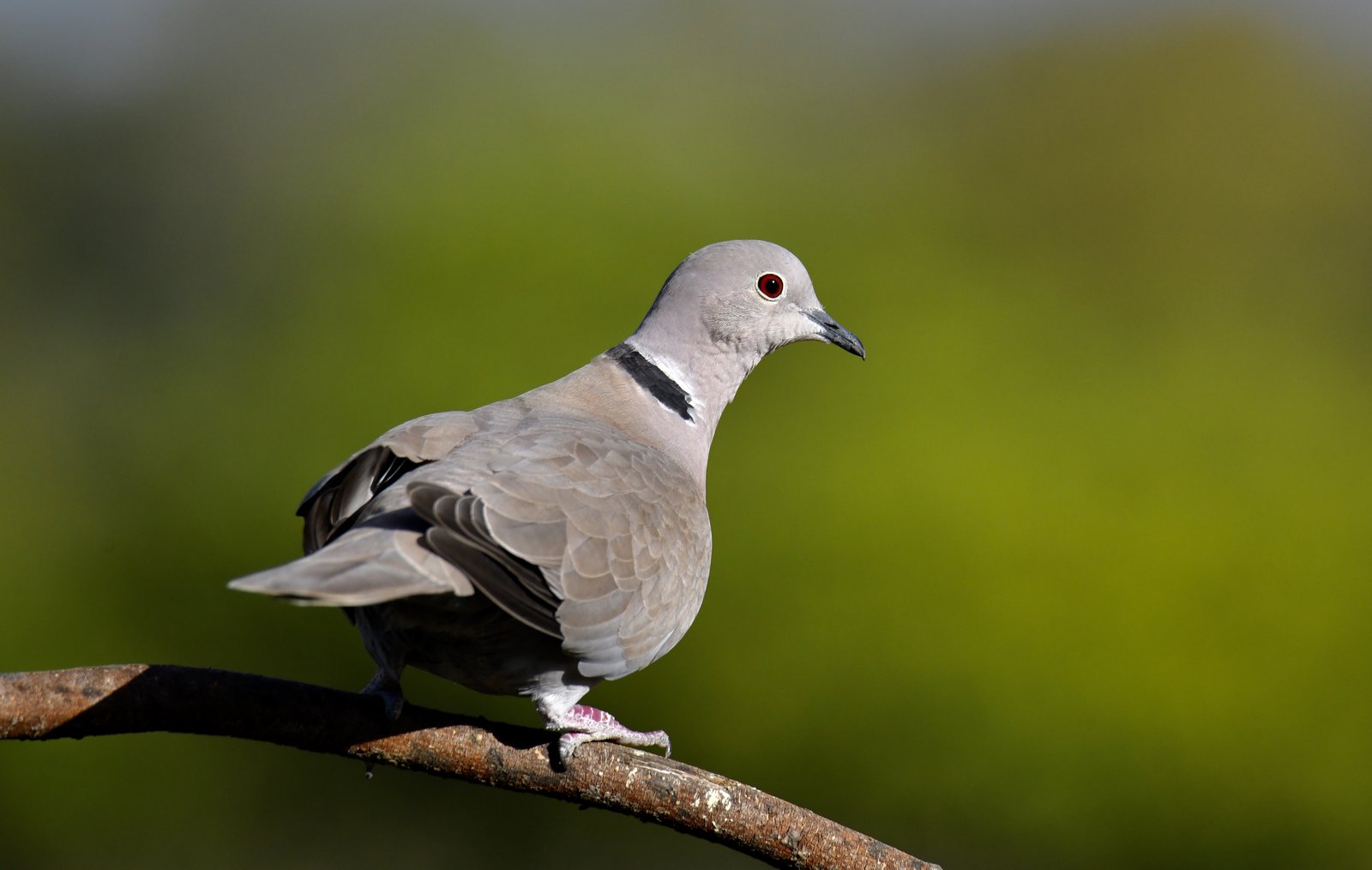
31–33 cm. A slender, pale sandy-grey dove with a narrow, white-edged black half-collar on the hindneck. The head and breast are pale pinkish grey, the primaries dark greyish brown, and the wings look two-toned in flight. The long tail shows a black base and a broad white terminal band from below. The iris is dark red, the legs red. The sexes are alike; juveniles lack the collar.
Confusion species
African Collared Dove and its domestic form, the Barbary Dove Streptopelia roseogrisea, are smaller and paler, creamier, with white undertail coverts and paler primaries; the call is a rolling coo. Eared Dove Zenaida auriculata and West Peruvian Dove Zenaida meloda lack a collar; Eared Dove has small black spots on the cheek and wings, West Peruvian Dove a white wing band.
Habitat
Towns, villages, parks, farmyards, fields and other open country with scattered trees, usually close to people. It eats seeds and grain, often on the ground, also at feeders and grain stores. The nest is a flimsy platform of twigs in a tree, on a building or on a pylon.
Where the bird is most at home, classified by the vegetation units of the Andes and the west coast.


Range and movements
Status in the guide area uncertain. In Colombia, Ecuador and Peru there are reports, mainly from towns, but most are unconfirmed and some refer to domestic Barbary Doves; a report from Lima has not been accepted. No confirmed records are known from Bolivia or the Galápagos. The native range is in southern Asia; introduced and expanding in Europe, North Africa, North America, the Caribbean and on Trinidad.
How and when to look
In towns and villages in northern Colombia, look for doves with a narrow black collar and a three-part call; if possible make a sound recording, since the call separates it from domestic Barbary Doves.
Conservation status
Least Concern; the species is spreading in large parts of the world. In the guide area an introduced species; elsewhere it may compete with native doves in towns.
Scientific name
Streptopelia decaocto | (Frivaldszky, 1838)
Frivaldszky described the species in 1838 as Columba decaocto; because it was later moved to another genus, the author and year stand in brackets. The genus Streptopelia was introduced in 1855 by Bonaparte. The genus name comes from Greek streptos, 'collar', and peleia, 'dove'. The species name is Greek for 'eighteen' (deka 'ten' and oktō 'eight'), an onomatopoeia of the call. The specimen the first description was based on came from Plovdiv, Bulgaria.