All species › Pigeons and doves › Doves and pigeons › African Collared Dove
African Collared Dove | Streptopelia roseogrisea
Izabeltortel | Tórtola rosigrís | Rola-de-colar-africana
The African Collared Dove is a small, pale dove of the dry Sahel zone of Africa and south-western Arabia. Its domestic form, the Barbary Dove, is kept worldwide as a cage and ornamental bird. The birds seen in the guide area are escaped or released Barbary Doves; the species does not occur here naturally.
Voice
A soft, rolling two-part coo, roughly coo-crrooo, often repeated. Also a short, laughing series of notes.
Recording: David Darrell-Lambert — CC BY-NC-SA 4.0 · xeno-canto
Identification
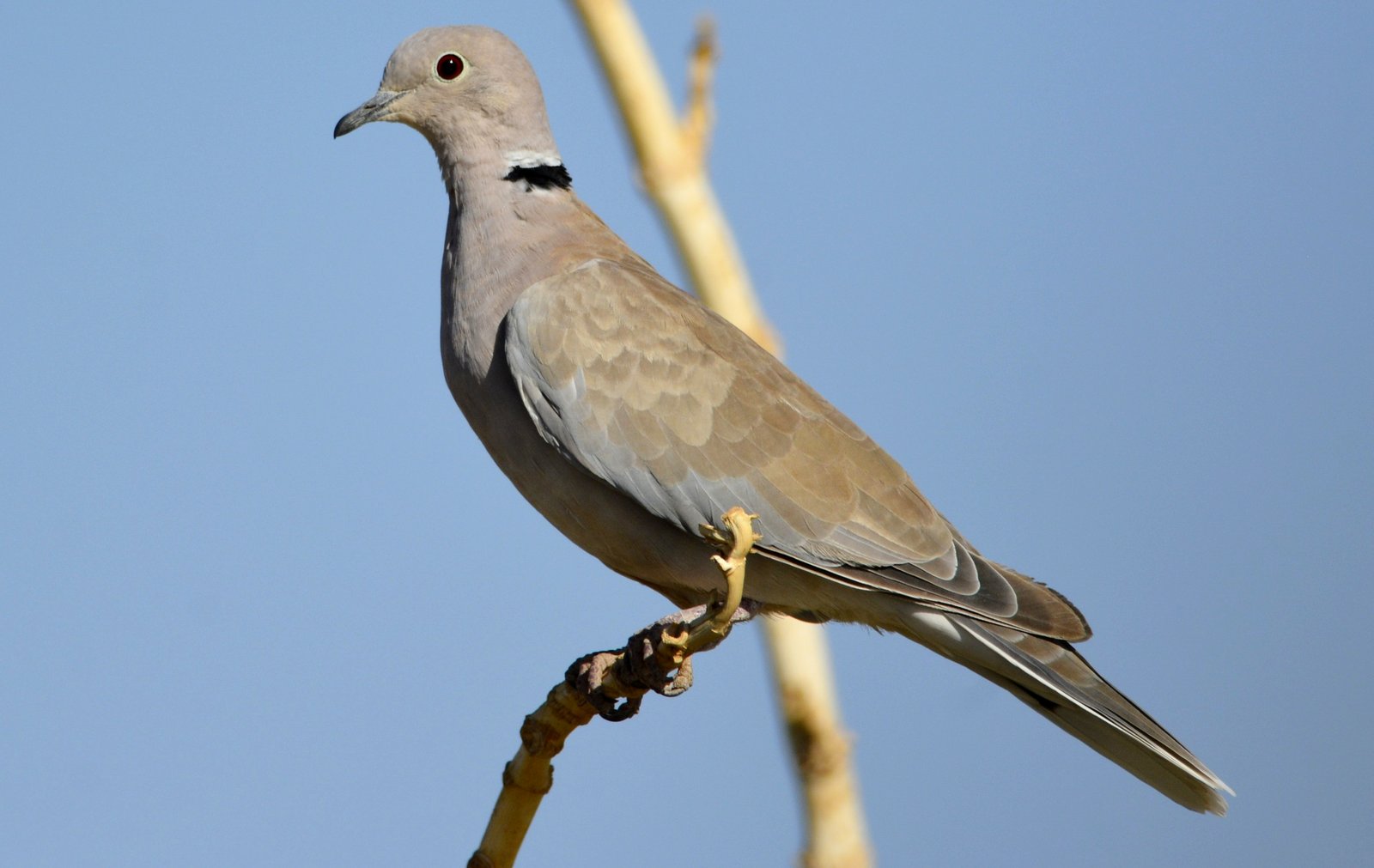
26–29 cm. A slender, pale cream to sandy dove with a narrow black half-collar on the hindneck. The head and breast are pale pinkish buff, the belly and undertail coverts white. The primaries are greyish brown and contrast little with the rest of the wing. The tail shows a dark base and broad white corners from below. Domestic birds vary in colour, from almost white to dark sandy brown. The sexes are alike.
Confusion species
Eurasian Collared-Dove Streptopelia decaocto is larger and greyer, with dark primaries, grey undertail coverts and a three-part call. Eared Dove Zenaida auriculata lacks a collar and has small black spots on the cheek and wings. West Peruvian Dove Zenaida meloda is larger and greyer, without a collar, and has a white wing band.
Habitat
In the guide area in towns, villages, parks and gardens, usually near houses or aviaries and often close to other pigeons. It eats seeds and grain on the ground. In its natural range the species lives in dry savanna and thorn scrub, where it builds a flimsy nest of twigs in a shrub or tree.
Where the bird is most at home, classified by the vegetation units of the Andes and the west coast.


Range and movements
Escaped birds are reported here and there, including in Colombia, Ecuador and Peru, mainly in towns; a bird in Manabí, Ecuador, proved on closer study to be a Barbary Dove rather than a Eurasian Collared-Dove. No self-sustaining wild population is known anywhere in the guide area. No data are known from Bolivia or the Galápagos. The native range is in the African Sahel and south-western Arabia.
- Winter visitor (c. Oct–Mar)
- Passage (Mar–Apr, Oct–Nov)
- dark = core range, pale = thinly spread
How and when to look
In parks and residential areas, look for pale doves with a black collar, which are often tame and walk among other pigeons; listen for the rolling coo to separate them from Eurasian Collared-Dove.
Conservation status
Least Concern. In the guide area these are escaped domestic birds with no known effect on native wildlife; they can, however, hybridise with Eurasian Collared-Dove.
Scientific name
Streptopelia roseogrisea | (Sundevall, 1857)
Sundevall described the species in 1857 as Columbam roseogriseam; because it was later moved to another genus, the author and year stand in brackets. The genus Streptopelia was introduced in 1855 by Bonaparte. The genus name comes from Greek streptos, 'collar', and peleia, 'dove'. The species name comes from Latin roseus, 'pink', and griseus, 'grey', after the plumage. The specimen the first description was based on came from Nubia (Sudan and southern Egypt).