All species › Pigeons and doves › Doves and pigeons › Rock Pigeon
Rock Pigeon | Columba livia
Rotsduif | Paloma bravía | Pombo-doméstico
The Rock Pigeon is the wild ancestor of the domestic and racing pigeon. In its natural range it breeds on cliffs and rock faces in Europe, North Africa and south-western Asia; the feral town pigeon now lives in cities throughout the world. It does not occur naturally in the guide area, but feral pigeons live in nearly every town and village.
Voice
A soft, rolling coo, roughly oo-roo-coo, often given in display with the neck puffed out. On take-off the wings clap audibly.
Recording: Paul Marvin — CC BY-NC-SA 4.0 · xeno-canto
Identification
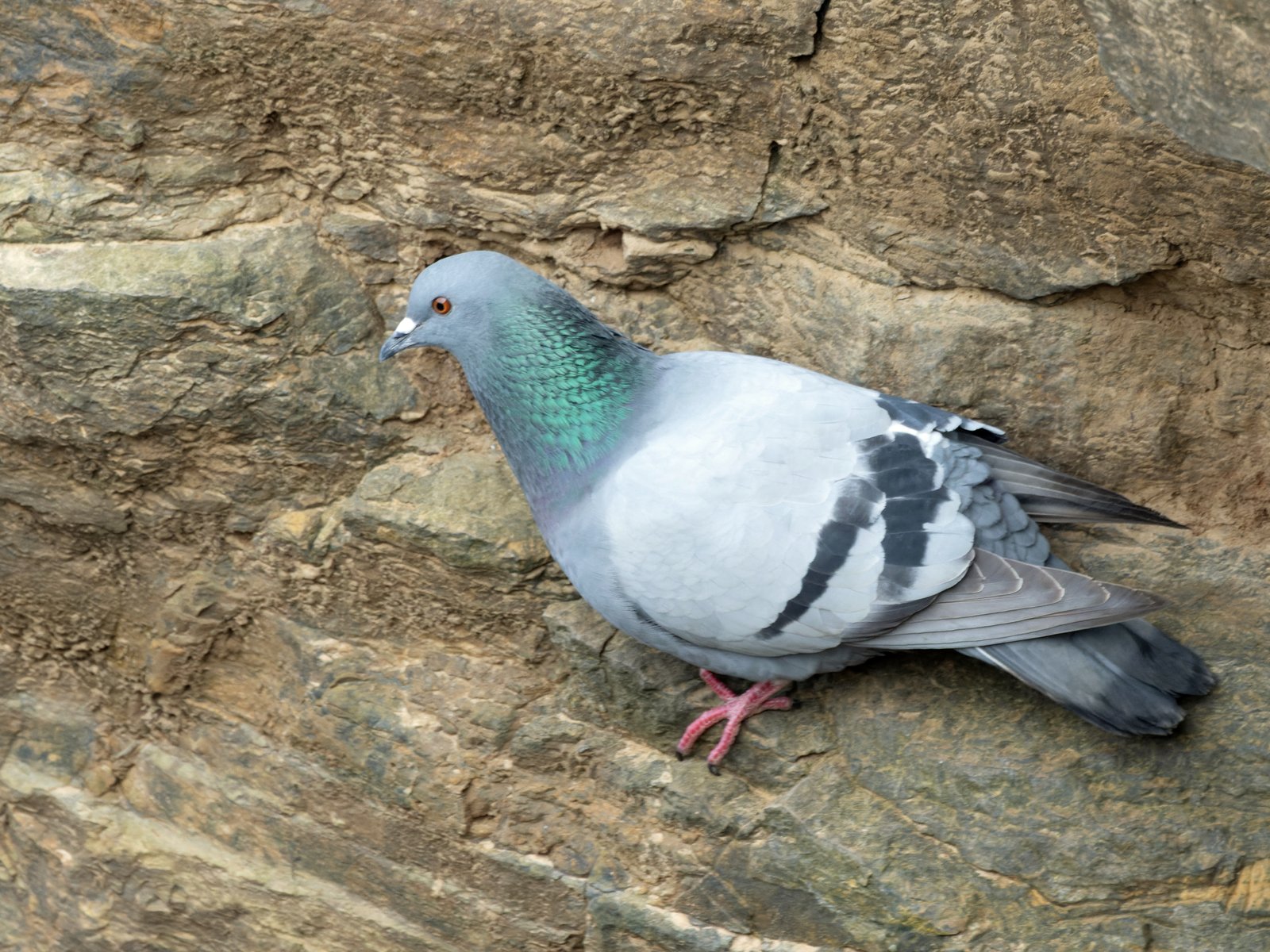
31–34 cm. The original form is blue-grey, with a green and purple glossed neck, two black wing bars, a white rump and a dark terminal tail band. The underwings are white. Feral town pigeons vary greatly: from almost white through brown, pied and chequered to almost black, often with traces of the original pattern. The bill is dark with a white cere, the iris orange, the legs red. The sexes are similar.
Confusion species
Spot-winged Pigeon Patagioenas maculosa has white spots on the wings and no white rump. Band-tailed Pigeon Patagioenas fasciata has a white half-collar, a yellow bill and a pale terminal tail band, and lives in montane forest. Picazuro Pigeon Patagioenas picazuro has a continuous white wing band and a scaled nape patch, but no white rump.
Habitat
Towns, villages, squares, markets, ports, grain stores and fields, from the coast to high in the Andes. It eats seeds, grain and food scraps, nearly always on the ground and often in flocks. The nest is an untidy platform on a building ledge, under a bridge or in a rock face.
Where the bird is most at home, classified by the vegetation units of the Andes and the west coast.


Range and movements
Feral in all towns and larger villages of Colombia, Ecuador, Peru and Bolivia, from the Pacific coast up to the altiplano. On the Galápagos feral pigeons were removed in the 2000s to prevent disease transmission to the Galapagos Dove. Native to Europe, North Africa and south-western Asia; worldwide as a feral town pigeon.
- Resident
- dark = core range, pale = thinly spread
How and when to look
In any town on squares, at churches and markets; in flocks, look for birds with the original blue-grey pattern with white rump and black wing bars.
Conservation status
Least Concern. In the guide area an introduced species; feral pigeons can transmit diseases and parasites to native doves.
Scientific name
Columba livia | Gmelin, 1789
Gmelin described the species in 1789 and placed it straight away in the genus where it still stands. The genus Columba was introduced in 1758 by Linnaeus. The genus name is Latin columba, 'dove, pigeon'. The species name comes from Medieval Latin livia, 'pigeon', from Latin lividus, 'bluish grey, leaden'. The specimen the first description was based on came from southern Europe.