All species › Pigeons and doves › Doves and pigeons › Mourning Dove
Mourning Dove | Zenaida macroura
Treurduif | Paloma huilota | Pomba-carpideira
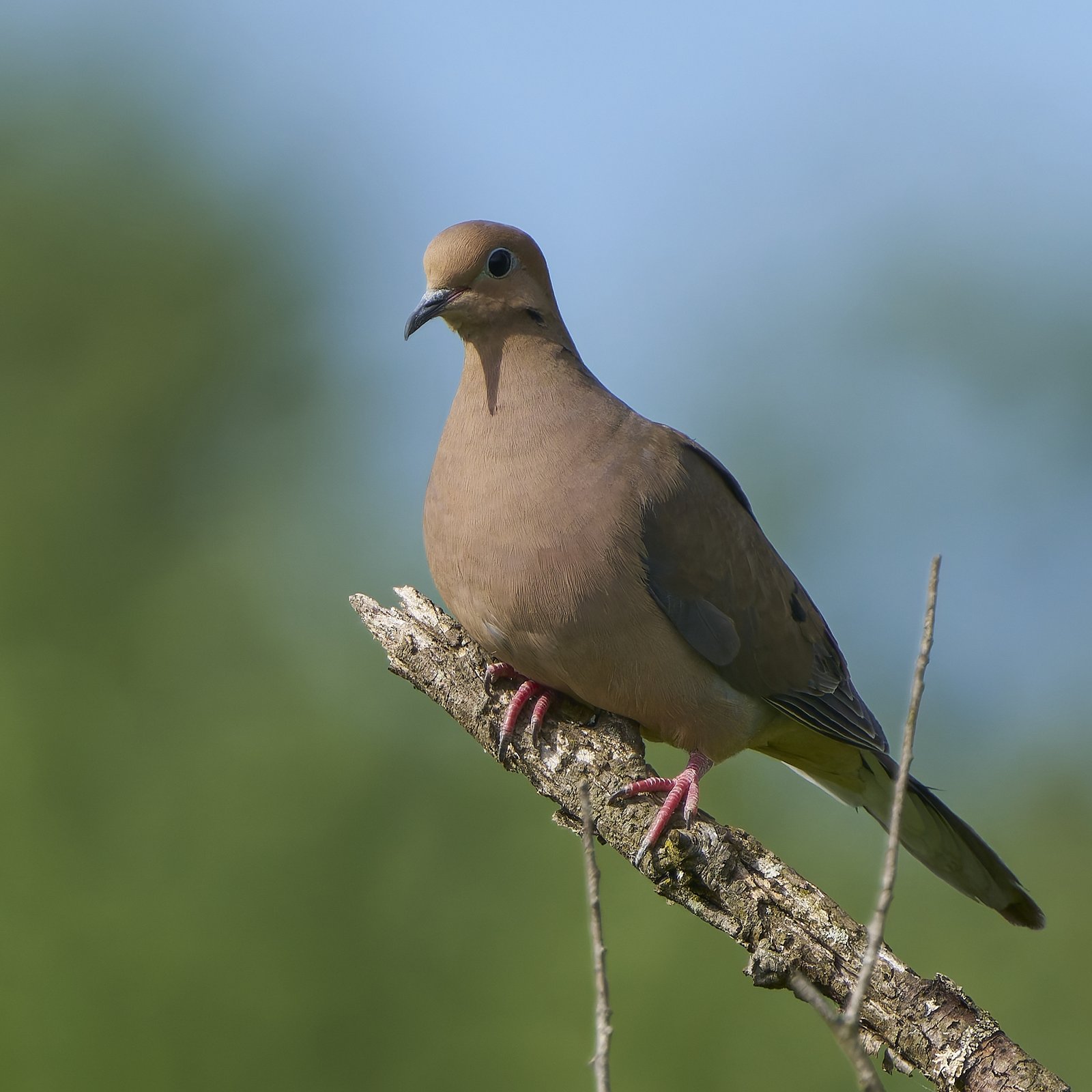
The Mourning Dove is a slender, brownish dove with a long, pointed tail, one of the commonest birds of North America. In the guide area it has been recorded only as a very rare vagrant. Its plaintive cooing gave the species its name in several languages.
Voice
A soft, plaintive cooing, oo-ooo-oo-oo-oo, the second note slightly higher. The wings make a whistling sound on take-off.
Recording: FREDERIC Lionel — CC BY-NC-SA 4.0 · xeno-canto
Identification
27–33 cm, slender, with a small head and a long, tapering, pointed tail. Upperparts greyish brown, with a few black spots on the tertials and coverts. Head and underparts pale buffy brown, with a small black spot below the ear coverts and a pink gloss on the sides of the neck. Pale bluish eye-ring. The outer tail feathers have a black band and white tips, visible as white edges along the pointed tail in flight. Legs pinkish red. The female is browner and duller; young birds have pale feather fringes.
Confusion species
Eared Dove Zenaida auriculata has a shorter, rounded tail, a second black line behind the eye and more rufous underparts. White-winged Dove Zenaida asiatica is stockier, with a short tail and a white band in the wing. West Peruvian Dove Zenaida meloda also has a white wing band and a short tail.
Habitat
In the breeding range open country with scattered trees, fields, pastures, gardens and towns. It eats almost only seeds, gathered on the ground. The nest is a flimsy platform of twigs in a tree or shrub.
Where the bird is most at home, classified by the vegetation units of the Andes and the west coast.


Range and movements
In the guide area recorded only a few times as a vagrant, in the north (Colombia); there is no site or season of regular occurrence. Absent from the rest of the guide area and from the Galápagos. Breeds from southern Canada to Mexico, locally to Panama and in the Caribbean; northern birds move south in winter, as far as Central America.
How and when to look
A vagrant may turn up among other doves in fields and open country in northern Colombia during the northern winter. Look for the long, pointed tail with white edges in flight.
Conservation status
Least Concern. Very common in North America, with a population of many tens of millions, despite intensive hunting.
Scientific name
Zenaida macroura | (Linnaeus, 1758)
Linnaeus described the species in 1758 as Columba macroura; because it was later moved to another genus, the author and year stand in brackets. The genus Zenaida was introduced in 1838 by Bonaparte. The genus name honours Zénaïde Laetitia Julie Bonaparte (1801–1854), wife of Charles Lucien Bonaparte, who described the genus, and niece of Napoleon. The species name comes from Greek makros, 'long', and oura, 'tail'. The specimen the first description was based on came from West Indies.