All species › Passerines › Tanagers and allies › Fawn-breasted Tanager
Fawn-breasted Tanager | Pipraeidea melanonota
Maskertangare | Tangara de antifaz | Saíra-viúva
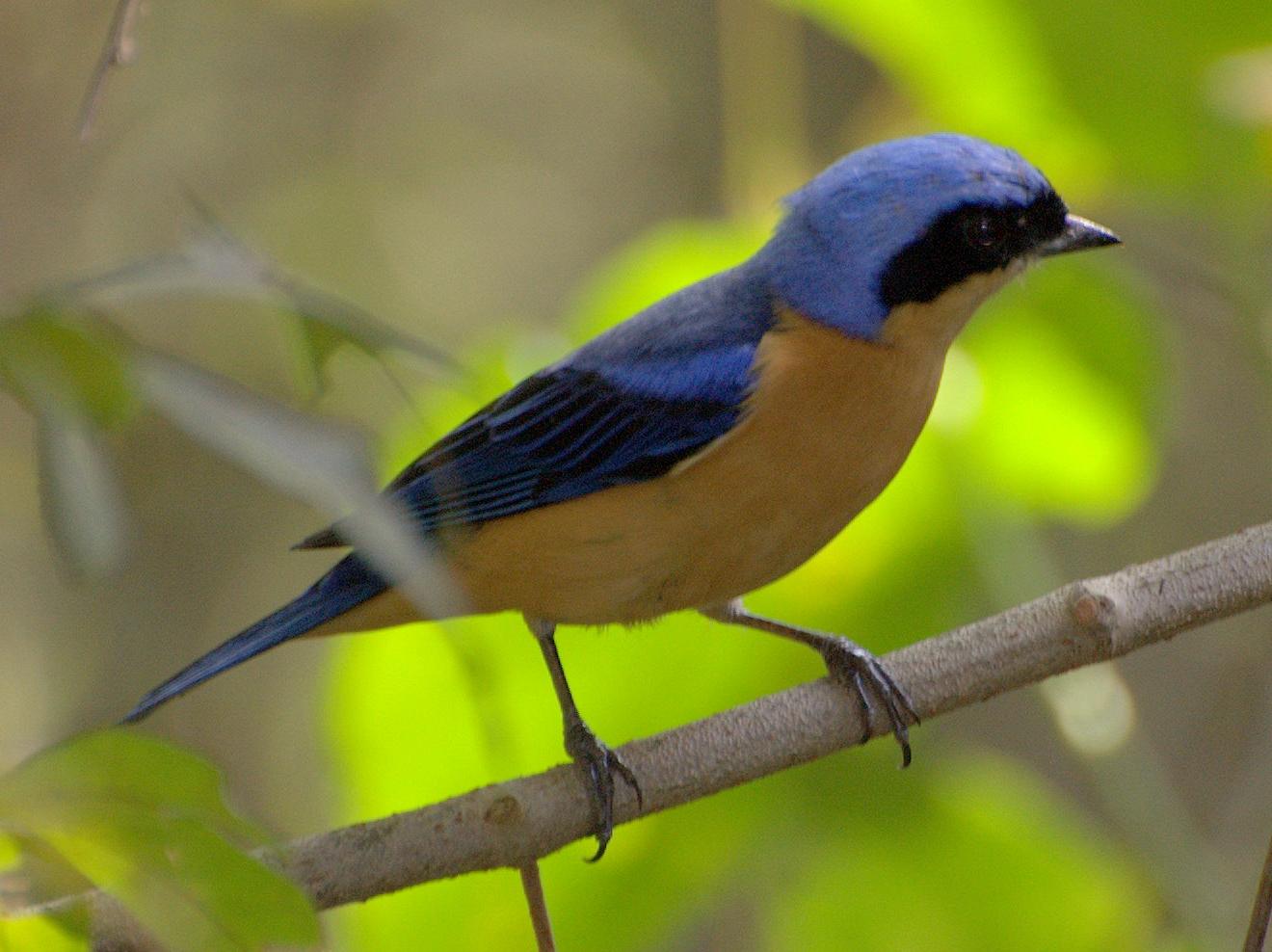
The Fawn-breasted Tanager is a small tanager of forest edges and semi-open country in the Andes, with a pale blue crown, a black mask and ochre underparts. It often sits still for long periods on a bare branch or in a treetop and eats fruit, insects and mistletoe berries.
Voice
Gives high, fine tseet notes; the song is a short, high and somewhat shrill series of notes.
Recording: JUAN ANTONIO ALONSO DE JUAN — CC BY 4.0 · xeno-canto
Identification
14 cm, with a short, thick bill and a red iris. The male has a pale sky-blue crown, nape and rump, a black mask from forehead to ear coverts and a dark blue-black back. Wings and tail are blackish with blue edges. The underparts are plain ochre-buff to warm tawny. The female is duller: crown greyish blue, back greyish olive-brown, mask less sharp and underparts paler. Juveniles resemble the female.
Confusion species
Masked Flowerpiercer Diglossa cyanea also has a black mask, but is entirely blue, including the underparts, and has a small hook at the bill tip. Blue-capped Tanager Sporathraupis cyanocephala has a blue cap and black face, but an olive-green back and grey underparts. Blue-and-yellow Tanager Rauenia bonariensis of dry valleys is larger, with a yellow to orange breast and rump.
Habitat
Edges of humid montane forest, clearings, secondary woodland, tree rows, coffee plantations, parks and gardens, mostly from about 1500 to 2800 m, locally lower or above 3000 m. It eats fruit, especially of mistletoes, and takes insects from twigs and in short sallies. The nest is an open cup in a tree or shrub.
Where the bird is most at home, classified by the vegetation units of the Andes and the west coast.


Range and movements
In Colombia in all three Andean ranges, the Sierra de Perijá and the Sierra Nevada de Santa Marta. In Ecuador on both slopes and in the inter-Andean valleys. In Peru along the Andes from north to south, mainly on the eastern slope. In Bolivia on the eastern slope of the Andes and in the Yungas. Does not occur on the Galápagos. Outside the guide area in Venezuela and north-western Argentina, with a separate population in south-eastern Brazil, Paraguay, Uruguay and north-eastern Argentina.
- Resident
- dark = core range, pale = thinly spread
How and when to look
Search forest edges and gardens with fruit trees and mistletoes in mountain villages, and look for a bird that sits still for a long time high in a bare tree; the ochre underparts show as soon as it turns around.
Conservation status
Least Concern. Widespread but usually at low density; tolerates semi-open and disturbed land.
Scientific name
Pipraeidea melanonota | (Vieillot, 1819)
Vieillot described the species in 1819 as Tanagra melanonota; because it was later moved to another genus, the author and year stand in brackets. The genus Pipraeidea was introduced in 1827 by Swainson. The genus name combines the genus Pipra (manakins) with Ancient Greek eidos, 'form, likeness'. The species name comes from Ancient Greek melas, 'black', and nōtos, 'back'. The specimen the first description was based on came from Rio de Janeiro, Brazil.