All species › Passerines › Tanagers and allies › Slender-billed Finch
Slender-billed Finch | Xenospingus concolor
Zwartteugelgors | Yal picofino | Tico-tico-de-bico-fino
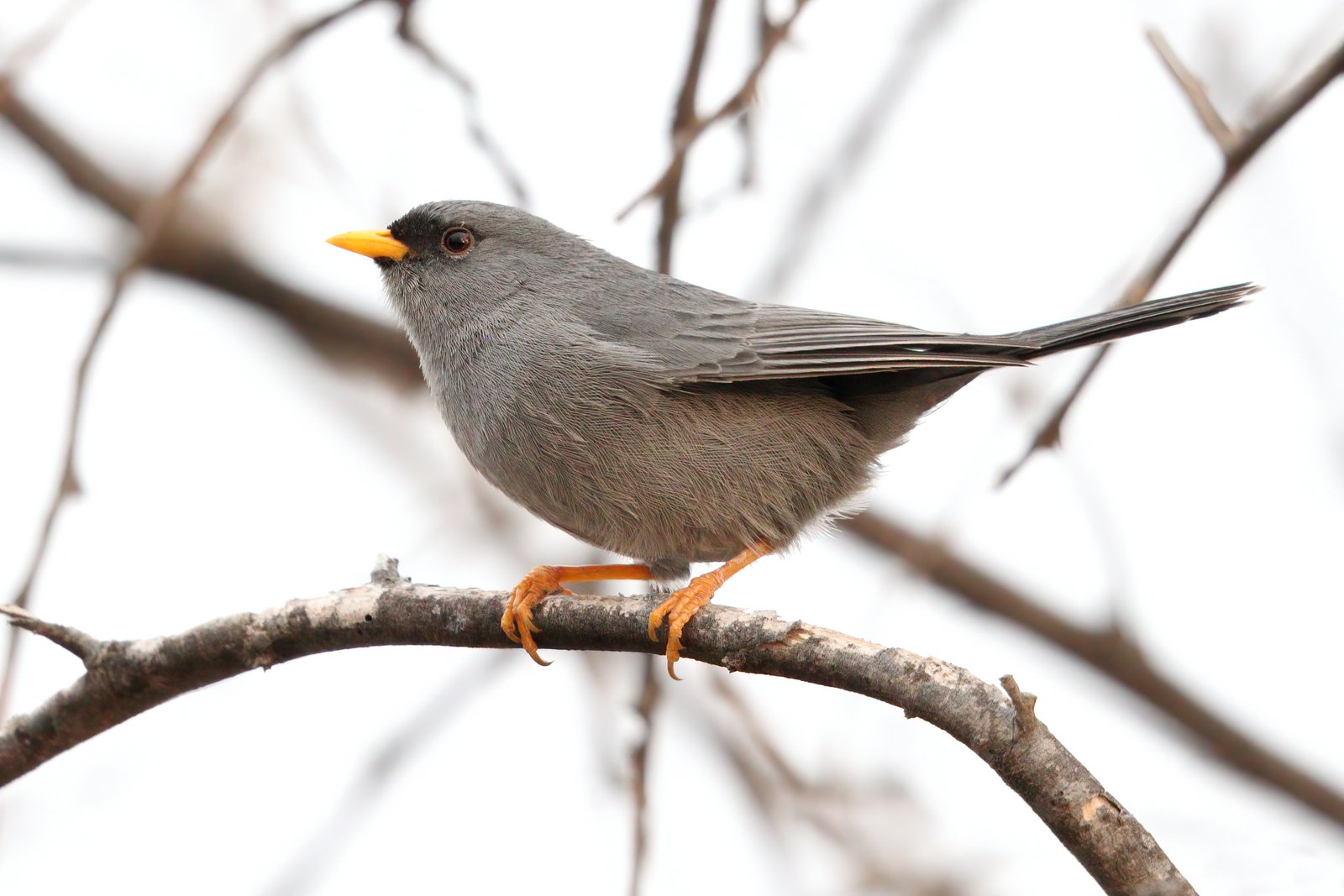
The Slender-billed Finch is a slim, long-tailed, uniformly grey finch of vegetated river valleys in the coastal desert of south-western Peru and northern Chile. The thin, pointed, yellow bill is unusual for a finch. The species is closely tied to riparian scrub, which is scarce in this dry region.
Voice
The song is a short, fast series of high, clear notes and trills. The call is a high, thin tseep.
Recording: Fabrice Schmitt — CC BY-NC-SA 4.0 · xeno-canto
Identification
15 cm, slim, with a long tail, a thin, pointed, slightly curved yellow bill and yellow legs. The plumage is uniform bluish grey, slightly paler below, with black lores reaching the bill. Sexes alike; the female is sometimes slightly duller. Young birds are brownish grey, with pale streaks below and a duller bill.
Confusion species
Cinereous Finch Piezorina cinerea is paler grey, with a heavy, conical bill, and lives further north. Cinereous Conebill Conirostrum cinereum is smaller, with a dark bill, a white eyebrow and a white wing patch. Males of Mourning Sierra Finch Rhopospina fruticeti are darker, with a black throat and breast, white wing bars and a thicker bill.
Habitat
Riparian scrub of reeds, Tessaria and other shrubs, Prosopis thickets, olive groves, field edges and gardens in river valleys and oases of the coastal desert, from sea level to roughly 2500 m, mostly lower. It searches shrubs and low on the ground for insects, seeds and nectar. The nest is a cup in a shrub.
Where the bird is most at home, classified by the vegetation units of the Andes and the west coast.


Range and movements
In Peru in the river valleys and oases of the southern coast, from Lima and Ica through Arequipa and Moquegua to Tacna. Absent from Colombia, Ecuador, Bolivia and the Galápagos. Outside the guide area only in the far north of Chile.
- Resident
- dark = core range, pale = thinly spread
How and when to look
Search riparian scrub and olive groves in the valleys of Arequipa, Moquegua and Tacna or near Ica. The birds forage in pairs or family groups in the shrubs.
Conservation status
Near Threatened. Its habitat consists of narrow strips of riparian scrub in the desert, which are cleared or converted to farmland and dry out through water extraction. In some valleys the species is still fairly common, and it also uses olive groves and gardens.
Scientific name
Xenospingus concolor | (d'Orbigny, ACVMD & de Lafresnaye, 1837)
D'Orbigny, ACVMD & de Lafresnaye described the species in 1837 as Sylvia concolor; because it was later moved to another genus, the author and year stand in brackets. The genus Xenospingus was introduced in 1867 by Cabanis. The genus name combines Greek xenos, 'strange, different', with spingos, 'finch'. The species name is Latin concolor, 'uniform, plain', for the even grey plumage. The specimen the first description was based on came from Arica, Chile.