All species › Passerines › Tanagers and allies › Crimson-breasted Finch
Crimson-breasted Finch | Rhodospingus cruentus
Purperkroongors | Pinzón pechicarmesí | Tico-tico-de-peito-carmim
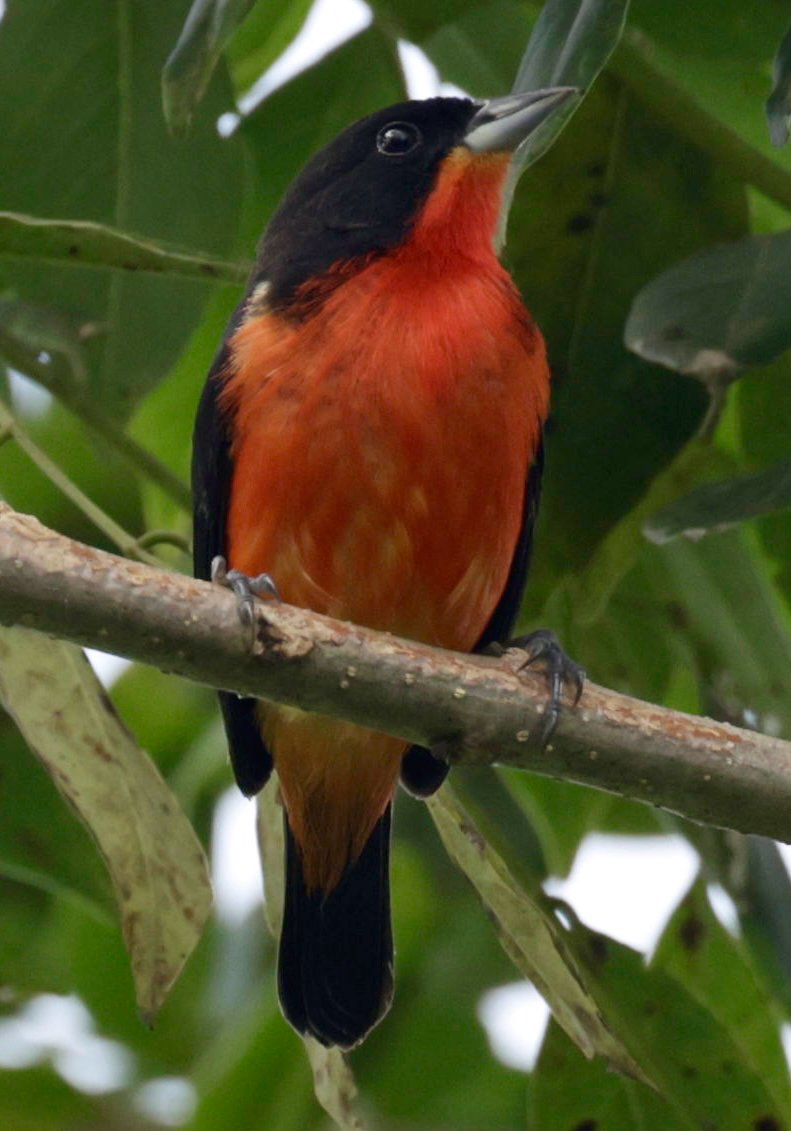
The Crimson-breasted Finch is a small, black-and-red tanager with a short, pointed bill, of the dry forest and scrub of western Ecuador and north-western Peru. The male is black above with a red crown stripe and crimson below. The species is numerous mainly in the rainy season and wanders at other times.
Voice
A high, thin, buzzy or trilled song, often repeated from an exposed branch; the call is a short, high tsit.
Recording: John V. Moore — CC BY-NC-SA 4.0 · xeno-canto
Identification
11–12 cm, with a short, pointed bill. The male is black above with a scarlet crown stripe, and has a crimson throat and breast that become pink to orange-red on the belly. The female is olive-brown above and buffy below, with no red. Young males at first resemble the female and gradually acquire black and red.
Confusion species
Male Chestnut-throated Seedeater Sporophila telasco is grey above with a small chestnut throat patch and white below. Blue-black Grassquit Volatinia jacarina is glossy blue-black with no red. Females resemble female seedeaters Sporophila, but have a more pointed, less heavy bill.
Habitat
Dry deciduous forest, scrub, forest edges and overgrown fields in the lowlands and lower foothills, mostly below 800 m. It forages in pairs or small groups on the ground and low in bushes for seeds and insects. It breeds in the rainy season; the nest is a small open cup in a shrub.
Where the bird is most at home, classified by the vegetation units of the Andes and the west coast.


Range and movements
In Ecuador in the dry western lowlands, mainly from Manabí and Guayas to El Oro and Loja. In Peru in the north-west, in Tumbes and Piura, south to Lambayeque. Absent from Colombia, Bolivia and the Galápagos. Does not occur outside the guide area.
- Resident
- dark = core range, pale = thinly spread
How and when to look
In the rainy season (roughly January to May) in the dry forest of western Ecuador and Tumbes, for example in Machalilla or around the town of Tumbes, where males sing from bare branches.
Conservation status
Least Concern. The dry forest of the Tumbes region is heavily degraded, but the species tolerates scrub and overgrown fields.
Scientific name
Rhodospingus cruentus | (Lesson, 1844)
Lesson described the species in 1844 as Tiaris cruentus; because it was later moved to another genus, the author and year stand in brackets. The genus Rhodospingus was introduced in 1888 by Sharpe. The genus name combines Greek rhodon, 'rose', and spingos, 'finch'. The species name comes from Latin cruentus, 'bloody', for the red breast. The specimen the first description was based on came from Guayaquil, Ecuador.