All species › Passerines › Tanagers and allies › Palm Tanager
Palm Tanager | Thraupis palmarum
Palmtangare | Tangara palmera | Sanhaço-do-coqueiro
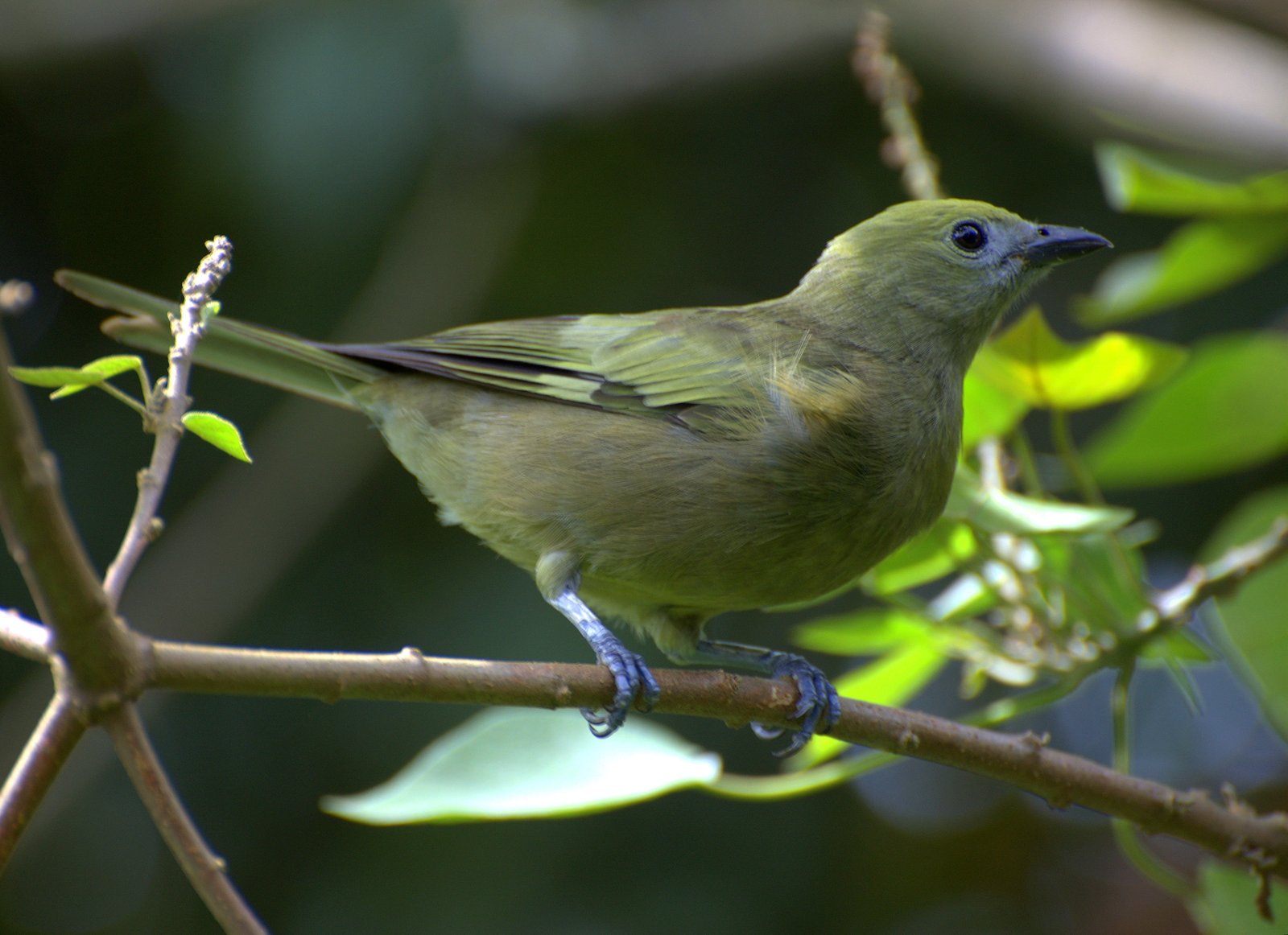
The Palm Tanager is a medium-sized, olive-grey tanager strongly tied to palms, found in the lowlands of the guide area almost everywhere there are palms and clearings. It lives in pairs and small groups and clambers nimbly along palm fronds, also upside down.
Voice
Gives sharp chip and tseep notes. The song is a rapid, squeaky and twittering series, similar to that of Blue-grey Tanager but slightly fuller.
Recording: JAYRSON ARAUJO DE OLIVEIRA — CC BY-NC-SA 4.0 · xeno-canto
Identification
18 cm, with a fairly thick, dark bill. The plumage is olive-grey with a yellowish or violet sheen depending on the light, the forehead slightly yellower. The wing is two-toned: the coverts and the base of the flight feathers are pale olive-green, the rest of the flight feathers blackish, which gives a clear pattern especially in flight. The sexes are alike. Juveniles are duller.
Confusion species
Blue-grey Tanager Thraupis episcopus is blue-grey, without a two-toned wing. Glaucous Tanager Thraupis glaucocolpa in northern Colombia is greyer, with a blue-green wing patch and a whitish belly. Blue-capped Tanager Sporathraupis cyanocephala has a blue cap and lives higher in montane forest.
Habitat
Forest edges, open woodland, secondary growth, palm swamps, oil palm and coconut plantations, gardens and villages, from the lowlands to about 1500 m, locally higher. It searches for insects and fruit, often in palm crowns and on the underside of palm fronds, and comes to fruiting trees. The nest is a cup, often among the leaf bases of a palm or under a roof.
Where the bird is most at home, classified by the vegetation units of the Andes and the west coast.


Range and movements
In Colombia widespread in the lowlands and lower slopes east and west of the Andes. In Ecuador on both sides of the Andes. In Peru in Amazonia and on the lower eastern slope. In Bolivia in the lowlands and foothills of the north and east. Does not occur on the Galápagos. Outside the guide area from Central America to southeastern Brazil and Paraguay.
- Resident
- dark = core range, pale = thinly spread
How and when to look
Check palms near villages, lodges and along rivers in the lowlands; the birds often clamber along the underside of palm fronds and show the two-toned wing in flight.
Conservation status
Least Concern. Very common and widespread; benefits from palm planting and open, human-modified land.
Scientific name
Thraupis palmarum | (Wied-Neuwied, 1821)
Wied-Neuwied described the species in 1821 as Tanagra palmarum; because it was later moved to another genus, the author and year stand in brackets. The genus Thraupis was introduced in 1826 by Boie. The genus name is Greek thraupis, an unidentified small bird mentioned by Aristotle. The species name is Latin palmarum, 'of the palms', for the species' preference for palm trees. The specimen the first description was based on came from Canavieiras, Bahia, Brazil.