All species › Passerines › Tanagers and allies › Glaucous Tanager
Glaucous Tanager | Thraupis glaucocolpa
Blauwgroene tangare | Tangara glauca | Sanhaço-glauco
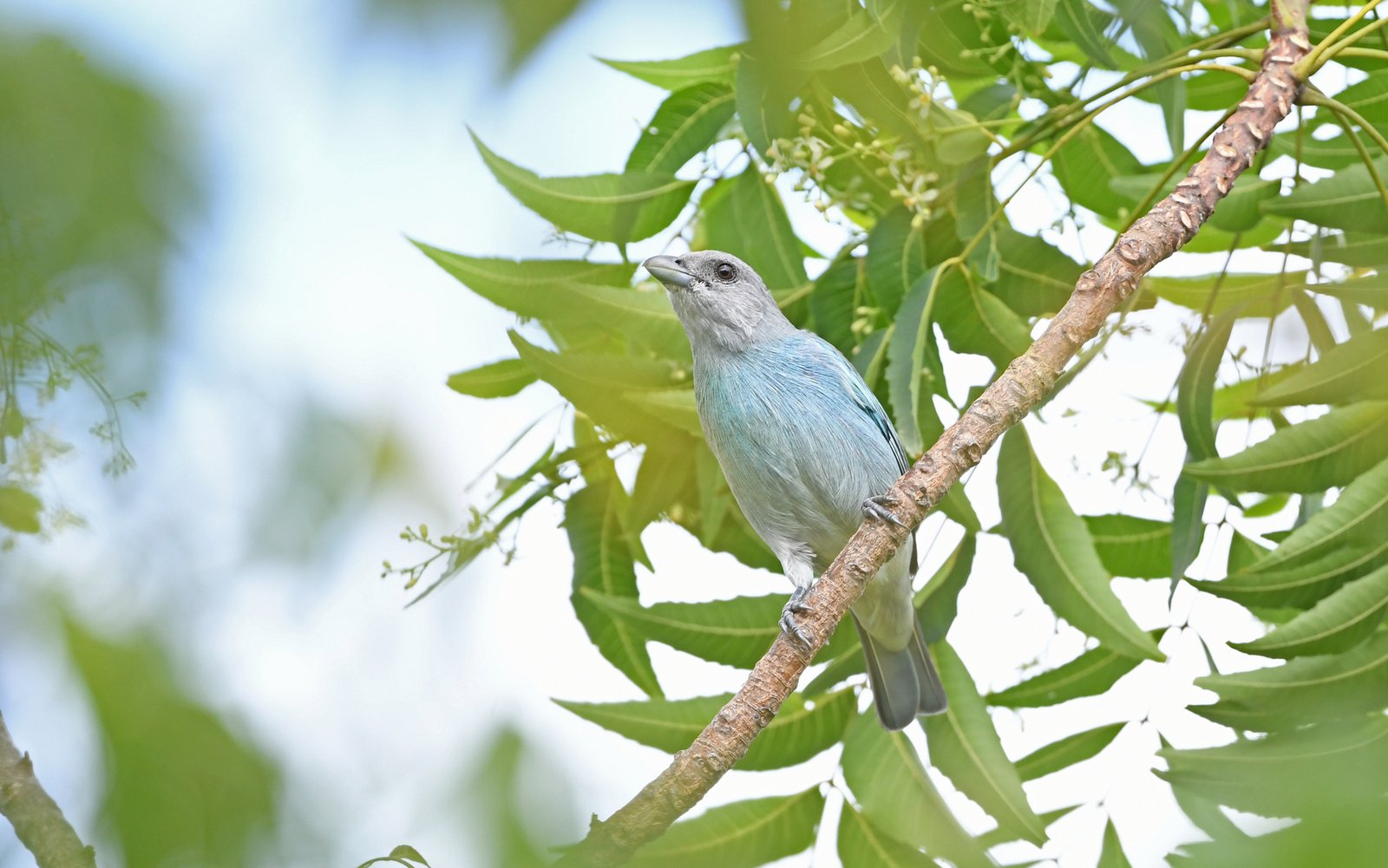
The Glaucous Tanager is a medium-sized, grey tanager of dry lowlands in northern Colombia and Venezuela. It resembles a grey Blue-grey Tanager, but has a blue-green wing patch and a pale belly and lives in drier, more open vegetation.
Voice
Gives thin tseep notes; the song is a short, squeaky and twittering series, thinner and higher than that of Blue-grey Tanager.
Recording: Francisco contreras — CC BY-NC-SA 4.0 · xeno-canto
Identification
16 cm, with a fairly thick, dark bill and blackish lores. Upperparts grey with a blue-green tinge, underparts paler grey, whitish towards the belly and undertail coverts. The wing is dark with a blue-green to turquoise patch on the primaries and blue-green edges to the coverts. The sexes are alike. Juveniles are duller.
Confusion species
Blue-grey Tanager Thraupis episcopus is bluer, without a whitish belly and without a defined blue-green patch on the primaries. Palm Tanager Thraupis palmarum is olive-grey, with a two-toned wing of pale olive-green front and blackish flight feathers.
Habitat
Dry forest, thorn scrub, open woodland with cacti, edges of gallery forest, pastures with trees, gardens and villages in the lowlands, mostly below about 600 m. It eats fruit, nectar and insects, in pairs or small groups. The nest is a cup in a tree or shrub.
Where the bird is most at home, classified by the vegetation units of the Andes and the west coast.


Range and movements
In Colombia in the dry Caribbean lowlands, from the Gulf of Urabá and Córdoba east to La Guajira and the lowlands of the Magdalena and Cesar. Does not occur in Ecuador, Peru, Bolivia or on the Galápagos. Outside the guide area in northern Venezuela.
- Resident
- dark = core range, pale = thinly spread
How and when to look
Search dry scrub and open woodland at the foot of the Sierra Nevada de Santa Marta and in La Guajira, for example around Riohacha; the birds often perch in treetops and on cacti.
Conservation status
Least Concern. Fairly common in a fairly small range; tolerates semi-open, human-modified land.
Scientific name
Thraupis glaucocolpa | Cabanis, 1851
Cabanis described the species in 1851 and placed it straight away in the genus where it still stands. The genus Thraupis was introduced in 1826 by Boie. The genus name is Greek thraupis, an unidentified small bird mentioned by Aristotle. The species name combines Greek glaukos, 'bluish-grey', with kolpos, 'bosom', for the glaucous breast. The specimen the first description was based on came from Caracas, Venezuela.