All species › Passerines › Ovenbirds and woodcreepers › Flammulated Treehunter
Flammulated Treehunter | Thripadectes flammulatus
Andesboomjager | Trepamusgos flamulado | Barranqueiro-flamulado
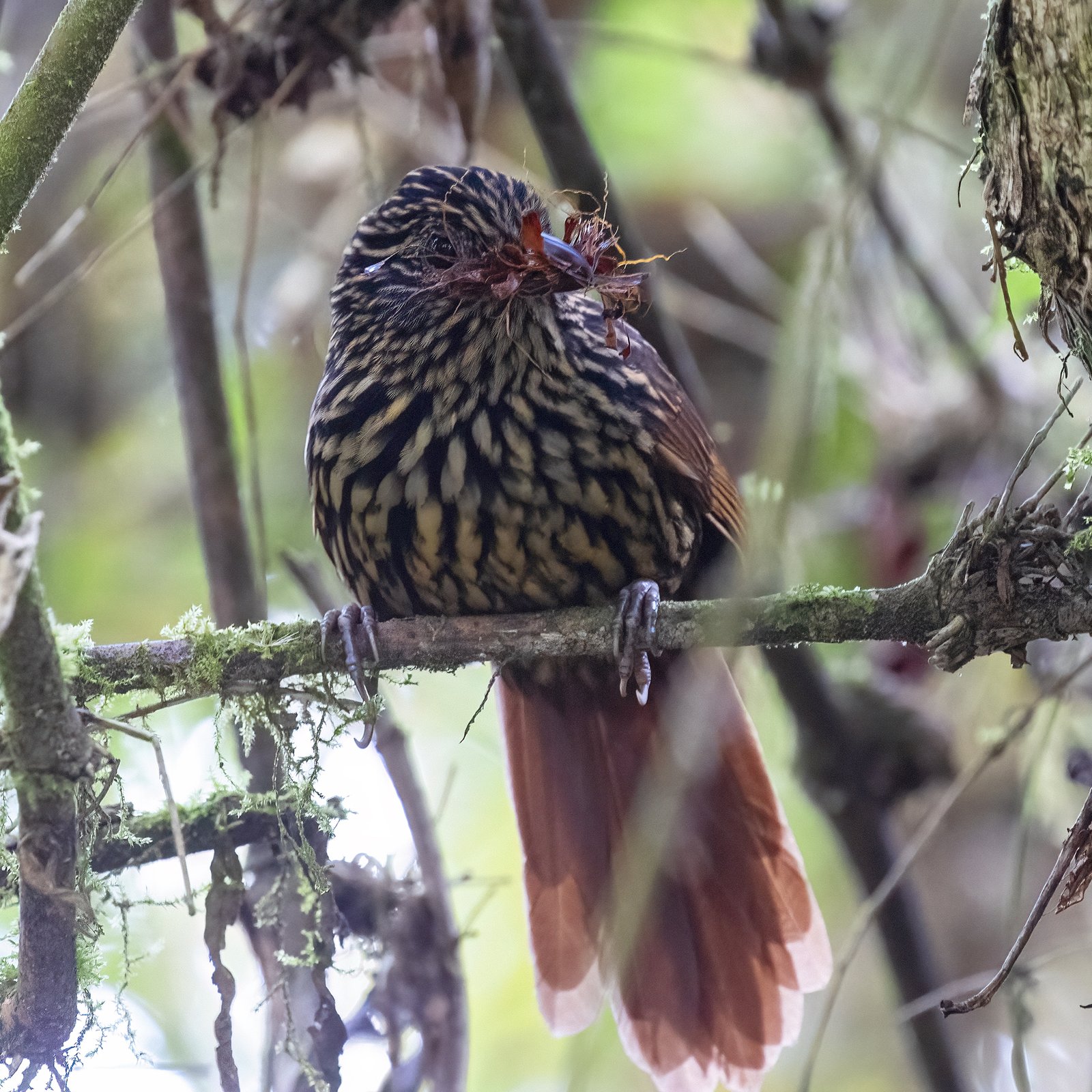
The Flammulated Treehunter is a large, blackish treehunter with broad ochre streaks, of upper montane forest in the northern Andes. It lives hidden in dense undergrowth, often with Chusquea bamboo, and is usually heard first. Of the treehunters of the guide area it is the heaviest and the most boldly streaked.
Voice
The song is a series of grating notes that begins as a stutter and then accelerates and grows louder. The contact call is an emphatic, sharp check.
Recording: Brian Cox — CC BY-NC-SA 4.0 · xeno-canto
Identification
24–25 cm, with a heavy, straight, blackish bill. The head, mantle and underparts down to the lower belly are blackish with broad ochre streaks. The throat is ochre with fine dark edges. The wings and tail are plain rufous to chestnut. The sexes are alike.
Confusion species
Striped Treehunter Thripadectes holostictus is smaller, with finer streaks and a less streaked belly, and usually lives lower. Black-billed Treehunter Thripadectes melanorhynchus has a plainer, browner back and lives lower on the eastern slope. Streak-capped Treehunter Thripadectes virgaticeps has streaks only on the head and throat and a plain back.
Habitat
Humid upper montane forest and cloud forest with dense undergrowth, often with bamboo, also forest edges and ravines, mostly from 2200 to 3500 m and locally lower. It forages in the undergrowth and lower mid-storey, searching dead leaves, moss and bromeliads with its heavy bill for insects and other arthropods. As in other treehunters, the nest is in a tunnel in an earthen bank.
Where the bird is most at home, classified by the vegetation units of the Andes and the west coast.


Range and movements
Colombia: the three Andean ranges. Ecuador: both slopes of the Andes. Peru: only the far north, adjoining Ecuador. Absent from Bolivia and the Galápagos. Outside the guide area in the Andes of western Venezuela.
- Resident
- dark = core range, pale = thinly spread
How and when to look
Search along trails and roads through cloud forest with dense bamboo at 2500 to 3200 m and listen for the grating, accelerating song. The bird usually stays low and hidden; wait quietly near an opening in the undergrowth.
Conservation status
Least Concern. The species has a fairly large range in the northern Andes, but is sensitive to the clearing of montane forest.
Scientific name
Thripadectes flammulatus | (Eyton, 1849)
Eyton described the species in 1849 as Anabates flammulatus; because it was later moved to another genus, the author and year stand in brackets. The genus Thripadectes was introduced in 1862 by Sclater. The genus name comes from Greek thrips 'woodworm' and dēktēs 'biter' (from daknō 'to bite'). The species name is New Latin flammulatus, 'marked with little flames', after the flame-like streaks. The specimen the first description was based on came from Bogotá, Colombia.