All species › Passerines › Ovenbirds and woodcreepers › Peruvian Treehunter
Peruvian Treehunter | Thripadectes scrutator
Schubkeelboomjager | Trepamusgos peruano | Barranqueiro-peruano
The Peruvian Treehunter is one of the largest treehunters, a heavy, dark ovenbird of high cloud forest in Peru and Bolivia. It is closely tied to dense stands of Chusquea bamboo just below the treeline. It was formerly treated as a subspecies of Flammulated Treehunter; the two are separated by the Marañón.
Voice
The song is a loud rattle of rapid notes that rises and falls, speeding up and slowing down. The call is a sharp, loud click, roughly chek.
Recording: Andrew Spencer — CC BY-NC-SA 4.0 · xeno-canto
Identification
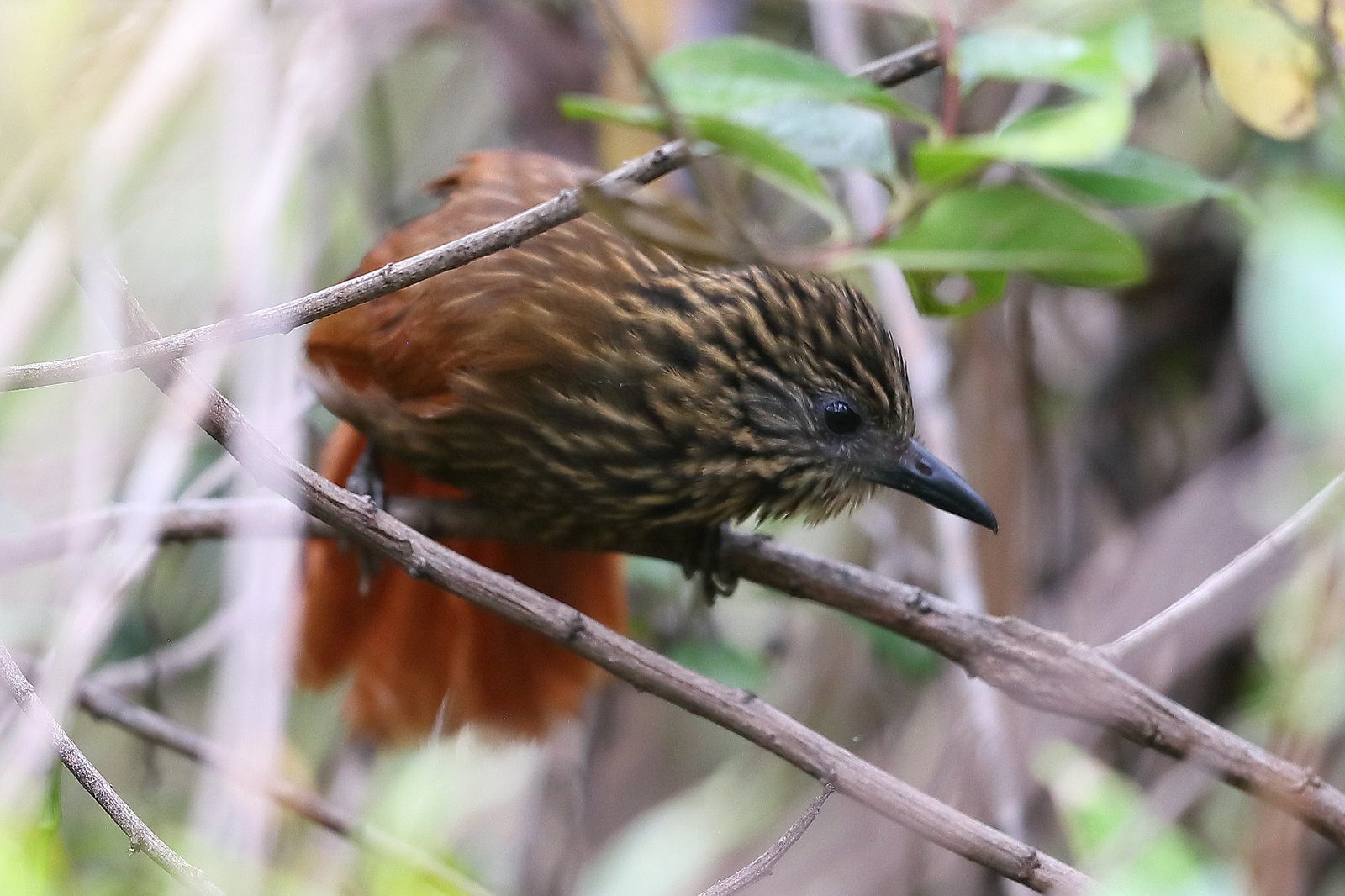
23–24 cm, a bulky, dark treehunter with a heavy, black bill. The head, neck and upper back are blackish with diffuse buff streaks; the rump, wing coverts and tail are chestnut. The throat and breast are blackish with dense buff streaks, broadest on the upper breast, giving a scaly look. The rest of the underparts are brown with faint streaks, and the undertail coverts are rufous. The iris is dark brown. The sexes are alike; southern birds are more reddish.
Confusion species
Striped Treehunter Thripadectes holostictus is smaller, with finer streaks and a less heavy bill, and usually lives lower. Black-billed Treehunter Thripadectes melanorhynchus is smaller, with an almost plain brown back, and lives much lower, between 1000 and 1700 m. Flammulated Treehunter Thripadectes flammulatus is very similar but lives north and west of the Marañón. Streaked Tuftedcheek Pseudocolaptes boissonneautii has white tufts on the sides of the neck and creeps along branches.
Habitat
High cloud forest and elfin forest on the eastern slope of the Andes, roughly between 2450 and 3500 m, mainly where large, dense stands of Chusquea bamboo grow. It searches the undergrowth for insects and other invertebrates in moss, dead leaves and bamboo. Like other treehunters it probably nests in a self-dug tunnel in an earth bank.
Where the bird is most at home, classified by the vegetation units of the Andes and the west coast.


Range and movements
In Peru on the eastern slope of the Andes from Amazonas southward, south and east of the Marañón, to Puno. In Bolivia on the eastern slope to Cochabamba. Absent from Colombia, Ecuador and the Galápagos. Does not occur outside the guide area.
- Resident
- dark = core range, pale = thinly spread
How and when to look
Listen in the early morning along roads and trails through bamboo in high cloud forest, such as the upper part of the Manu road and the road to Satipo in Peru. The bird stays low in the bamboo and is usually heard first.
Conservation status
Least Concern. The species is poorly known and appears thinly distributed; the high cloud forest it lives in is being cleared and fragmented rapidly in places.
Scientific name
Thripadectes scrutator | Taczanowski, 1874
Taczanowski described the species in 1874 and placed it straight away in the genus where it still stands. The genus Thripadectes was introduced in 1862 by Sclater. The genus name comes from Greek thrips 'woodworm' and dēktēs 'biter' (from daknō 'to bite'). The species name is Latin scrutator, 'searcher' or 'examiner', after its foraging among leaves and moss. The specimen the first description was based on came from Maraynioc, Junín, Peru.