All species › Passerines › Ovenbirds and woodcreepers › Uniform Treehunter
Uniform Treehunter | Thripadectes ignobilis
Eenkleurige boomjager | Trepamusgos uniforme | Barranqueiro-uniforme
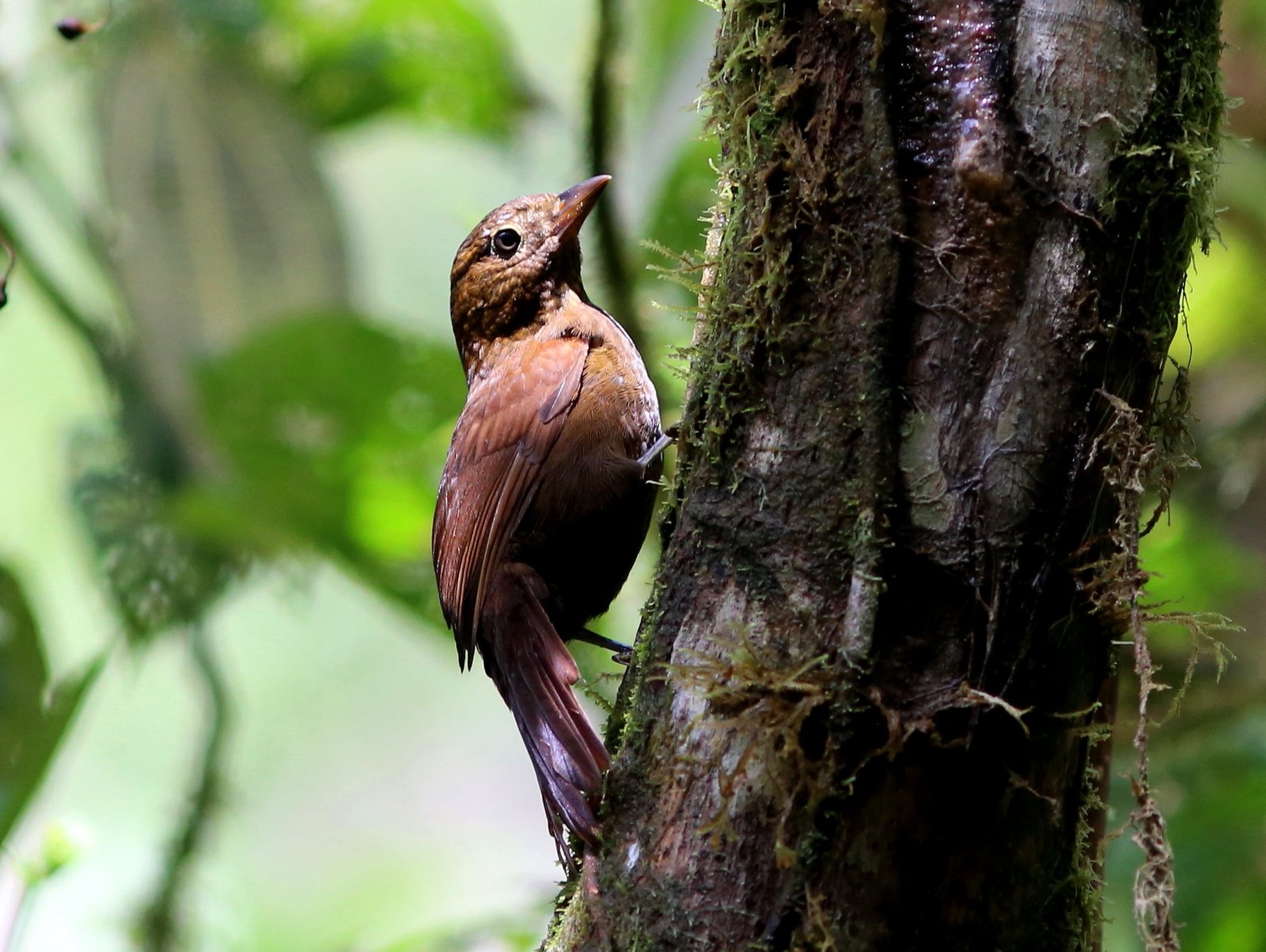
The Uniform Treehunter is the smallest, darkest and shortest-billed treehunter, restricted to the Pacific slope of the Andes in Colombia and Ecuador. Its plumage is almost uniformly dark brown, with only fine pale streaks on the throat and breast. It keeps to dense undergrowth and mainly gives itself away by its sharp calls.
Voice
The song is a high series of six to eight sharp notes, kik or kyip.
Recording: Jerome Fischer — CC BY-NC-SA 4.0 · xeno-canto
Identification
19–20 cm, with a heavy, straight, dark bill. The crown and breast are dark brown, the wings, tail and flanks dark rufous-brown. The throat is dull dark buff with darker streaks, and the breast and belly have narrow buff streaks. A faint tawny eye-ring and supercilium are sometimes visible. The sexes are alike.
Confusion species
Striped Treehunter Thripadectes holostictus is more obviously streaked on the head, back and breast. Streak-capped Treehunter Thripadectes virgaticeps is larger, with a streaked crown, a rufous throat and a plain brown back. Ruddy Foliage-Gleaner Clibanornis rubiginosus lacks streaks and has a slimmer bill, and in this area has a blackish tail. Scaly-throated Foliage-Gleaner Anabacerthia variegaticeps has a pale eye-ring and a pale, scaled throat.
Habitat
Evergreen montane forest and secondary forest in the subtropical zone and the foothills, in Colombia mostly from 500 to 2500 m, in Ecuador mainly from 1000 to 1700 m and locally lower or higher. It forages mainly in dense undergrowth, but also up into the mid-storey and higher, searching dead leaves, moss and epiphytes for insects and other arthropods. Like other treehunters it probably nests in a tunnel in an earthen bank.
Where the bird is most at home, classified by the vegetation units of the Andes and the west coast.


Range and movements
Colombia: the Pacific slope of the Western Andes, from Chocó southwards. Ecuador: the western Andean slope south to El Oro. Absent from Peru, Bolivia and the Galápagos. Does not occur outside the guide area.
- Resident
- dark = core range, pale = thinly spread
How and when to look
Search humid montane forest on the western slope, for example along trails and roads with dense forest edges in north-western Ecuador. Listen for the series of sharp kik notes from the undergrowth and wait for the bird to show itself.
Conservation status
Least Concern. The range is limited to the Pacific slope, where forest is being cleared, but the species also tolerates secondary forest.
Scientific name
Thripadectes ignobilis | (Sclater & Salvin, 1879)
Sclater & Salvin described the species in 1879 as Automolus ignobilis; because it was later moved to another genus, the author and year stand in brackets. The genus Thripadectes was introduced in 1862 by Sclater. The genus name comes from Greek thrips 'woodworm' and dēktēs 'biter' (from daknō 'to bite'). The species name is Latin ignobilis, 'obscure' or 'undistinguished', after the plain plumage. The specimen the first description was based on came from Frontino, Antioquia, Colombia.