All species › Passerines › Ovenbirds and woodcreepers › Rufous-tailed Foliage-Gleaner
Rufous-tailed Foliage-Gleaner | Anabacerthia ruficaudata
Roodstaartbladspeurder | Limpiafronda colirrufa | Limpa-folha-de-cauda-ruiva
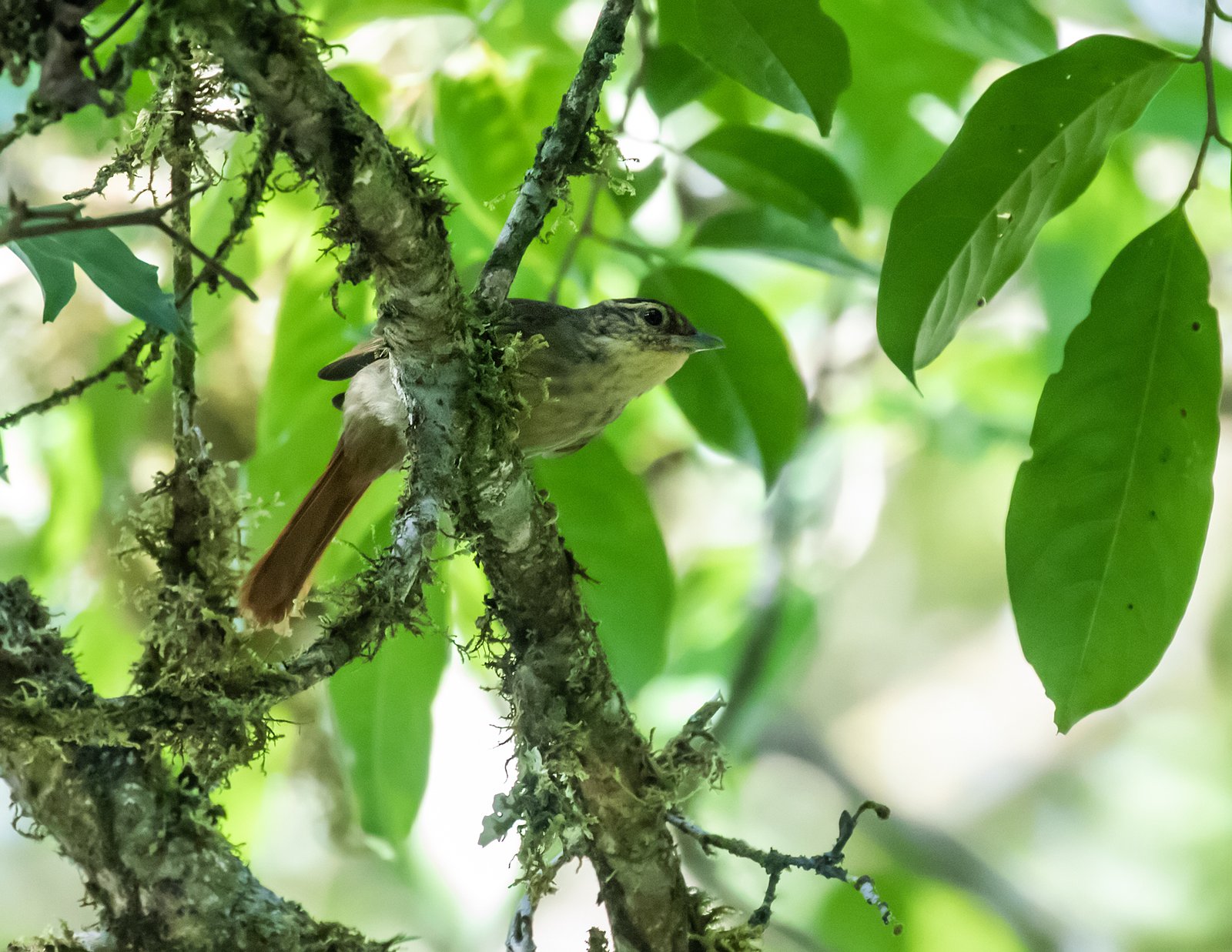
The Rufous-tailed Foliage-Gleaner is the lowland representative of the genus Anabacerthia and lives in the rainforest of Amazonia and the Guianas. It forages high in the canopy and subcanopy, often in mixed flocks with tanagers and other ovenbirds. Its yellowish throat and rufous tail set it apart from most other canopy foliage-gleaners.
Voice
The song is a loud, staccato series of up to 25 short notes, te-te-te-te; there is also a more variable series of wt-pt-pt and d-d-d notes. The call is a dry, very short rattle.
Recording: Paul Coopmans — CC BY-NC-SA 4.0 · xeno-canto
Identification
16–17 cm, with a fairly short, straight bill. The crown and back are olive-brown, the tail is bright rufous and the rump is not. An ochre-buff eyering and a narrow yellowish supercilium mark the head; the throat and malar area are yellowish. The breast and belly are dull yellowish buff with faint olive streaks. The sexes are alike. Juveniles have a more ochraceous supercilium, browner upperparts and darker underparts.
Confusion species
Rufous-rumped Foliage-Gleaner Neophilydor erythrocercum has a rufous rump as well as a rufous tail and more ochraceous underparts. Cinnamon-rumped Foliage-Gleaner Philydor pyrrhodes has cinnamon underparts, rump and tail and dark wings, and lives low in palms and undergrowth. Chestnut-winged Foliage-Gleaner Dendroma erythroptera has rufous wings and an ochre face. Montane Foliage-Gleaner Anabacerthia striaticollis has a whitish throat and lives higher in the Andes.
Habitat
Evergreen terra firme rainforest, locally also tall várzea forest, mostly below 850 m and slightly higher in the foothills. It searches dead leaves, epiphytes and branches in the canopy and subcanopy for insects and other arthropods. Almost nothing is known of its nest and breeding biology.
Where the bird is most at home, classified by the vegetation units of the Andes and the west coast.


Range and movements
Colombia: in the south-east. Ecuador: in the north-eastern lowlands. Peru: in the Amazonian lowlands of the east and south-east. Bolivia: in the north. Absent from the Galápagos. Outside the guide area in southern Venezuela, Guyana and Suriname and in Amazonian and north-eastern Brazil.
- Resident
- dark = core range, pale = thinly spread
How and when to look
Follow mixed canopy flocks in terra firme forest, preferably from a canopy tower or walkway. Look for an olive-brown foliage-gleaner with a yellowish throat and a rufous tail searching dead leaves on the branches.
Conservation status
Least Concern. The species has a large range, but depends on undisturbed tall forest and disappears with deforestation.
Scientific name
Anabacerthia ruficaudata | (d'Orbigny, ACVMD & de Lafresnaye, 1838) (GBIF: Philydor ruficaudatum)
D'Orbigny, ACVMD & de Lafresnaye described the species in 1838 as Anabates ruficaudatus; because it was later moved to another genus, the author and year stand in brackets. The genus Anabacerthia was introduced in 1841 by De Lafresnaye. The genus name is a blend of the genus names Anabates (foliage-gleaners) and Certhia (treecreepers). The species name comes from Latin rufus, 'rufous', and cauda, 'tail', for the rufous tail. The specimen the first description was based on came from Yuracarés region, Bolivia.