All species › Passerines › Ovenbirds and woodcreepers › Montane Foliage-Gleaner
Montane Foliage-Gleaner | Anabacerthia striaticollis
Bergbladspeurder | Limpiafronda montana | Limpa-folha-montano
The Montane Foliage-Gleaner is one of the most numerous foliage-gleaners of the Andean slopes, from Venezuela to Bolivia. With its whitish spectacles and throat and rufous tail it is a regular member of mixed flocks in montane forest. It works acrobatically through dead leaves, moss and epiphytes in the middle and upper strata.
Voice
A dry, fast rattling series, chi-chi-chrrrr, and sharp, dry calls, chek, often repeated as the bird moves with a flock.
Recording: Jerome Fischer — CC BY-NC-SA 4.0 · xeno-canto
Identification
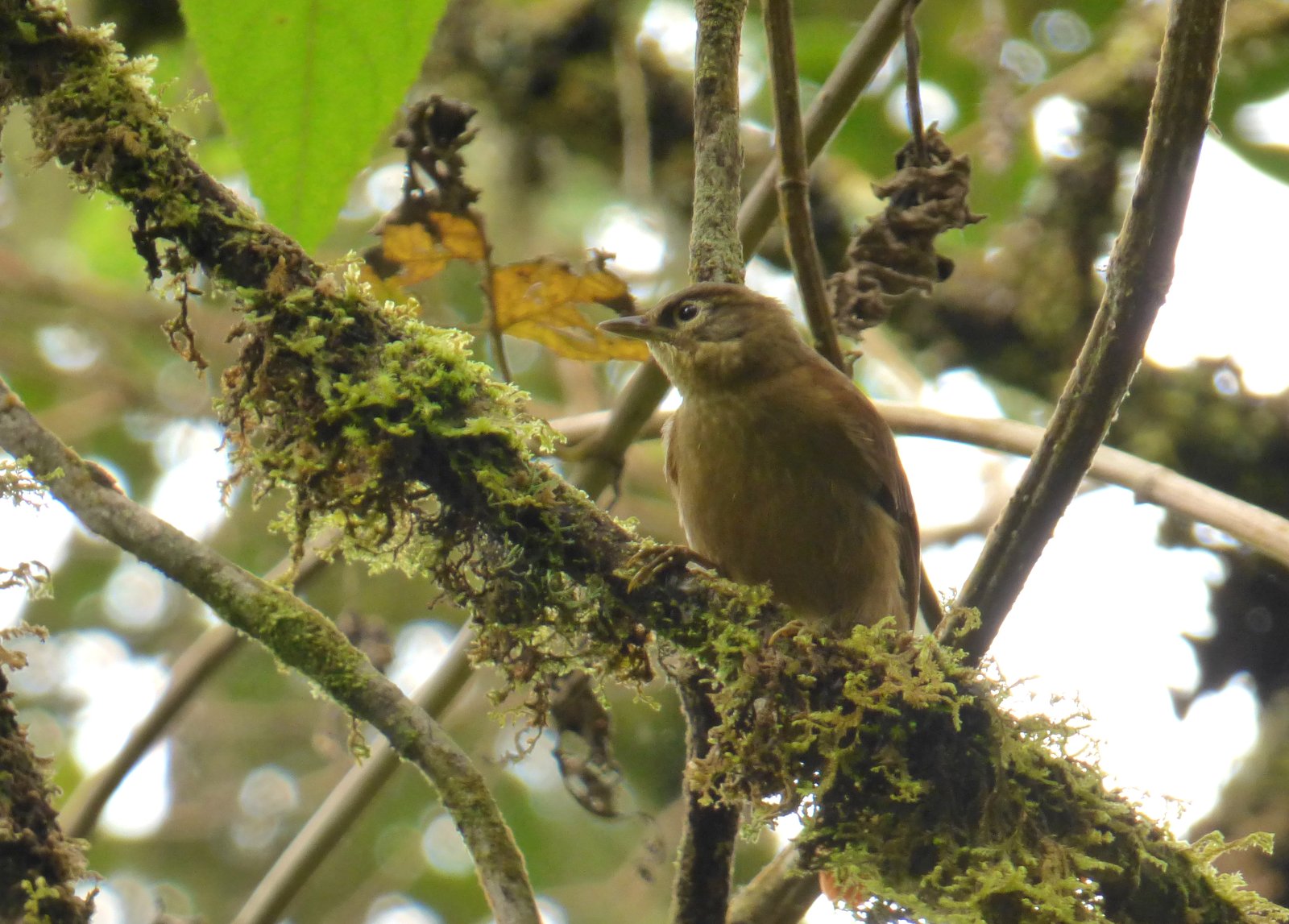
16–17 cm, with a fairly short, straight bill whose lower mandible is pale. The crown is greyish brown with faint streaks; a whitish to pale yellowish eyering and a supercilium behind the eye stand out against a dark eyestripe, and the cheeks are finely streaked. The upperparts are olive-brown and the tail is rufous. The throat is whitish; the breast is olive-brown with faint pale streaks and the belly is paler. The sexes are alike.
Confusion species
Scaly-throated Foliage-Gleaner Anabacerthia variegaticeps has an ochre-buff, finely scaled throat and ochre-buff spectacles, and lives on the Pacific side. Rufous-tailed Foliage-Gleaner Anabacerthia ruficaudata has a yellower throat and underparts and lives in the lowlands. Lineated Foliage-Gleaner Syndactyla subalaris is larger and darker, with pale streaks on the back. Buff-browed Foliage-Gleaner Syndactyla rufosuperciliata is larger, with a longer bill, a scaled breast and an ochre-buff supercilium, and forages lower in the undergrowth.
Habitat
Humid montane forest, cloud forest and forest edge, mostly between 900 and 2500 m. It forages in the middle stratum and the canopy, searching moss, bromeliads, dead leaves and branches for insects and spiders. The nest is in a hole in a tree or in an earth bank.
Where the bird is most at home, classified by the vegetation units of the Andes and the west coast.


Range and movements
Colombia: in all three Andean ranges, the Serranía de Perijá and the Sierra Nevada de Santa Marta. Ecuador: on the eastern slope of the Andes. Peru: along the eastern slope over almost the whole length of the country. Bolivia: in the Yungas of La Paz and Cochabamba to western Santa Cruz. Absent from the Galápagos. Outside the guide area in the Andes and coastal mountains of Venezuela.
- Resident
- dark = core range, pale = thinly spread
How and when to look
Follow mixed flocks along roads and trails through cloud forest on the eastern slope; the species is often one of the first foliage-gleaners in such a flock. Look for the whitish spectacles and throat and the rufous tail.
Conservation status
Least Concern. The species is widespread and common, and also persists at forest edges and in secondary forest.
Scientific name
Anabacerthia striaticollis | de Lafresnaye, 1840
De Lafresnaye described the species in 1840 and placed it straight away in the genus where it still stands. The genus Anabacerthia was introduced in 1841 by De Lafresnaye. The genus name is a blend of the genus names Anabates (foliage-gleaners) and Certhia (treecreepers). The species name comes from Latin striatus, 'striated', and collum, 'neck', for the streaked throat and neck. The specimen the first description was based on came from Bogotá, Colombia.