All species › Passerines › Ovenbirds and woodcreepers › Scaly-throated Foliage-Gleaner
Scaly-throated Foliage-Gleaner | Anabacerthia variegaticeps
Schubkeelbladspeurder | Breñero cejudo | Limpa-folha-de-garganta-escamada
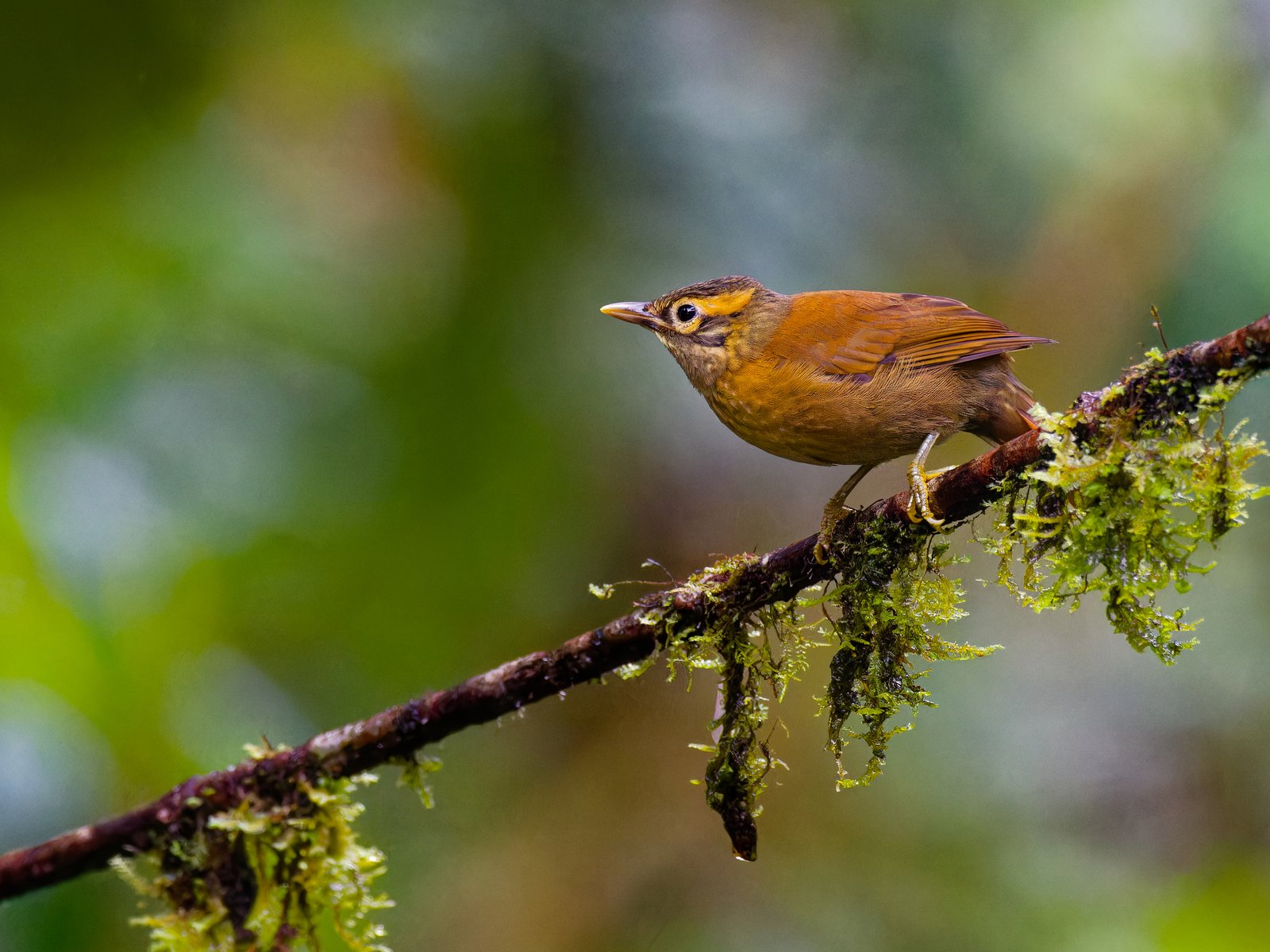
The Scaly-throated Foliage-Gleaner is a small, olive-brown foliage-gleaner with ochre-buff spectacles formed by an eyering and a supercilium. In the guide area it lives only on the Pacific side of the Andes in Colombia and Ecuador, usually lower than the closely related Montane Foliage-Gleaner. It is a regular member of mixed foraging flocks in humid montane forest.
Voice
Sharp, dry single calls, chek, and a fast, dry rattle or series of harsh notes, mainly heard in mixed flocks.
Recording: José María Loaiza B. — CC BY-NC-SA 4.0 · xeno-canto
Identification
15–16 cm, with a fairly short, straight bill whose lower mandible is paler. The crown is greyish to dark olive-brown and contrasts with a broad ochre-buff eyering and a supercilium behind the eye. The upperparts are olive-brown and the tail is rufous. The throat is ochre-buff with fine dusky scaling; the breast and belly are olive-brown, with faint pale streaks on the breast. The sexes are alike.
Confusion species
Montane Foliage-Gleaner Anabacerthia striaticollis has a whitish throat without scaling and whiter spectacles, and in the guide area lives mainly on the eastern slope. Lineated Foliage-Gleaner Syndactyla subalaris is larger and darker, with pale streaks on the back and breast, and forages lower in the vegetation. Buff-fronted Foliage-Gleaner Dendroma rufa is larger, with an ochre forehead and face and rufous wings.
Habitat
Humid montane forest, cloud forest and forest edge, mainly between 600 and 2000 m. It forages in the middle and upper strata, working through moss, epiphytes and hanging dead leaves for insects and spiders. The nest is in a hole in a tree or in an earth bank.
Where the bird is most at home, classified by the vegetation units of the Andes and the west coast.


Range and movements
Colombia: in the Western Andes and on the Pacific slope. Ecuador: on the western slope of the Andes and in the coastal hills, south to El Oro and Loja. Absent from Peru, Bolivia and the Galápagos. Outside the guide area in southern Mexico and in Central America to Panama.
- Resident
- dark = core range, pale = thinly spread
How and when to look
Follow mixed flocks in cloud forest on the Pacific slope of Colombia and Ecuador. Watch for an olive-brown bird working half upside down through moss clumps and epiphytes, and for the ochre-buff spectacles.
Conservation status
Least Concern. The species depends on humid forest and disappears with deforestation, but also occurs in older secondary forest and at forest edges.
Scientific name
Anabacerthia variegaticeps | (Sclater, 1857)
Sclater described the species in 1857 as Anabazenops variegaticeps; because it was later moved to another genus, the author and year stand in brackets. The genus Anabacerthia was introduced in 1841 by De Lafresnaye. The genus name is a blend of the genus names Anabates (foliage-gleaners) and Certhia (treecreepers). The species name comes from Latin variegatus, 'variegated', and -ceps, '-headed', for the variegated head. The specimen the first description was based on came from Córdoba, Veracruz, Mexico.